
Introduction
The cryptocurrency market is notorious for its relentless and rapid volatility. While sudden price swings can be intimidating for traditional investors, they represent a goldmine of opportunities for proactive crypto traders. Instead of relying on the stressful pursuit of timing the market—trying to buy at the absolute bottom and sell at the exact top—savvy traders are increasingly turning to automated strategies to generate consistent returns. Chief among these automated solutions is cryptocurrency grid trading.
Whether the market is moving sideways in a tight consolidation phase or experiencing aggressive price chops, a grid trading strategy is designed to continuously capture small, incremental profits. By automating your entries and exits within a predetermined price range, you can essentially force market fluctuations to work in your favor 24 hours a day, 7 days a week. This comprehensive guide will walk you through the mechanics of cryptocurrency grid trading, how to deploy automated bots effectively, the technical analysis required to optimize your grids, and crucial risk management protocols.
What is Cryptocurrency Grid Trading?
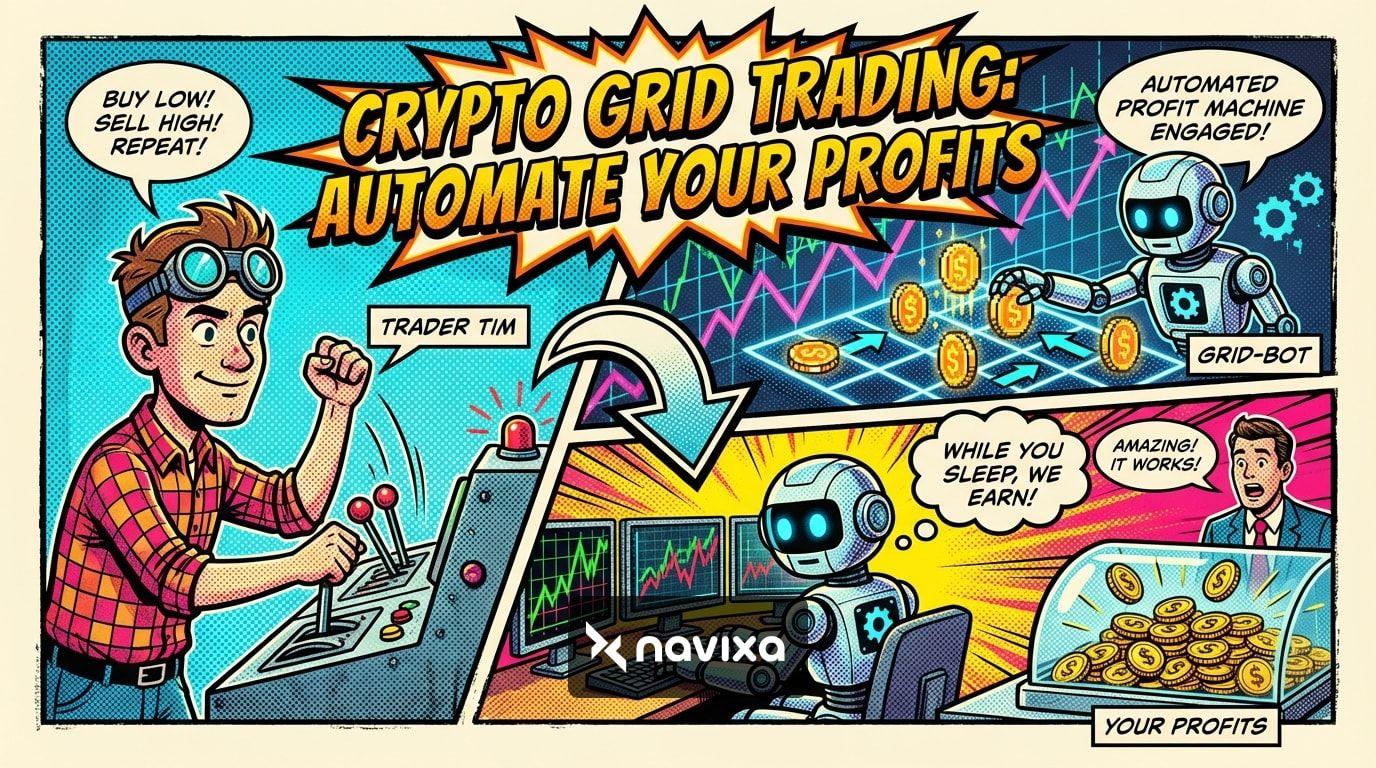
At its core, cryptocurrency grid trading is a quantitative trading strategy that involves placing a series of predefined buy and sell orders at specific price intervals. These intervals form a mathematical "grid" on the trading chart. The fundamental goal is to capitalize on normal price volatility by buying low and selling high within an established range, entirely independent of the asset's long-term macro trend.
"Grid trading thrives in the noise of the market. It does not demand a massive bull run to be profitable; it merely requires the asset to move and breathe."
Imagine Bitcoin is trading between $60,000 and $65,000. A grid trader will set up a grid bot to place buy orders incrementally below the current market price (e.g., at $62,000, $61,000, and $60,000) and sell orders incrementally above the current market price (e.g., at $63,000, $64,000, and $65,000). As the price dips, the bot executes buy orders. When the price subsequently rises, the bot executes the corresponding sell orders. The mathematical difference between the buy and sell price at each interval is the trader's realized profit.
The Rise of Grid Trading Bots
Executing a grid strategy manually is mathematically possible but practically exhausting. Cryptocurrency markets operate globally and never close, and human traders simply cannot monitor charts endlessly. This is where grid trading bots come into play. Top-tier cryptocurrency platforms and specialized bot providers have integrated these algorithms natively into their user interfaces. By using a bot, traders completely remove emotional bias from their execution, ensuring that orders are instantly placed and executed the very millisecond a targeted price threshold is crossed.
Types of Grid Trading Strategies
Not all grids are built the same. Depending on your macroeconomic outlook, technical analysis, and personal risk appetite, you can choose from several distinct variations of grid bots to maximize your edge.
Spot Grid Trading
This is the most traditional, widely used, and secure form of grid trading. A spot grid bot uses your actual capital to buy the underlying cryptocurrency and holds it until the programmed sell target is reached. It operates purely in the spot market, meaning there is no borrowed money (leverage) and therefore absolutely no risk of an exchange liquidation. It is mathematically ideal for sideways or moderately bullish markets where the asset spends time bouncing between well-defined support and resistance levels.
Futures Grid Trading
For advanced traders with a higher risk tolerance, a futures grid bot allows the use of leverage. By trading derivatives rather than the underlying asset, traders can multiply their potential profits—though it is critical to note that this also exponentially increases potential losses. Futures grids can be configured to be "Long" (profiting from upward volatility), "Short" (profiting from downward volatility), or "Neutral" (profiting from sideways chop without a directional bias).
Infinity Grid Bots
A standard grid has a fixed upper and lower limit. If the price violently breaks above your highest sell order, your bot stops working, and you miss out on further upside gains. To counter this, algorithmic developers introduced the Infinity Grid. This bot dynamically adjusts its range upward as the price of the cryptocurrency appreciates, mathematically ensuring you always keep a small portion of the asset to capitalize on infinite upward trends.
Grid Trading Bot Comparison
Understanding the specific nuances between different bot types will help you seamlessly align your automated trading strategy with your overall financial goals. Below is a breakdown of how the primary grid bots compare against each other.
| Feature | Spot Grid Bot | Futures Grid Bot | Infinity Grid Bot |
|---|---|---|---|
| Ideal Market Condition | Sideways, slightly bullish | Highly volatile, trending | Strong bullish trend |
| Overall Risk Level | Low to Medium | High (Due to leverage) | Medium |
| Leverage Available | None (1x) | High (Up to 100x+) | None (1x) |
| Liquidation Risk | None | High | None |
| Capital Efficiency | Lower | Higher | Moderate |
Actionable Steps to Set Up Your Grid
To successfully launch a cryptocurrency grid trading strategy, you must systematically plan your operational parameters. A poorly configured bot can tie up your capital for months or result in frustrating and entirely preventable losses.
Step 1: Choose the Right Trading Pair
Not every cryptocurrency is suitable for grid trading. You should explicitly look for asset pairs that exhibit high liquidity and strong sideways volatility. Avoid illiquid, low-cap altcoins, as a lack of trading volume can lead to heavy slippage or leave your grid orders unfilled. Major pairs like BTC/USDT, ETH/USDT, or SOL/USDT are highly recommended for beginners. You can verify current liquidity, trading volumes, and market depth using reliable aggregators like CoinMarketCap.
Step 2: Define Your Price Range
You must set a Lower Limit and an Upper Limit to box in the bot's operating area. * Lower Limit: The price at which the bot stops buying. If the asset falls below this price, you will be left holding the cryptocurrency bought on the way down. * Upper Limit: The price at which the bot stops selling. If the asset breaks above this limit, you will have sold all your holdings and captured the cash profit, but you will miss further upside action.
Step 3: Determine Grid Density (Number of Grids)
The number of grids strictly determines the mathematical distance between each buy and sell order. * More grids: Closer price intervals, resulting in a higher frequency of trades but much smaller profits per individual trade. You will also pay substantially more in exchange fees due to the sheer volume of transactions. * Fewer grids: Wider price intervals, resulting in fewer trades overall but significantly larger profit margins per successfully executed trade.
Step 4: Configure Stop-Loss and Take-Profit Limits
Professional traders never run an automated bot without structural safety nets. A Stop-Loss ensures that if the market suddenly crashes significantly below your established lower limit, the bot will immediately sell all holdings at market price to prevent a catastrophic portfolio loss. Conversely, a Take-Profit parameter will automatically close the entire grid and secure your profits if the asset hits a specific, highly optimistic upside target.
Technical Analysis for Optimizing Grid Trades
Blindly setting a grid range based on instinct or guesses is a recipe for severe underperformance. The most profitable cryptocurrency grid trading bots are actively guided by robust technical analysis (TA).
Identifying Support and Resistance
The single most effective way to set your upper and lower limits is by identifying historical support and resistance levels on the daily or weekly charts. Support is the price floor where buyers historically step in with volume, while resistance is the price ceiling where sellers typically take aggressive control. Setting your grid's lower limit slightly below a major support line and the upper limit slightly above a major resistance line ensures the bot has plenty of room to operate without constantly shutting down.
Utilizing the Average True Range (ATR)
The Average True Range (ATR) is an excellent technical indicator for determining market volatility. By checking the ATR, you can mathematically estimate exactly how much an asset's price is likely to move on a given day. This granular data is invaluable when deciding the spacing (density) of your grid intervals.
Using the Relative Strength Index (RSI)
Before officially launching a grid, always check the RSI to gauge whether the asset is broadly overbought or oversold. If the RSI is reading above 70 (overbought), it might be a remarkably poor time to start a long-biased spot grid, as an impending market correction could quickly push the price heavily below your lower limit. For more in-depth knowledge on advanced charting tools and indicators, you can explore professional resources like TradingView.
Risk Management: Protecting Your Capital
While cryptocurrency grid trading highly mitigates the daily stress of manual trading, it is absolutely not without risk. Automation does not natively equal guaranteed, perpetual profits.
The Threat of Impermanent Loss and Drawdowns
In a standard spot grid, as the price of an asset drops, your algorithmic bot is programmed to continually buy the asset. If the coin experiences a massive, sustained crash, your bot will completely exhaust its fiat reserves buying the dip, and you will be left holding a heavily depreciating asset. Always ensure you are only grid trading a fundamentally strong project that you genuinely wouldn't mind holding long-term if the macroeconomic environment turns aggressively against you.
Fee Accumulation (Death by a Thousand Cuts)
Grid bots enthusiastically place hundreds, sometimes thousands, of trades per week. Every single transaction you execute incurs a trading fee from the exchange. If your grid intervals are set too tight, the fractional profit made on a tiny price swing might be completely wiped out by the exchange's maker/taker fees. Always rigorously calculate your exact profit per grid *after* all fees are explicitly deducted. Seek out exchanges that offer low-fee environments, zero-fee trading pairs, or lucrative tiered VIP fee discounts.
System and Exchange Risks
When you run a bot, your funds are usually held directly on a centralized exchange or connected to a decentralized platform via API keys. If the exchange inexplicably goes offline during moments of extreme volatility, or if the API connection tragically fails, your bot will be completely unable to execute crucial orders, potentially leaving your portfolio entirely exposed to severe market drops with no active stop-loss protection.
Practical Takeaways
* Start with Spot Grids: If you are an absolute beginner to automation, ignore futures grids entirely. Start building your foundation with a spot grid bot on a major, highly liquid pair like BTC/USDT. * Analyze the Fees: Always ensure that your calculated minimum profit per individual grid interval is at least double the standard exchange trading fee. * Embrace Sideways Markets: Understand that grid trading is your best friend during dull, boring, consolidating market phases where standard trend-following strategies actively bleed capital. * Monitor, Don't Meddle: Let the bot do its mathematical job. Constantly manually stopping and restarting your bot instantly resets your average entry price and completely disrupts the mathematical edge of the strategy. * Use Paper Trading First: Most reputable bot providers offer zero-risk demo accounts. Test your grid parameters with fake money for at least a full week before carelessly committing real capital.
Conclusion
Cryptocurrency grid trading provides a highly systematic, strictly emotionless approach to navigating the incredibly chaotic digital asset markets. By establishing a rigid, mathematically sound framework of buy and sell orders, traders can consistently extract measurable value from day-to-day market noise. While it is certainly not a "get-rich-quick" scheme, a masterfully optimized grid bot serves as an incredibly powerful tool in any diversified cryptocurrency trading portfolio.
Before eagerly diving into live markets, take the necessary time to rigorously study technical support levels, painstakingly configure your risk management settings, and aggressively backtest your parameters. Stop letting unpredictable market volatility keep you continuously awake at night—take control, automate your strategy, protect your downside, and let the grid tirelessly capture your profits.
---
Frequently Asked Questions
What happens if the price leaves my grid range?
If the price dramatically falls below your configured lower limit, the bot will have fully executed all of its buy orders and will simply hold the cryptocurrency until the price rises back into the active range. If the price spikes above your upper limit, the bot will have sold all the cryptocurrency and will hold cash (stablecoins). In either scenario, all automated trading ceases until the price re-enters the active grid or you manually close and strategically reconfigure the bot.
Is cryptocurrency grid trading profitable in a bear market?
Standard spot grid bots heavily struggle in a sustained bear market because they systematically accumulate the asset as the price falls, leading to inevitable portfolio devaluation. However, advanced traders can deploy Futures Grid Bots strictly set to a "Short" bias, which places automated sell orders as the price rises slightly and profitably buys back as the price continues its broader downward trajectory.
How much capital do I realistically need to start grid trading?
The absolute minimum capital required depends entirely on the specific exchange you are using and the exact number of grids you wish to deploy. Because most cryptocurrency exchanges enforce a minimum order size (e.g., $5 to $10 per trade), a bot running 50 separate grids would mathematically require at least $250 to $500 to function properly. Always investigate the specific minimum capital requirements of your chosen platform before designing your bot.
Can grid trading bots guarantee profits in crypto?
Absolutely no trading strategy, human or automated, can definitively guarantee profits in financial markets. While grid bots excel dramatically in sideways markets and flawlessly automate the tedious buy-low/sell-high process, they remain highly vulnerable to strong, unidirectional market trends (especially unforeseen market crashes). Strict risk management, capital preservation techniques, and precise parameter configuration remain completely mandatory for long-term automated success.