
Introduction
Welcome to the definitive guide on CRWD stock technical analysis. Whether you are an active day trader looking to capitalize on intraday volatility or a swing trader eyeing multi-week trends, understanding the price action of CrowdStrike Holdings Inc. (NASDAQ: CRWD) is an absolute necessity.
In the modern trading landscape, high-growth technology and cybersecurity stocks often exhibit massive price swings. These explosive moves are highly comparable to the momentum-driven environments found in cryptocurrency markets. By utilizing a strict framework of technical analysis, traders can identify high-probability entry and exit points, effectively managing their downside risk while maximizing potential upside.
This comprehensive guide will walk you through the precise indicators, chart patterns, and trading methodologies required to master CrowdStrike's market movements. We will look beyond the noise of daily news headlines and focus strictly on what the charts are telling us.
The Fundamentals Intersecting the Chart
Before diving deep into the technicals, it is critical to understand the market context surrounding CrowdStrike. While pure chartists rely solely on price data, knowing the fundamental catalysts helps explain sudden spikes in volume and volatility.
CrowdStrike has established itself as a premier cloud-native cybersecurity company. Recently, the company reached a massive fundamental milestone by crossing $5.25 billion in Annual Recurring Revenue (ARR). Despite these impressive growth metrics, the stock price has experienced significant volatility, heavily influenced by broader macroeconomic trends, shifting interest rates, and institutional repositioning.
When fundamental data hits the market—such as quarterly earnings reports or macro IT spending shifts—technical analysis provides the roadmap for how to trade the reaction. Price action immediately following these events will often dictate the trend for the subsequent weeks or months. Let's transition into the charts and build our analytical framework.
CRWD Stock Technical Analysis: Core Indicators
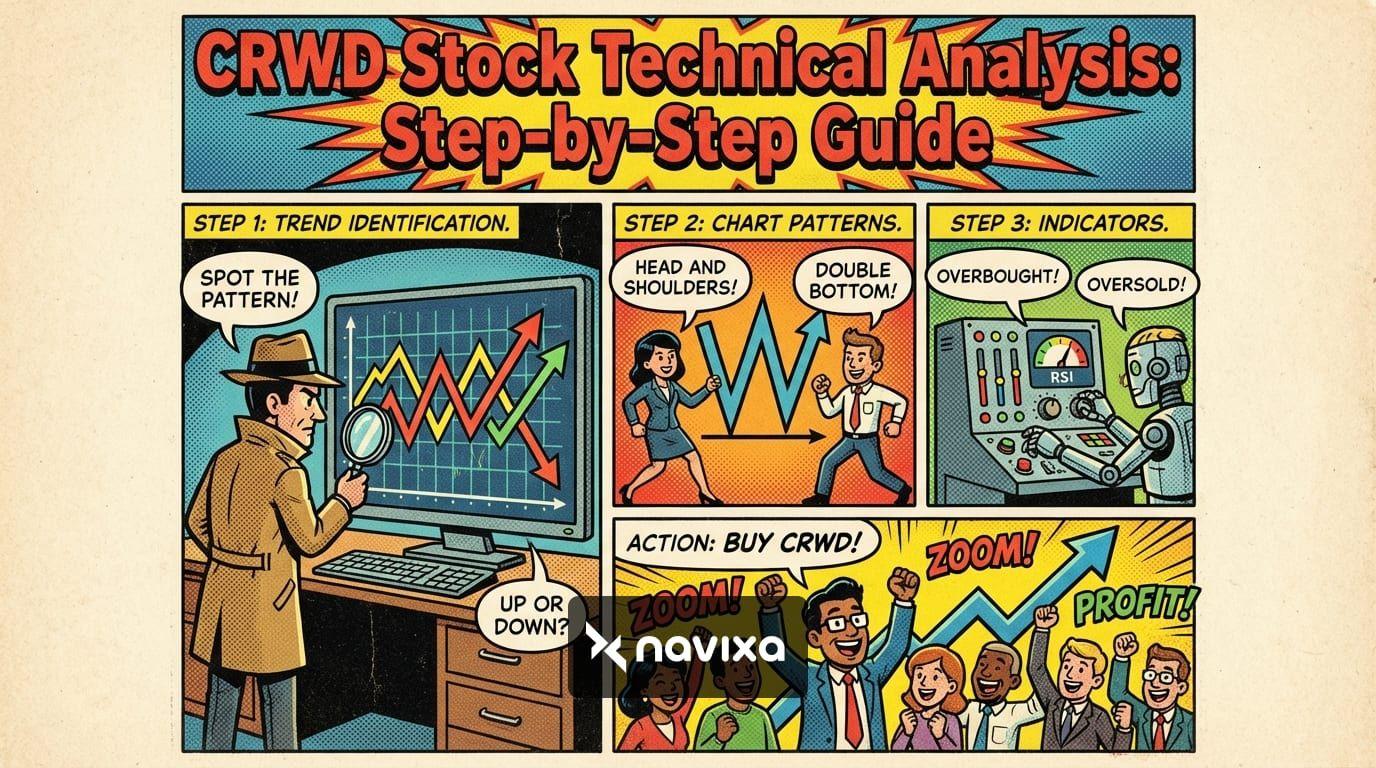
To effectively evaluate CRWD, traders must utilize a confluence of technical indicators. Relying on a single metric is a surefire way to encounter false signals. Here are the most vital indicators for conducting a thorough CRWD stock technical analysis.
1. Moving Averages (SMA and EMA)
Moving averages smooth out price data to create a single flowing line, making it easier to identify the direction of the trend. For CrowdStrike, the 50-day and 200-day Simple Moving Averages (SMA) are the most widely watched institutional levels.
- The 50-Day SMA: This acts as the short-to-medium-term trend indicator. When CRWD trades below its 50-day SMA, the immediate sentiment is considered bearish, and rallies to this line are often treated as resistance by short sellers. - The 200-Day SMA: This is the macroeconomic trendline for the stock. If CRWD is trading beneath the 200-day SMA, the broader institutional bias is negative. Conversely, breaking back above this level often signals a renewed bull market phase. Traders frequently look for "Golden Crosses" (50-day crossing above the 200-day) or "Death Crosses" (50-day crossing below the 200-day) to confirm massive structural shifts in momentum.
2. The Relative Strength Index (RSI)
The RSI is a momentum oscillator that measures the speed and change of price movements, fluctuating between 0 and 100. For an in-depth understanding, you can review Investopedia's guide to the Relative Strength Index (RSI).
- Oversold Territory: An RSI reading below 30 typically suggests that the stock has been aggressively sold off and may be due for a mean-reversion bounce. - Overbought Territory: An RSI above 70 indicates that the stock has rallied too far, too fast, and is susceptible to a pullback. - In recent market conditions, CRWD has frequently seen its RSI hover around the 40 level during consolidations. This is considered a "neutral-to-bearish" zone, meaning the stock is experiencing distribution but has not yet reached a state of extreme panic selling that would trigger an automatic buy signal for contrarians.
3. Moving Average Convergence Divergence (MACD)
The MACD is a trend-following momentum indicator that shows the relationship between two moving averages of a security's price. When conducting a CRWD stock technical analysis, the MACD histogram is incredibly useful for spotting fading momentum.
If the MACD line crosses below the signal line, it is a bearish indicator, suggesting that downward momentum is accelerating. Conversely, a bullish crossover suggests the worst of a selloff may be over. Many swing traders wait for the MACD histogram to flip from red to green on the daily chart before initiating a long position in CRWD.
4. Volume Analysis
Price action without volume is like a car without fuel—it simply will not go far. Volume is the ultimate validator of any technical breakout or breakdown. When CrowdStrike experiences a 5% drop on average volume, it may just be algorithmic noise. However, if the stock drops 5% on volume that is double its 30-day average, it indicates heavy institutional distribution. Always check the daily volume on the NASDAQ's official CRWD quote page to confirm your technical thesis.
Chart Patterns and Critical Price Levels
Beyond mathematical indicators, visual chart patterns play a massive role in CRWD stock technical analysis. Human psychology heavily influences market behavior, creating repeating patterns on the charts.
Support and Resistance Zones
Support and resistance are the foundational building blocks of technical trading. - Support: A price level where a downtrend tends to pause due to a concentration of demand. For CRWD, historic consolidation zones—often found near the $340 to $360 range during market corrections—serve as critical psychological and structural support. - Resistance: A price level where an uptrend pauses due to overwhelming selling pressure. If CRWD attempts to rally, previous breakdown levels (such as the $410 to $425 zone) will act as heavy resistance.
The Head and Shoulders Pattern
One of the most reliable reversal patterns in technical analysis is the Head and Shoulders top. This pattern features a peak (shoulder), followed by a higher peak (head), and then a lower peak (right shoulder).
When conducting a CRWD stock technical analysis during a broad market pullback, traders often look for this pattern to gauge whether institutional distribution is occurring. The key to this pattern is the "neckline," which connects the lows of the two troughs. A decisive break below the neckline—especially on high volume—often triggers algorithmic sell orders, leading to swift downside price action.
Fibonacci Retracements
Fibonacci retracement levels are horizontal lines that indicate where support and resistance are likely to occur, based on the mathematical sequence discovered by Leonardo Fibonacci. By drawing a Fibonacci grid from the stock's all-time highs down to its most recent significant lows, traders can find hidden resistance levels. The 0.382 and 0.618 levels are particularly highly respected by trading algorithms in high-beta tech stocks like CrowdStrike.
Indicator Summary Matrix
To synthesize the data, traders should always compile an indicator matrix before executing a trade. Below is a framework for how you might analyze CRWD's technical posture in real-time.
| Technical Indicator | Observation Example | Market Implication |
|---|---|---|
| 50-Day SMA | Price trading below the line | Bearish short-term momentum |
| 200-Day SMA | Price trading below the line | Bearish structural trend |
| RSI (14-Day) | Reading at 40.5 | Neutral, leaning slightly oversold |
| MACD | Negative crossover | Sustained downward momentum |
| Volume | Spiking on red days | Institutional distribution phase |
Pro Tip: Never trade based on a single indicator. Wait for a "confluence of evidence" where at least three separate indicators align (e.g., price hits major support, RSI drops below 30, and MACD prints a bullish crossover) before risking your capital.
Actionable Trading Strategies for CRWD
Once you have completed your CRWD stock technical analysis, the next step is applying a profitable strategy. Here are three distinct methodologies tailored for CrowdStrike's volatility.
Strategy 1: The Mean Reversion Bounce
This strategy is ideal for active swing traders. When CRWD experiences an aggressive selloff and the daily RSI plunges below 30, the stock is historically prone to a violent short-covering rally. How to execute: Wait for a "capitulation candle" (a day with massive volume and a long lower wick). Enter the trade near the close of the day, placing a tight stop loss just below the wick's low. Your target should be the declining 20-day EMA.
Strategy 2: The Breakout / Breakdown Trade
Tech stocks are famous for massive continuation moves once key horizontal levels break. How to execute: If CRWD is consolidating in a tight range, set conditional alerts at the upper resistance and lower support boundaries. If the stock breaks resistance on volume that is at least 150% of the normal average, buy the breakout. Conversely, if it breaks support, aggressive traders can short the stock or purchase put options.
Strategy 3: Selling Options for Premium
If your CRWD stock technical analysis indicates that the stock is trapped in a sideways consolidation channel, pure directional trading can be frustrating. Instead, traders can utilize options strategies like the "Iron Condor." By selling out-of-the-money call and put spreads simultaneously, you can generate income as long as CRWD remains trading within your specified technical boundaries.
Risk Management: Protecting Your Capital
The most critical component of any CRWD stock technical analysis guide is risk management. High-beta cybersecurity stocks can move 5% to 10% in a single trading session. If you do not respect risk, the market will quickly drain your trading account.
Strict Stop Loss Placement
Never enter a trade without knowing exactly where you will exit if you are wrong. A common technical approach is to place your stop loss immediately below the nearest moving average or horizontal support zone. If that support breaks, your fundamental thesis for the trade is invalidated, and you must exit immediately. Hope is not a valid trading strategy.
Position Sizing and Risk-to-Reward Ratio
Professional traders typically risk no more than 1% to 2% of their total account equity on a single trade. Furthermore, you should always target a minimum Risk-to-Reward ratio of 1:2. This means if you are risking $500 on a CRWD setup, your technical profit target must offer at least $1,000 in upside. By maintaining a strict 1:2 ratio, you can be wrong on half of your trades and still remain mathematically profitable over the long run.
Practical Takeaways
- Trend is Your Friend: Always check the relationship between the 50-day and 200-day SMAs before establishing a directional bias. - Volume Validates Moves: A breakout or breakdown without volume is highly likely to be a trap. - Patience Pays: Do not chase the stock when the RSI is overbought. Wait for natural pullbacks to support zones. - Use Confluence: Combine moving averages, RSI, and MACD to build a strong, high-probability case for every trade.
Conclusion
Conducting a thorough CRWD stock technical analysis is the key to successfully navigating the extreme volatility inherent in the cybersecurity sector. By understanding institutional moving averages, momentum oscillators like the RSI and MACD, and critical chart patterns, you can eliminate emotion from your trading and make objective, data-driven decisions.
Remember, technical analysis is not a crystal ball; it is a framework for probability and risk management. Stay disciplined, always utilize strict stop losses, and continuously adapt your strategies as market conditions evolve. If you found this step-by-step guide valuable, be sure to bookmark this page and reference it before your next trading session!
Frequently Asked Questions
What is the most reliable indicator for CRWD stock technical analysis?
There is no single "holy grail" indicator. However, because CrowdStrike is heavily traded by institutional algorithms, the 50-day and 200-day Simple Moving Averages (SMAs) act as the most reliable gauges of long-term structural trends. Combining these moving averages with volume analysis provides a highly reliable framework.
How does fundamental news impact technical setups for CrowdStrike?
Fundamental news—such as quarterly earnings reports or macroeconomic data—acts as the catalyst that drives technical price action. While the charts show you where the support and resistance levels are, the fundamental news dictates whether the stock will break through those levels or violently reject them.
Is CRWD currently in a bull or bear trend?
Trend determination strictly depends on your time horizon. Day traders might see an intraday bull trend if the stock is bouncing off local support, while long-term investors might view the stock in a bear trend if it is trading decisively below its 200-day moving average. Always align your trend analysis with your specific trading timeframe.
Can I use cryptocurrency trading strategies on tech stocks like CRWD?
Absolutely. High-growth, high-beta tech equities like CrowdStrike behave very similarly to major cryptocurrencies. Both asset classes are heavily driven by momentum, retail sentiment, and algorithmic trading. Strategies involving breakout trading, RSI mean reversion, and Fibonacci retracements apply flawlessly to both markets.