

Introduction to Energy Market Volatility
Energy markets are arguably the most dynamic and fiercely contested financial arenas on the planet. Recently, the trading landscape has been marked by staggering volatility. Driven by severe geopolitical tensions, unexpected supply chain disruptions in the Middle East, and shifting macroeconomic policies, benchmark crude prices have swung violently. With West Texas Intermediate (WTI) and Brent crude oscillating rapidly between the $95 and $115 marks, traders have been forced to navigate a minefield of unpredictable price action.
In such an erratic environment, relying solely on fundamental analysis or breaking news headlines is a recipe for disaster. By the time a headline hits the mainstream media, the market has often already priced in the event. This is exactly where crude oil technical analysis becomes an indispensable tool. By studying historical price movements, volume profiles, and specific geometric formations on the charts, traders can strip away the emotional noise and identify high-probability entry and exit points.
This comprehensive guide will walk you through the essential chart patterns, key technical indicators, and robust risk management strategies required to master crude oil technical analysis and consistently extract value from the energy markets.
Why Crude Oil Technical Analysis Matters Today
The fundamental drivers of crude oil—supply quotas, inventory reports, and global demand forecasts—are undeniably important. However, the exact timing of a trade relies heavily on technicals. Technical analysis provides the framework to understand market psychology. When millions of market participants react to fear, greed, and uncertainty, their collective actions leave a tangible footprint on the charts.
"Price action discounts everything, including the latest breaking geopolitical headline."
Whether you are a day trader looking to capitalize on intraday volatility or a swing trader aiming to ride a multi-week trend, understanding these footprints is critical. Crude oil technical analysis allows you to pinpoint where buyers are stepping in (support), where sellers are taking control (resistance), and when a major trend reversal is imminent.
Understanding the Energy Benchmarks
Before diving into complex chart patterns, it is crucial to understand the two primary benchmarks in the crude oil market:
1. West Texas Intermediate (WTI): The benchmark for North American crude oil. It is lighter and sweeter, making it ideal for gasoline refining. WTI is heavily influenced by U.S. production levels and inventory data. 2. Brent Crude: The international benchmark, sourced from the North Sea. It prices roughly two-thirds of the world's internationally traded crude supplies. Brent is highly sensitive to global shipping disruptions and international geopolitical conflicts.
While WTI and Brent generally follow the same macroeconomic trends, their price spread can widen dramatically during localized supply shocks or shipping constraints. Technical analysts must account for these nuances when charting either asset.
Essential Chart Patterns for Crude Oil Trading
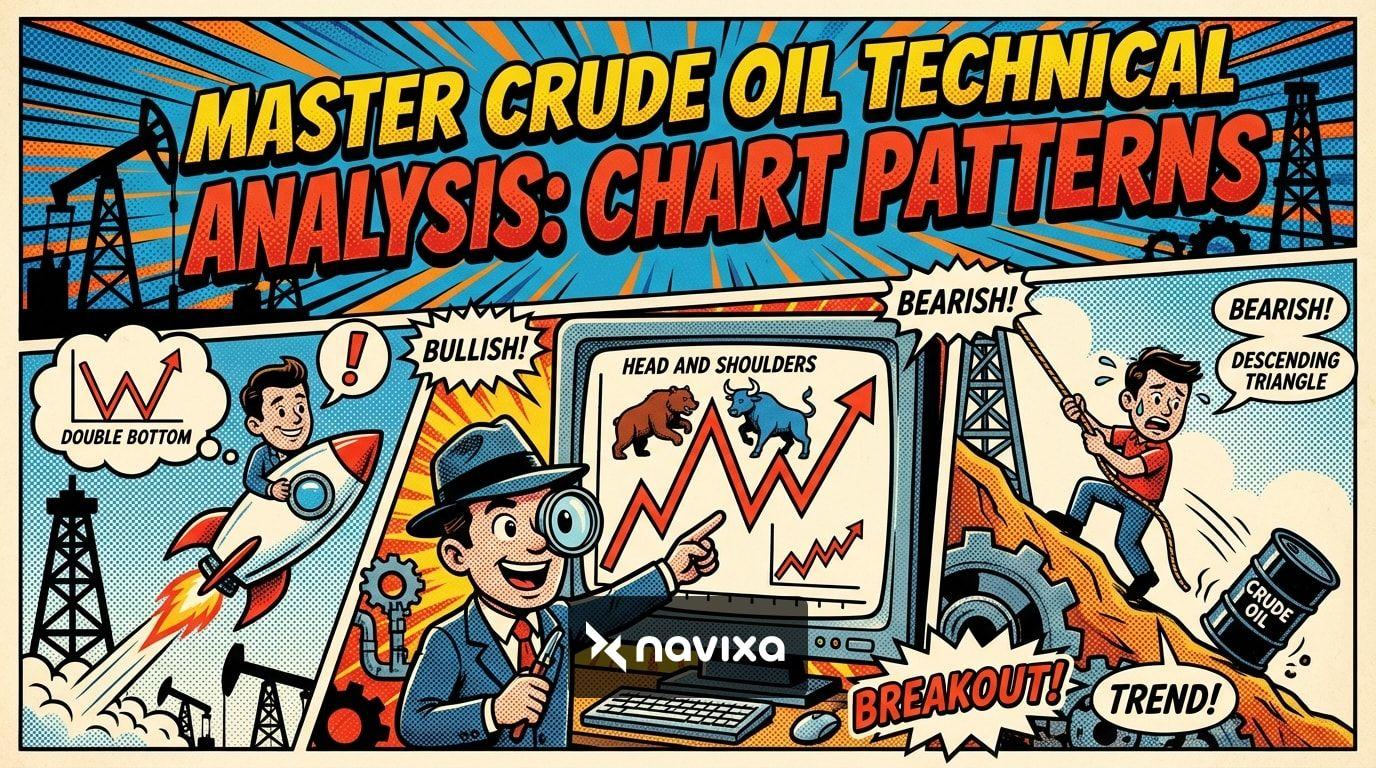
Chart patterns are visual representations of the ongoing battle between buyers (bulls) and sellers (bears). In crude oil technical analysis, recognizing these patterns early can provide a massive edge.
Bullish Reversal Patterns
These patterns typically form at the end of a prolonged downtrend, signaling that sellers are exhausted and buyers are preparing to take control.
The Double Bottom Resembling the letter "W," a double bottom occurs when the price drops to a specific support level, rebounds, drops back to the same level, and rebounds again. This indicates massive buying interest at that specific price point. For instance, when Brent crude previously formed a massive double bottom around the mid-$50s, it laid the technical groundwork for a spectacular multi-month rally. Traders typically buy the breakout above the pattern's middle peak (the neckline).
The Falling Wedge Characterized by two downward-sloping, converging trendlines, the falling wedge shows that while the price is making lower lows, the downward momentum is decelerating. A breakout above the upper trendline is a potent bullish signal, often resulting in a swift upward price expansion as short-sellers are forced to cover their positions.
Inverse Head and Shoulders This pattern features three distinct troughs: a lower middle trough (the head) sandwiched between two higher troughs (the shoulders). It represents a gradual shift in market structure from bearish to bullish. A decisive close above the neckline confirms the reversal.
Bearish Reversal Patterns
Bearish patterns warn traders that an uptrend is losing steam and a correction is likely imminent.
The Head and Shoulders The inverse of the bullish variant, this formation looks like three peaks, with the middle peak being the highest. It frequently appears when oil prices become overextended following a massive rally. Once the price breaks below the neckline support, it triggers cascading sell orders.
The Double Top Shaped like the letter "M," a double top forms when oil fails to break through a resistance level twice. It is a clear sign of buyer exhaustion. The pattern is validated when the price falls below the intermediary swing low, signaling a shift in trend.
Continuation Patterns
Sometimes, the market just needs to catch its breath before resuming its primary trend.
Bull and Bear Flags Flags are short-term consolidation patterns that look like a small rectangular channel sloping against the prevailing trend. In a bull flag, oil prices consolidate downward slightly before erupting higher. In a bear flag, a brief upward consolidation precedes another massive leg down. These are highly favored by day traders for their clear risk-to-reward ratios.
Symmetrical Triangles Formed by converging support and resistance trendlines, a symmetrical triangle indicates a period of equilibrium and compressing volatility. In the explosive crude oil market, this compression almost always leads to a violent breakout. While they can break in either direction, they usually resolve in the direction of the macro trend.
Key Indicators to Complement Chart Patterns
To avoid false breakouts (bull traps or bear traps), expert traders use technical indicators to confirm what the chart patterns are suggesting.
* Moving Averages: The 50-day and 100-day Exponential Moving Averages (EMAs) are staples in crude oil technical analysis. During strong trends, these averages act as dynamic support or resistance. A crossover of short-term and long-term averages can also signal major trend shifts. * Relative Strength Index (RSI): A momentum oscillator that measures the speed and change of price movements. An RSI above 70 suggests oil is overbought and ripe for a pullback, while an RSI below 30 indicates it is oversold. * MACD (Moving Average Convergence Divergence): This tool helps traders spot changes in momentum. A bullish MACD crossover (when the MACD line crosses above the signal line) can provide excellent confirmation for a breakout from a bullish chart pattern.
Comparison Table: WTI vs. Brent Crude Trading
| Feature | WTI Crude Oil | Brent Crude Oil |
|---|---|---|
| Primary Geography | North America (U.S.) | Global (North Sea) |
| Key Pricing Influence | U.S. inventories, Cushing storage | Global geopolitics, shipping routes |
| Volatility Drivers | Domestic production, EIA reports | International conflicts, OPEC+ policies |
| Trading Volume | Exceptionally high in U.S. hours | High across European and Asian sessions |
| Typical Technical Behavior | Responds sharply to immediate data releases | Trends heavily on macro supply chain shifts |
Actionable Trading Strategies for Crude Oil
Armed with an understanding of patterns and indicators, you need structured strategies to execute your trades effectively.
The Breakout Strategy
The crude oil market is famous for its powerful breakouts. When a chart pattern (like a symmetrical triangle or a flag) is completed, traders place a buy-stop or sell-stop order just outside the pattern's boundary. To filter out fakeouts, wait for a high-volume candlestick to close decisively beyond the trendline. Your initial price target can often be calculated by measuring the height of the pattern and projecting it outward from the breakout point.
The Pullback (Retest) Strategy
Breakouts can be aggressive and hard to catch. A safer alternative is the pullback strategy. After oil breaks a major support or resistance level (such as the neckline of a Head and Shoulders pattern), it frequently returns to "retest" that broken level. A former resistance level turning into new support provides a low-risk entry point with an incredibly tight stop-loss.
Navigating Risk Management in Volatile Markets
No discussion of crude oil technical analysis is complete without addressing risk management. The energy sector is highly susceptible to sudden news shocks, unexpected inventory data from the U.S. Energy Information Administration (EIA), or sudden geopolitical statements that can gap the market by several dollars in seconds.
1. Position Sizing: Never risk more than 1% to 2% of your total account capital on a single crude oil trade. 2. Use the Average True Range (ATR): Because oil volatility fluctuates wildly, a static stop-loss of $0.50 might be too tight one week and too loose the next. The ATR indicator measures average volatility, allowing you to set dynamic, mathematically sound stop-losses. 3. Monitor the Calendar: Even pure technical analysts must know when high-impact news is scheduled. It is often wise to tighten stops or reduce position sizes ahead of major central bank decisions or global energy summits.
For advanced charting features and real-time data analysis, utilizing robust platforms like TradingView is highly recommended to keep your technical edge sharp.
Practical Takeaways
* Always align your chart pattern analysis with the prevailing macroeconomic trend for higher probability setups. * Never trade a chart pattern in isolation; seek confirmation from volume, RSI, or Moving Averages. * Understand the difference between WTI and Brent, ensuring you are charting the correct asset for your specific strategy. * Embrace strict risk management using ATR to survive the oil market's notorious volatility spikes.
Conclusion
Mastering crude oil technical analysis is a continuous journey of adapting to shifting market structures. While fundamental catalysts like geopolitical conflicts or supply chain disruptions provide the fuel for market movements, chart patterns serve as the map that guides your trading decisions. By combining classic pattern recognition with momentum indicators and disciplined risk management, you can transform market chaos into calculated trading opportunities.
Start reviewing historical oil charts today, backtest these patterns, and build a trading plan that respects both the technicals and the inherent volatility of the energy sector.
Frequently Asked Questions
What is the best timeframe for crude oil technical analysis?
The ideal timeframe depends entirely on your trading style. Day traders rely heavily on the 5-minute and 15-minute charts to catch intraday volatility. Swing traders prefer the 4-hour and daily charts, as these timeframes filter out intraday noise and provide much more reliable chart patterns.
Do chart patterns work during major geopolitical news events?
Chart patterns generally reflect the aggregate psychology of the market, but unexpected, high-impact news can immediately invalidate a technical setup. During times of extreme geopolitical stress, it is crucial to use wider stops, reduce your position size, or step aside entirely until the market absorbs the new information and forms a new technical structure.
How does inventory data affect technical analysis in crude oil?
Weekly inventory reports, such as those from the EIA or API, often act as catalysts that trigger breakouts from existing chart patterns. For example, if WTI is consolidating in a symmetrical triangle, an unexpectedly massive drawdown in inventories might provide the exact volume spark needed to confirm a bullish breakout.
Can I use cryptocurrency technical analysis strategies on crude oil?
Yes, the core principles of technical analysis—such as support/resistance, trendlines, and chart patterns—are universal across all liquid asset classes. However, traders must account for crude oil's unique fundamentals, specific trading hours, and the fact that commodities often exhibit sharper mean-reverting tendencies compared to the exponential growth cycles seen in crypto.