
The intersection of traditional macroeconomics and digital assets has never been more volatile—or more profitable for the prepared trader. The Consumer Price Index (CPI) has evolved from a dry economic metric into one of the most explosive catalysts in the cryptocurrency market. For day traders and swing traders alike, a well-defined CPI crypto trading strategy is no longer optional; it is a mandatory survival tool.
In this comprehensive guide, we will break down exactly how inflation data impacts digital assets, why the market often reacts counterintuitively, and how you can implement a step-by-step CPI crypto trading strategy to capture massive price swings while minimizing your risk.
Understanding the Consumer Price Index (CPI) and Its Crypto Impact
To trade the news effectively, you first need to understand the underlying mechanics of the data. The Consumer Price Index is a measure that examines the weighted average of prices of a basket of consumer goods and services. When the Bureau of Labor Statistics releases this monthly report, it acts as the primary barometer for inflation in the United States. You can read more about the fundamental mechanics of inflation on Investopedia.
For crypto traders, CPI data serves as a critical proxy for future Federal Reserve monetary policy. The general rule of thumb is:
Hot CPI (Higher than expected): Inflation is rising. The Federal Reserve is likely to keep interest rates high or raise them to cool the economy. High interest rates strengthen the US Dollar (DXY) and pull liquidity out of risk-on assets like Bitcoin and altcoins.
Cold CPI (Lower than expected): Inflation is cooling. This opens the door for potential rate cuts, cheaper borrowing, and a flood of capital into speculative markets, typically resulting in a crypto market rally.
However, modern cryptocurrency markets are highly complex, and the correlation isn't always perfectly linear. For example, recent market cycles have shown that Bitcoin can defy traditional expectations. Even when US inflation data spiked to near 2-year highs due to external energy costs, Bitcoin shocked markets by surging past the $72,000 resistance zone. Typically, a hotter-than-expected CPI print strengthens the stagflation narrative and threatens lower support levels. But because the market had already positioned itself cautiously ahead of the release, the data did not trigger fresh selling; once the uncertainty passed, the price action shifted upward in a massive relief rally.
This dynamic proves exactly why you need a refined CPI crypto trading strategy rather than relying on pure fundamental guesswork.
The Anatomy of a CPI Print: Understanding the "Whipsaw Effect"
One of the biggest mistakes novice traders make is trying to front-run the CPI data or entering a position in the exact second the numbers are released. This usually results in falling victim to the "Whipsaw Effect."
When the CPI data drops at 8:30 AM Eastern Time, automated trading algorithms and high-frequency trading (HFT) bots react in milliseconds. This creates massive liquidity vacuums in the order book. You will often see a massive 1-minute candle shoot up by 2%, only to instantly reverse and crash by 4% in the opposite direction.
This initial chaos is designed to liquidate over-leveraged long and short positions. The "Whipsaw" is a liquidity grab. Institutional players use this extreme volatility to fill their large orders at optimal prices. A professional CPI crypto trading strategy involves sitting on your hands during this initial 5 to 15-minute window and waiting for the true macroeconomic trend to establish itself.
The Core CPI Crypto Trading Strategy: A Phased Approach
To consistently profit from inflation data releases, you must break your trading routine into three distinct phases: Preparation, Observation, and Execution.
Phase 1: Pre-Release Preparation
Hours before the CPI drop, you need to establish your baseline. This means knowing exactly what the market is expecting. Check economic calendars to find the "Consensus" estimate for both Headline CPI and Core CPI (which excludes volatile food and energy sectors).
Next, mark your technical charts. Identify major support and resistance zones on the 1-hour and 4-hour timeframes. During the CPI release, price will often gravitate toward these major liquidity pools, treating them as magnets before reversing or breaking out entirely.
Phase 2: Observation (The 15-Minute Rule)
When the clock strikes 8:30 AM ET, do not click buy or sell. Watch how the price reacts to the data. Compare the actual print to the consensus estimate. If the data is incredibly divergent (e.g., expected 3.0% but actual is 3.5%), expect extreme, sustained volatility. If the data matches expectations, the market might whip around briefly before resuming its pre-existing trend. Let the first 15-minute candle close. This candle often leaves a long wick, which will serve as your invalidation point (stop loss level) for your upcoming trade.
Phase 3: Post-Release Execution
Once the initial 15-minute candle has closed, the market usually reveals its true hand. If the price reclaims a key resistance level that was lost during the initial fakeout, it signals strong buying pressure. This is where you enter your trade, aligning technical price action with the macroeconomic reality.
Step-by-Step Guide to Executing Your CPI Crypto Trade
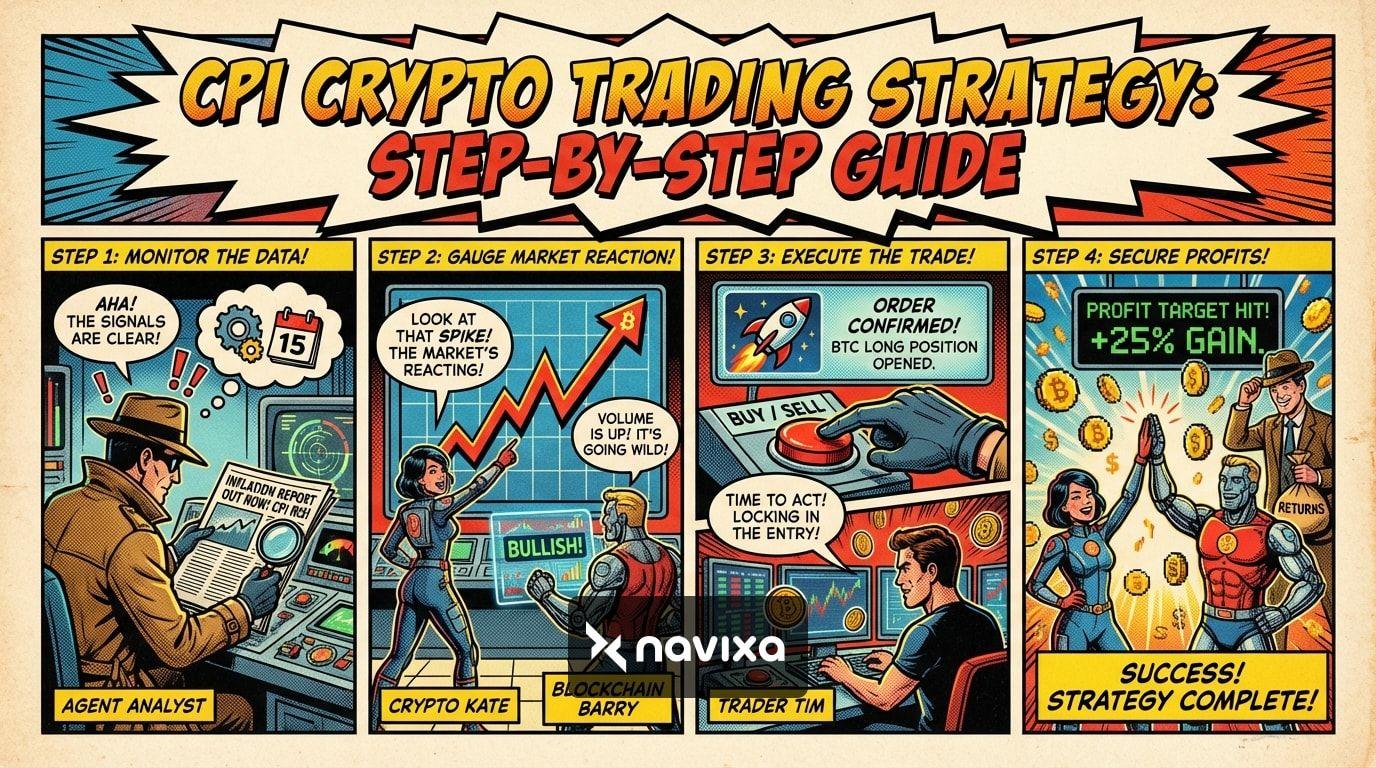
Let's translate the theory into actionable steps that you can apply during the next inflation report to execute a flawless CPI crypto trading strategy.
Step 1: Map Key Liquidity Zones. Open your charting platform and draw horizontal lines at the most obvious swing highs and swing lows from the past 48 hours. These are areas where retail traders have placed their stop losses, making them prime targets for market makers.
Step 2: Determine the Macro Bias. Check the economic calendar exactly at release time. Is the actual CPI number bullish (lower than expected) or bearish (higher than expected)? Remember to account for market sentiment—if the print is bearish but the price refuses to drop, the market is showing underlying fundamental strength.
Step 3: Wait for the 15-Minute Close. Let the algorithm-driven chaos settle. Wait for the first 15-minute candle to close completely before making any assumptions about market direction.
Step 4: Look for the Break and Retest. A high-probability setup involves waiting for the price to break a key 15-minute resistance level, and then buying on the retest of that level. This confirms that the previous ceiling has now become a supportive floor.
Step 5: Set Your Stop Loss. Place your stop loss just behind the wick of the initial CPI fakeout candle. If the price breaches that wick, the trend has reversed, and your trade idea is officially invalidated.
Step 6: Take Profits at Next Liquidity. CPI trends can last for the entire daily session. Take partial profits at the next major 1-hour or 4-hour resistance zone, and trail your stop loss to lock in guaranteed gains.
Integrating Technical Analysis with Macro Data
A successful CPI crypto trading strategy does not rely on news alone; it marries fundamental data with strict technical analysis. During a CPI event, certain technical indicators become highly valuable for filtering out the noise.
Relative Strength Index (RSI): Look for bullish or bearish divergences on the 15-minute chart. If Bitcoin's price makes a lower low during the CPI whipsaw, but the RSI makes a higher low, it indicates that selling momentum is exhausting. This is a prime signal for a reversal trade.
Exponential Moving Averages (EMA): The 50-period and 200-period EMAs on the 15-minute chart act as dynamic support and resistance. Once the CPI volatility settles, the price will often use the 50 EMA as a bouncing point to sustain the new post-CPI trend.
Volume Profile: Volume is the ultimate validator of any move. A breakout caused by CPI data must be accompanied by a massive surge in trading volume. If the price is moving up but volume is declining, it is a low-probability fakeout trap.
Scenario Mapping: The CPI Matrix
To simplify your decision-making process, use the following matrix to anticipate market reactions based on how the actual CPI data compares to consensus estimates.
| Scenario | CPI Print vs. Expectation | Typical Initial Market Reaction | Optimal Trading Action |
|---|---|---|---|
| Hot Inflation | Actual > Consensus | DXY pumps, Crypto dumps | Look for short setups after the 15m pullback, or long if a strong relief rally triggers. |
| Cold Inflation | Actual < Consensus | DXY dumps, Crypto pumps | Wait for a 15m breakout of resistance; enter long on the retest. |
| As Expected | Actual = Consensus | Choppy, mixed volatility | Avoid trading the news; wait for price to resume its standard daily trend. |
| Stagflation Fear | High Headline, Low Core | Extreme Whipsaw | Trade the range; buy support and sell resistance until a clear breakout occurs. |
Strict Risk Management Rules for Trading News
Trading CPI events carries a significant amount of risk due to the sheer speed of price movements. Without strict risk management, a single CPI release can blow up your entire trading account.
Cap Your Leverage: High leverage is an absolute death sentence during CPI volatility. Because of extreme spread widening and order book slippage, an overly leveraged position can be liquidated even if your stop loss is technically triggered. Keep your leverage strictly between 2x and 5x.
Reduce Position Sizing: Because your stop loss will typically be wider during a CPI event (to account for the massive 15-minute wicks), you must reduce your overall position size to ensure you are still only risking 1% to 2% of your total account equity per trade.
Use Mental and Hard Stops: Always have a hard stop loss placed in the exchange order book to protect against catastrophic market dumps. However, be prepared to manually close a trade if the 15-minute candle closes aggressively against your thesis.
Practical Takeaways
* Never Front-Run the Data: Guessing the CPI number is gambling, not trading. Always wait for the data to become public. * Beware the Whipsaw: The first move is almost always a fakeout designed to hunt retail liquidity. Let the market makers finish their business first. * Context is King: A bad CPI print doesn't automatically mean a market crash. If the market is heavily short going into the release, a bad print can still cause a short-squeeze relief rally. * Combine Macro with TA: Let the fundamental data give you the directional bias, but let the technical charts dictate your exact entry and exit triggers.
Conclusion
Mastering a CPI crypto trading strategy takes patience, discipline, and a deep understanding of market psychology. Inflation data is merely the spark; the real fire is how institutional algorithms and retail traders react to that data. By stepping back, waiting for the initial algorithmic whipsaw to clear, and entering trades based on confirmed technical levels, you can transform CPI release days from a source of anxiety into some of the most profitable trading sessions of the month.
Stop gambling on macroeconomic news. Start applying a calculated, step-by-step strategy to outsmart the volatility, protect your capital, and secure consistent long-term gains in the crypto market.
Frequently Asked Questions
What is the difference between Headline CPI and Core CPI?
Headline CPI includes all goods and services in the consumer basket, including highly volatile sectors like food and energy. Core CPI excludes food and energy prices to provide a clearer picture of underlying, long-term inflation trends. Traders often watch Core CPI more closely, as it heavily influences the Federal Reserve's long-term interest rate decisions.
Why does Bitcoin sometimes pump when the CPI is higher than expected?
This counterintuitive reaction usually happens due to market positioning. If traders anticipate a terrible CPI print, they may heavily short Bitcoin in advance. Once the data is released—even if it is bad—the uncertainty is removed. Traders buy back their shorts to take profits, triggering a massive short squeeze and a relief rally, pushing the price higher despite the seemingly bearish macroeconomic news.
How long does the volatility from a CPI release usually last?
The most extreme, unpredictable volatility occurs within the first 15 to 30 minutes following the 8:30 AM ET release. However, the macro trend established by the CPI data can dictate the price action for the rest of the daily trading session, and sometimes set the structural tone for the entire week.
Should I use market orders or limit orders during a CPI drop?
It is highly recommended to avoid market orders during the exact minute of the CPI release. The severe lack of liquidity can cause extreme slippage, meaning your order might get filled at a significantly worse price than you intended. Once the initial volatility settles after 15 minutes, standard limit and market orders can be used safely based on your strategy.