
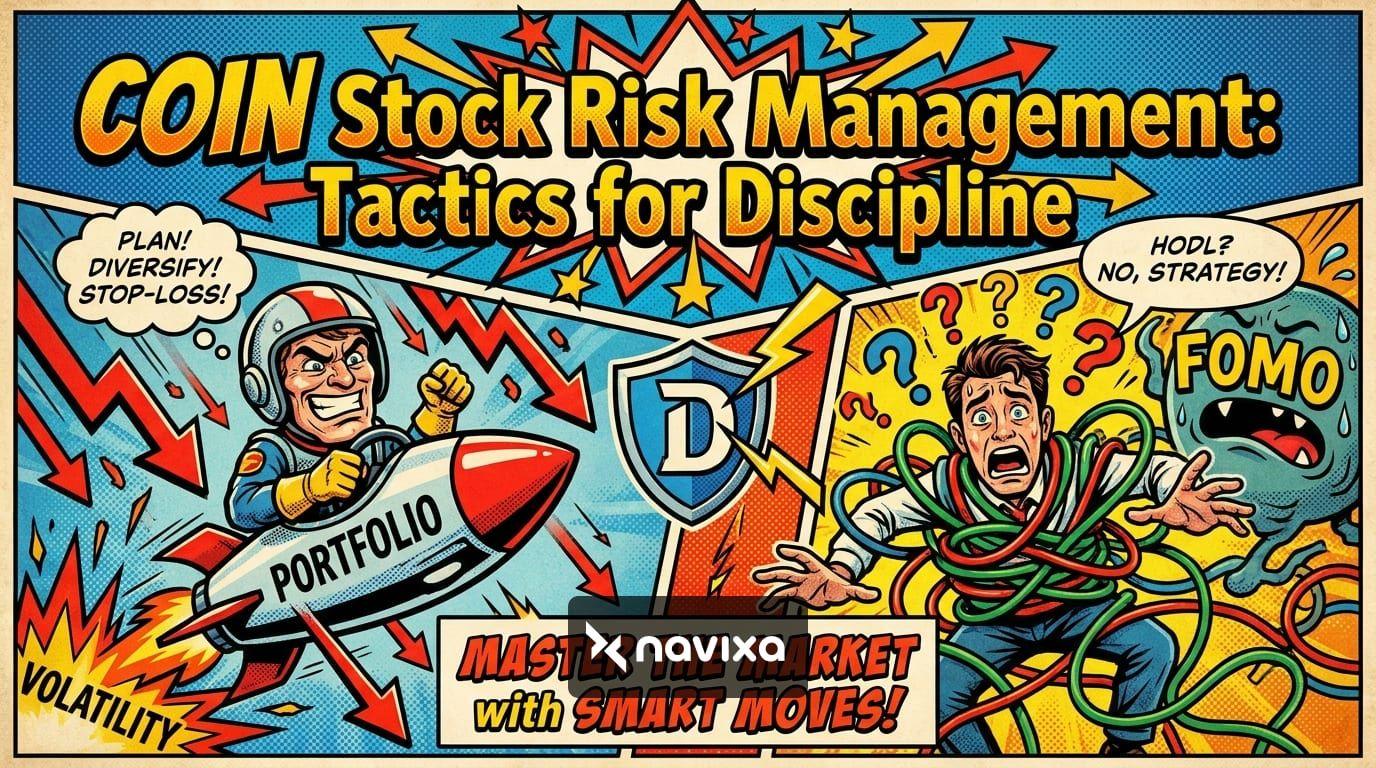
Introduction: The Necessity of COIN Stock Risk Management
Trading in the digital asset sector requires an iron stomach, and few traditional equities embody this wild ride quite like Coinbase Global, Inc. (NASDAQ: COIN). As the primary gateway to the tokenized economy for millions of retail and institutional investors, Coinbase stock is heavily tethered to the broader crypto ecosystem. However, unlike simply buying digital assets, trading COIN stock introduces a unique blend of traditional equity market dynamics, quarterly earnings pressures, and extreme high-beta volatility. Without strict COIN stock risk management, traders expose themselves to devastating portfolio drawdowns.
Following its dizzying valuation peaks of over $400 in previous market cycles, the stock frequently experiences dramatic repricing, navigating tight ranges buffeted by everything from geopolitical conflicts (such as global maritime security risks impacting energy and derivatives markets) to the fluctuating performance of spot Bitcoin ETFs. With its beta historically ranging between 2.85 and 3.70, COIN is significantly more volatile than the S&P 500. This hyper-volatility means that a solid trading framework isn't just a recommendation—it is a survival requirement.
In this comprehensive guide, we will explore advanced tactics for discipline, actionable trading strategies, and how to implement a bulletproof risk architecture when trading Coinbase stock.
Understanding the Beast: High Beta and Event-Driven Volatility
Before deploying capital, it is critical to understand what fundamentally drives COIN's price action. Unlike a legacy utility stock or consumer staple, Coinbase's revenue models are historically sensitive to trading volumes, which in turn are driven by crypto price speculation, derivative market expansion, and macroeconomic conditions.
The Beta Factor
Beta measures a stock's volatility in relation to the overall market. A beta of 1.0 indicates that the stock moves in tandem with the broader market indices. When you see COIN sporting a beta north of 3.0, it means the asset theoretically experiences price swings three times as large as the broader equity index. For more information on how beta impacts overall portfolio volatility, you can review Investopedia's guide on Beta.
Because of this multiplier effect, a minor correction in the Nasdaq or a sudden drop in digital asset prices can trigger massive sell-offs in COIN shares. Conversely, bullish regulatory news—such as anticipations surrounding crypto legislative breakthroughs—can send the stock soaring. Failing to account for this magnified variance is the leading cause of blown-out trading accounts.
Event-Driven Gaps
Earnings reports often act as aggressive, unpredictable catalysts. In the lead-up to Coinbase's quarterly earnings reports, options markets traditionally price in immense implied volatility. A trader holding an unhedged position through an earnings call is essentially flipping a coin. Proper COIN stock risk management dictates that you either reduce your position size ahead of these binary events or utilize complex options strategies to cap your downside. Investors tracking these binary events should regularly consult SEC Edgar for Coinbase Filings to monitor insider trading behaviors and fundamental institutional shifts.
'Risk comes from not knowing what you are doing. In high-beta equities, risk comes from ignoring the mathematical reality of volatility.'
Core Trading Strategy: Sizing, The Kelly Criterion, and Hedging
Discipline begins before the trade is even placed. The mathematical foundation of successful trading relies heavily on position sizing and strategic portfolio hedging.
The 1% to 2% Rule and The Kelly Criterion
The golden rule of risk management across all asset classes is the 1% to 2% rule. This principle states that you should never risk more than 1% to 2% of your total trading capital on a single trade setup. For a stock as volatile as COIN, leaning closer to the 1% mark is highly advisable.
If your total portfolio size is $50,000, risking 1% means you are willing to lose a maximum of $500 if the trade goes against you. If your stop-loss is set 10% below your entry price, you can only allocate $5,000 to the COIN position. This mathematical boundary removes emotion from the equation, ensuring that a sudden 15% gap down does not severely impair your purchasing power.
Advanced traders often refer to the Kelly Criterion, a mathematical formula used to determine the optimal size of a series of bets. While traditional equities might allow for larger fractional Kelly sizes, the underlying unpredictability of crypto-adjacent stocks requires a 'Half-Kelly' or 'Quarter-Kelly' approach to account for black swan events.
Options as a Protective Shield
Another highly effective tactic for COIN stock risk management is utilizing the options market to build a protective moat around your capital.
1. Protective Puts: Buying a put option gives you the right, but not the obligation, to sell your shares at a predetermined strike price. If COIN suffers a sudden flash crash due to regulatory crackdowns or a broader crypto market sell-off, the put option acts as an insurance policy, strictly capping your losses. 2. Covered Calls: For longer-term investors looking to hold COIN through volatile periods, selling out-of-the-money call options against your accumulated shares can generate upfront premium income. This income serves to systematically lower your overall cost basis and provides a small psychological and mathematical buffer against downside moves.
Technical Analysis and Dynamic Stop-Loss Placement
Risk management isn't just about limiting capital allocation; it is about knowing precisely where your initial thesis is proven wrong. Relying on arbitrary percentage stops (e.g., 'I will sell if it drops exactly 5%') is a fundamentally flawed strategy for a high-beta stock. A 5% move in COIN can easily occur within the first thirty minutes of the trading day.
The Average True Range (ATR)
Instead of static percentages, professional technical traders use the Average True Range (ATR) indicator to set dynamic, volatility-adjusted stop-losses. The ATR measures the average volatility of the stock over a given period, most commonly a 14-day lookback window.
If COIN is trading at $180 and its daily ATR is $12, a stop-loss placed just $5 below the current price is highly vulnerable to being triggered by normal intraday market noise. A much safer, mathematically sound approach is to place the stop-loss 1.5 to 2 times the ATR below your entry point. This gives the stock enough breathing room to fluctuate naturally without stopping you out prematurely.
Identifying Key Support Zones
Before entering a trade, plot out major moving averages—such as the 50-day and 200-day Simple Moving Averages (SMAs)—and locate historical supply and demand zones. Entering a position near a strong, heavily defended support level allows you to place a tighter, technically logical stop-loss right beneath that specific level, thereby vastly optimizing your risk-to-reward ratio.
Strategy Comparison: Active Trading vs. Long-Term Holding
Different time horizons require completely different risk management frameworks. An intraday scalper cannot use the same risk metrics as an investor looking to hold shares for five years. Below is a comparison table outlining how risk parameters shift depending on your specific trading style.
| Strategy Component | Active Swing Trading | Long-Term Investing |
|---|---|---|
| Time Horizon | Days to Weeks | Months to Years |
| Risk Per Trade | 1% - 2% of total equity | Portfolio allocation limit (e.g., max 5%) |
| Stop-Loss Type | ATR-based or structural support | Fundamental breakdown or protective puts |
| Reaction to Earnings | Reduce size or close before event | Hold through, hedge with options |
| Key Focus | Price action, momentum, liquidity | Revenue diversification, regulatory clarity |
Actionable Steps for Unwavering Discipline
Knowing the theories behind COIN stock risk management is only half the battle; executing them flawlessly under live market pressure is the true test of a profitable trader.
1. Develop a Strict Pre-Trade Checklist
Never execute a trade on a whim or due to social media hype. Create a mandatory checklist that includes: - Is the overall macroeconomic environment favoring risk-on assets? - Have I calculated my maximum total loss based on the 1% account rule? - Is my stop-loss placed logically based on the ATR or a major moving average? - Are there any macroeconomic catalysts, central bank announcements, or earnings reports expected this week that could disrupt the trade?
2. Embrace the Power of Walking Away
Revenge trading is the ultimate destroyer of retail portfolios. If you take a loss on a COIN setup because of a sudden market whipsaw, step back. High-beta stocks are prone to erratic behavior during periods of low volume. If the market conditions are unfavorable or unclear, holding cash is a valid and highly powerful strategic position.
3. Maintain an Emotional Ledger
Keep a detailed trading journal that tracks not just your numerical entries and exits, but your emotional state during the trade. Note how you felt when COIN experienced a volatile 8% intraday swing. Over time, identifying the emotional triggers that cause you to abandon your pre-established risk management rules will help you build long-lasting mental fortitude.
Practical Takeaways
To summarize the essential components of successfully managing risk when trading Coinbase stock, ensure you keep these core principles top of mind at all times:
- Respect the Beta: Acknowledge that COIN moves aggressively. Adjust your daily expectations and position sizes to accommodate multi-percentage intraday swings. - Formulate the Risk: Always define your maximum monetary loss before ever clicking the buy button. Adhere strictly to the mathematical boundaries of your portfolio. - Avoid Arbitrary Stops: Utilize volatility-adjusted indicators like the ATR to set meaningful stop-loss levels rather than guessing with flat percentages. - Hedge the Unknown: Use advanced options strategies such as protective puts to insulate your broader portfolio from catastrophic geopolitical or regulatory black swan events. - Patience Pays: Do not force trades during periods of extreme regulatory uncertainty. Wait for the chart to present a clear, high-probability setup.
Conclusion
Trading digital asset equities is a high-stakes endeavor that merges the speed of modern tech stocks with the severe regulatory uncertainty of frontier financial markets. Mastering COIN stock risk management is not about avoiding risk altogether—it is about intelligently defining it, systematically capping it, and ensuring you live to trade another day.
By utilizing strict position sizing, technical volatility-adjusted stop-losses, and options market hedging, you can strip the dangerous emotion out of the equation. Approach Coinbase's inevitable volatility with cold, calculated discipline. Equip yourself with these advanced tactics, stick rigorously to your trading plan, and remember that in the chaotic world of high-beta assets, ultimate capital preservation is the true hallmark of a successful trader. Protect your downside, and let the upside take care of itself.
Frequently Asked Questions
Why is COIN stock risk management more complex than traditional stocks?
COIN stock carries a much higher beta than traditional legacy equities, meaning it experiences highly amplified price movements compared to the broader index. Furthermore, its underlying performance is deeply connected to the 24/7 cryptocurrency market. This makes the stock incredibly vulnerable to weekend crypto crashes, which can cause the stock to gap down violently the moment traditional equity markets open on Monday morning.
How does Bitcoin's price affect Coinbase shares?
While Coinbase is actively diversifying its revenue streams through corporate subscriptions, blockchain staking, and institutional custody services, retail trading volume remains a massive core driver of its total profits. Historically, when Bitcoin's price surges to new highs, retail interest and transaction volumes spike, driving Coinbase's revenues higher. Conversely, during a 'crypto winter,' trading volumes compress heavily, which traditionally drags the stock price down.
What is the best stop-loss strategy for high-beta stocks like COIN?
Arbitrary percentage-based stops (like a fixed 3% or 5% rule) often result in premature exits due to the stock's normal intraday noise. The best approach for high-beta assets is utilizing a volatility-adjusted stop-loss using the Average True Range (ATR) indicator, or placing hard stops structurally just below significant, historically defended support levels and moving averages.
Can I use options to hedge my COIN position?
Absolutely. Buying protective puts allows you to establish a hard mathematical floor on potential losses in the event of a severe market crash. Alternatively, selling covered calls against your long position can generate immediate premium income, helping to subtly offset minor downside movements in the stock's overall price and lowering your average cost basis.
Should I hold COIN stock through earnings reports?
Holding a highly volatile stock entirely unhedged through a quarterly earnings report is extremely risky, as it acts as a binary event that can easily cause 10% to 20% gaps in either direction. Risk-conscious active swing traders typically reduce their position size drastically or close out completely before the earnings call, while long-term investors should strongly consider hedging their core positions with options to survive the volatility.