

macroeconomics & crypto
Chris Wright Secretary of Energy: Macro Bitcoin Outlook
- May 11, 2026
- 13 min read
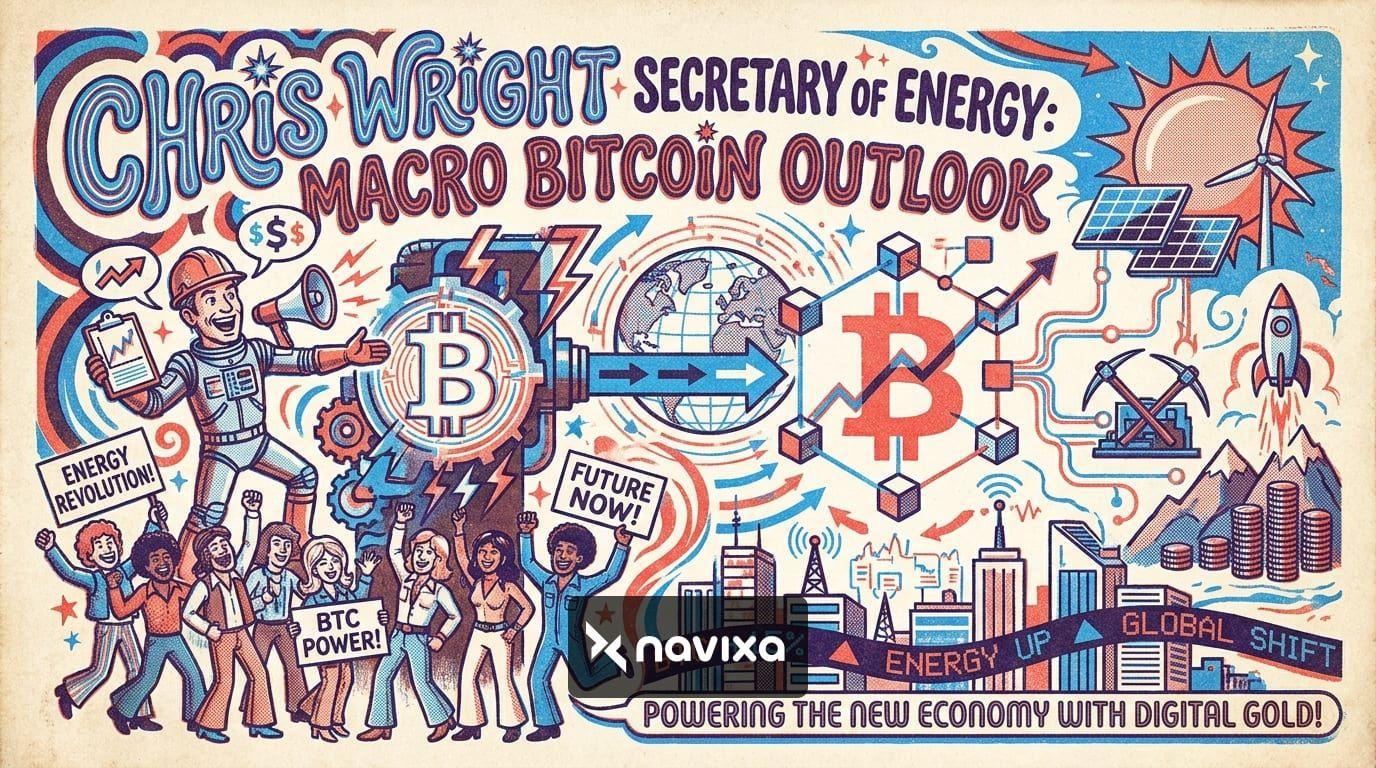
Since his confirmation in February 2025, Chris Wright Secretary of Energy has fundamentally reshaped the United States' approach to power generation. Known as a self-described "tech nerd turned entrepreneur" and the former CEO of Liberty Energy, Wright has championed an unapologetic "all-of-the-above" energy policy. But while mainstream media focuses heavily on his fossil fuel advocacy and the rollback of select green initiatives, cryptocurrency traders and institutional investors are closely watching the profound macroeconomic ripple effects this energy abundance creates for the Bitcoin network.
With Bitcoin holding strong above $80,000 in May 2026 and boasting a market capitalization exceeding $1.61 trillion, the cost and availability of electricity have never been more critical. Mining digital assets is an exceptionally energy-intensive industrial process. Any shift in federal policy that promotes deregulation, boosts grid resilience, or lowers base power costs serves as an immediate catalyst for the U.S.-based mining sector. In this comprehensive guide, we break down the Chris Wright Secretary of Energy era, analyzing how his administration's domestic policy and handling of global energy shocks dictate the macro trading outlook for Bitcoin.
- Deregulation under the current Department of Energy reduces operational overhead for domestic Bitcoin miners.
- An emphasis on baseload reliability via nuclear and natural gas provides miners with consistent 24/7 uptime.
- Recent geopolitical oil shocks have reinforced Bitcoin's narrative as an inflation hedge amidst global energy volatility.
- Competition for grid capacity between AI data centers and crypto mining operations continues to drive infrastructure innovation.

The "Drill, Baby, Drill" Directive and U.S. Mining Economics
Before stepping into his role as a cabinet member, Wright built a highly successful career leading Liberty Energy, a titan in the hydraulic fracturing industry. His philosophy is exceptionally straightforward: maximizing domestic energy production lowers living costs and drives widespread human prosperity. This directive heavily influences the modern U.S. macroeconomic environment, acting as a foundational pillar for industrial expansion.
For Bitcoin miners, electricity constitutes the overwhelming majority of operational expenditure. When domestic energy production scales up—whether through natural gas, oil, or relaxed restrictions on legacy coal plants—wholesale electricity prices tend to stabilize or drop significantly. Lower per-kilowatt-hour (kWh) costs immediately expand mining profit margins. This economic buffer allows domestic operators to run older-generation ASICs profitably and naturally increases the overall network hash rate housed within the United States.
Understanding how lower utility costs flow into the broader financial system is vital for modern investors, as analyzing how macroeconomic growth impacts crypto valuations over time reveals deep correlations between industrial energy policies and digital asset prices. When the cost to produce a Bitcoin drops natively in the U.S., it creates an asymmetrical advantage for publicly traded mining equities.
**Energy Abundance as a Catalyst:** By fostering a deregulated energy market, the administration effectively subsidizes the primary cost center for Bitcoin miners, encouraging further centralization of hash power in North America.
Nuclear Energy and Small Modular Reactors
Perhaps the most fascinating aspect of Wright's background is his prior tenure on the board of Oklo, a nuclear technology company specializing in the development of small modular reactors (SMRs). While his core roots are deeply embedded in oil and gas, Wright has explicitly acknowledged that baseload grid reliability is a non-negotiable requirement for modern infrastructure.
Renewable sources like wind and solar natively suffer from intermittency; the wind does not always blow, and the sun does not always shine. Bitcoin miners, however, demand a 24/7 power supply to remain competitive and maximize their hash output. Nuclear energy provides exactly this type of dense, uninterrupted baseload power. As the Department of Energy streamlines permitting for SMRs, we are seeing the beginnings of a localized power renaissance where major data centers and mining farms can operate seamlessly "behind the meter," completely insulated from broader grid fluctuations.
Market Analysis & Trading Psychology
When evaluating the Chris Wright Secretary of Energy framework, sophisticated traders must contextualize domestic policies against the backdrop of persistent global chaos. The early 2026 conflict involving Iran and the strategic closure of the Strait of Hormuz vividly demonstrated how quickly international energy markets can break down. With crude oil prices surging well past $100 a barrel, global supply chains absorbed massive inflationary shocks.
"The biggest challenge with energy in the world today isn't toxic chemicals in frac fluid... It's the fact that so many people around the world don't have access to energy that makes long, healthy, wonderful lives possible." — Chris Wright
How do professional crypto traders react to these macro shocks? Historically, rapid spikes in global energy costs act as a dual-edged sword for the Bitcoin network. On one side, rising energy prices severely squeeze the margins of global miners located outside the U.S., occasionally leading to miner capitulation events. On the other side, surging oil prices reignite institutional fears regarding inflationary pressures on bitcoin, prompting capital to flee into hard assets like BTC and gold as long-term safe havens.
As an investor, the psychological play is to distinguish between domestic energy insulation and global energy inflation. With the U.S. expanding its own fossil fuel and nuclear output, American miners are partially insulated from Middle Eastern supply disruptions. Traders who understand this fundamental divergence often implement a smart DCA trend strategy to steadily accumulate exposure to Bitcoin and domestic infrastructure during periods of high fear, effectively front-running the inevitable inflation narrative.

Institutional Accumulation vs. Retail Sentiment
The psychology of the modern crypto market currently reflects massive institutional confidence. While central bank interest policies dictate short-term liquidity and high-frequency trading behavior, long-term fundamentals depend heavily on the physical infrastructure backing the digital economy. The realization that the United States is actively prioritizing energy dominance reassures major capital allocators that the Bitcoin network will not face hostile domestic energy bans—a stark contrast to China's 2021 mining crackdown. When older dormant wallets start moving massive sums, legacy holders are explicitly signaling that protocol security is deeply linked to real-world energy generation.
Comparative Economics: U.S. vs. Rest of World
The macroeconomic divergence between the United States and other global regions is becoming significantly more pronounced. The table below outlines the general economic environment for Bitcoin miners operating under current U.S. policy compared to regions strictly adhering to aggressive green transition mandates.
| Economic Factor | U.S. Market (Wright Era) | European/Green Markets |
|---|---|---|
| Primary Power Focus | All-of-the-above, Baseload (Fossil/Nuclear) | Renewables (Wind, Solar), Phase-outs |
| Regulatory Burden | Deregulated, stream-lined permitting | High compliance, strict carbon taxation |
| Grid Reliability | High (focused on maintaining 24/7 capacity) | Variable (highly vulnerable to intermittency) |
| Mining Margins | Expanding due to localized cheap power | Compressing amid soaring industrial rates |

The AI and Crypto Synergy
It is impossible to discuss the modern energy landscape without addressing the elephant in the room: Artificial Intelligence. Both Bitcoin miners and AI data centers require immense, virtually unprecedented amounts of electricity. Rather than viewing these two industries purely as adversaries competing for limited wattage, the current Department of Energy framework treats them as complementary drivers of American technological dominance.
By pushing for the aggressive revitalization of aging power plants and expanding natural gas pipelines, the administration is attempting to build an electrical grid capable of supporting both technological revolutions simultaneously. Understanding these artificial intelligence market trends is absolutely crucial for crypto investors. Some highly adaptive Bitcoin mining facilities are currently retrofitting their warehouses to lease high-performance computing (HPC) power directly to AI developers. This creates a beautifully diversified revenue stream that stabilizes a miner's bottom line regardless of short-term Bitcoin price volatility.
**Diversified Revenue Streams:** Bitcoin mining companies that actively adapt their infrastructure to host AI computing tasks are experiencing massive valuation premiums, successfully blending the crypto macro narrative with the AI tech boom.
Navigating Geopolitical Energy Shocks
With the global cryptocurrency market cap standing strong at over $2.78 trillion, digital assets are deeply intertwined with traditional financial plumbing. Tracking macro data via platforms like CoinGecko reveals that when a crisis hits—such as tensions threatening the flow of oil through critical maritime chokepoints—crypto markets react immediately. Energy Secretary Wright has routinely expressed that securing domestic production is the ultimate defense against foreign market coercion.
For a retail investor, holding assets that benefit from monetary debasement and energy-induced inflation is a cornerstone of robust portfolio management. Because Bitcoin requires real-world wattage to produce a virtual asset, it essentially anchors digital wealth to physical thermodynamics. When energy prices skyrocket globally, the intrinsic cost of production for Bitcoin rises, establishing a much higher absolute price floor over the long term. Ethereum’s transition to Proof-of-Stake effectively decoupled it from energy politics, whereas Bitcoin’s Proof-of-Work permanently tethers its value proposition to these exact global energy flows.
To navigate these turbulent macro waters effectively, traders must rely on sophisticated risk management tools. Taking the time to explore advanced Navixa strategies can help retail investors build algorithmic rules that trigger buy or sell orders based on predefined macroeconomic indicators, energy spikes, and purely objective price action.

Conclusion
The appointment and aggressive policy execution of Chris Wright Secretary of Energy have cemented a new macroeconomic reality for the American digital asset ecosystem. By prioritizing energy abundance, drastically reducing bureaucratic friction for baseload power plants, and leaning heavily into U.S. resource independence, the administration is inadvertently building the most hospitable environment on Earth for industrial-scale Bitcoin mining.
While environmental critics heavily warn of the tradeoffs associated with reversing clean energy grants, financial markets have responded with undeniable clarity. Bitcoin’s immense resilience in the face of international unrest proves that the asset class thrives on network certainty and physical security. For traders and investors looking to the future, actively tracking the intersection of energy policy and blockchain technology is no longer an optional endeavor—it is the definitive edge in the modern financial market.
Frequently Asked Questions
Who is Chris Wright and what is his primary role?
Chris Wright is the 17th United States Secretary of Energy, confirmed by the Senate in February 2025. Before leading the Department of Energy, he was the highly successful CEO of Liberty Energy, a major hydraulic fracturing company, and remains a staunch advocate for expanding both fossil fuel and nuclear energy production.
How do Chris Wright's policies directly impact Bitcoin mining?
Wright's "all-of-the-above" energy policy heavily focuses on deregulation and aggressively expanding grid capacity. This results in more abundant and cheaper electricity for U.S. industrial consumers, which directly expands the profit margins of energy-intensive domestic Bitcoin mining operations.
Why is nuclear energy considered important for cryptocurrencies?
Cryptocurrency mining requires massive amounts of continuous, 24/7 power to operate efficiently. Nuclear energy, particularly through small modular reactors (SMRs), provides stable, high-density baseload power without the severe intermittency issues associated with renewable sources like wind or solar.
How do global oil prices affect the price of Bitcoin?
When global oil prices spike due to geopolitical tension, it drives up overall consumer and industrial inflation. Investors historically flock to hard, mathematically scarce assets like Bitcoin as a safe-haven hedge against currency debasement. Furthermore, higher global energy costs raise the intrinsic cost of mining a Bitcoin, which historically establishes a higher long-term price floor.