

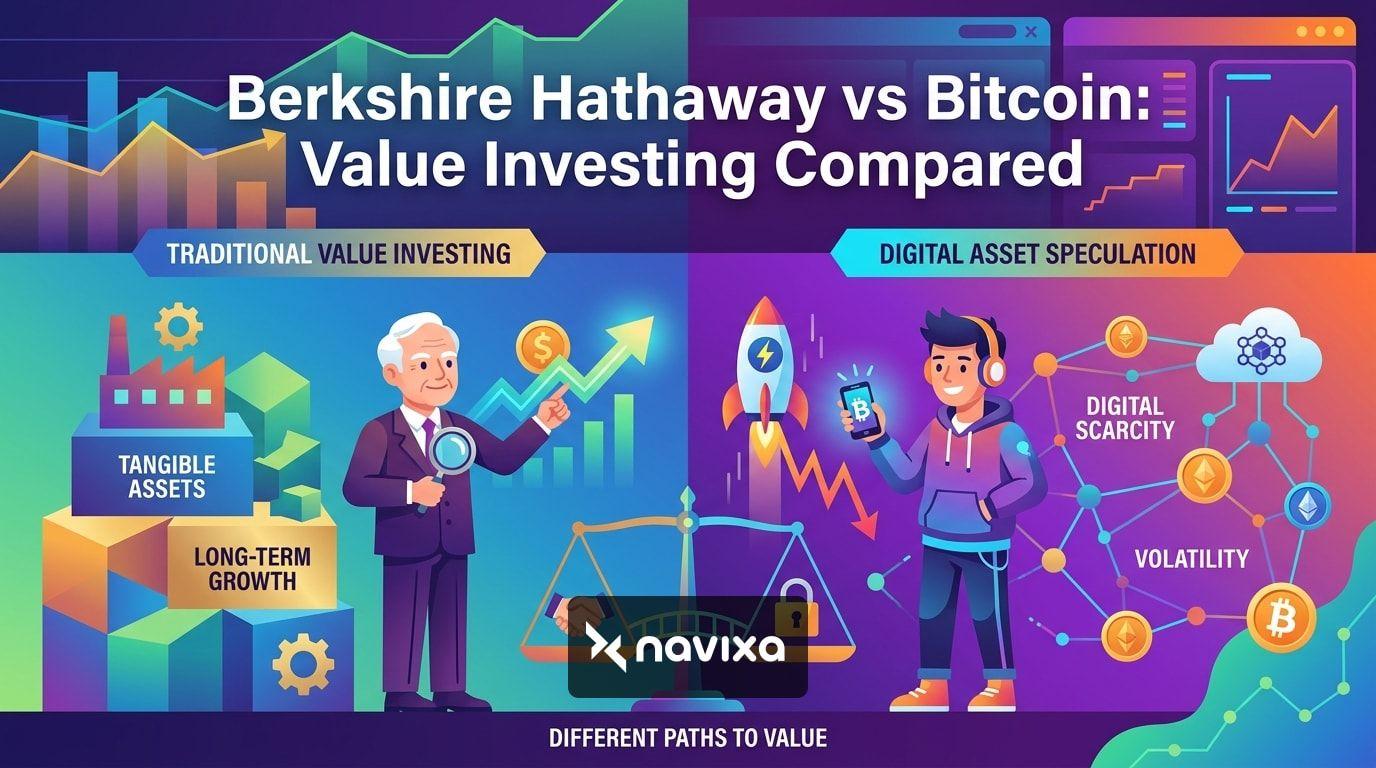
When discussing generational wealth creation, two distinct schools of thought dominate the financial landscape: the traditional, cash-flow-driven methodology championed by Warren Buffett, and the modern, decentralized digital scarcity represented by Satoshi Nakamoto's invention. The debate of Berkshire Hathaway vs Bitcoin is more than just a comparison of two assets; it is a clash of financial philosophies. On one side, you have a conglomerate of productive businesses generating billions in free cash flow. On the other, you have a global, decentralized network that recently pushed its market capitalization past $1.56 trillion, with individual coins trading comfortably above $78,400.
Understanding both approaches is essential for the modern investor aiming to build a resilient, diversified portfolio. By examining value investing alongside cryptocurrency economics, we can extract valuable lessons on risk, intrinsic value, and future growth.
- Berkshire Hathaway derives its value from productive businesses and predictable, compounding cash flows.
- Bitcoin relies on absolute scarcity, decentralization, and network adoption as a store of value.
- Combining traditional equities with digital assets can provide a hedge against inflation and currency debasement.
- Emotional resilience and strict risk management are mandatory, as traditional and digital assets exhibit vastly different volatility profiles.

The Core Philosophies: Value Investing vs Digital Scarcity
To grasp the fundamental differences between these two titans of wealth generation, we must look at how each defines "value."
Berkshire Hathaway: The Power of Productive Assets
Warren Buffett's investment conglomerate, Berkshire Hathaway, operates on the principles of classic value investing. The core philosophy is simple: buy fundamentally strong, productive businesses at a fair price and hold them indefinitely. Berkshire's portfolio includes railroads, utilities, insurance companies, and massive stakes in consumer goods and technology giants.
These companies produce tangible goods or services, generate real-world revenue, and return value to shareholders through dividends or stock buybacks. The intrinsic value of Berkshire Hathaway is directly tied to the discounted future cash flows of its underlying businesses. When you buy a share of Berkshire, you are buying a fractional ownership stake in American industry.
Bitcoin: The Power of Absolute Scarcity
Bitcoin, conversely, produces no quarterly earnings, pays no dividends, and employs no CEO. Its value proposition is rooted in monetary theory and digital scarcity. With a hard-capped supply of 21 million coins, Bitcoin acts as a decentralized ledger secured by cryptographic proof-of-work.
Advocates argue that Bitcoin is "digital gold," a superior store of value in an era of rapid fiat currency debasement. While Berkshire relies on human management and corporate earnings, Bitcoin relies on mathematics and network effects. As institutional adoption grows—highlighted by recent events such as the Canadian pension giant AIMCo buying the dip and securing a $69 million unrealized gain—Bitcoin's role as a legitimate macro asset continues to solidify.
"Price is what you pay. Value is what you get." — Warren Buffett
While Buffett famously applies this quote to undervalued stocks, cryptocurrency advocates apply the same logic to Bitcoin's fixed supply in a world of infinite fiat printing.
Market Analysis & Trading Psychology
Navigating the markets requires more than just capital; it demands an ironclad mindset. The psychological toll of holding these two distinct assets varies significantly.
The Patience of the Value Investor
Traditional value investing requires immense patience and an indifference to short-term market noise. Berkshire investors are trained to ignore quarterly earnings misses if the underlying business model remains intact. The psychology here is built on trust—trust in Warren Buffett's capital allocation skills and trust in the long-term growth of the global economy. Drawdowns are generally milder compared to emerging tech sectors, allowing for a steady, low-stress compounding process.
When analyzing crypto against speculative markets, investors often notice that both traditional technology conglomerates and digital asset networks experience cyclical hype phases, yet Berkshire remains largely insulated from these speculative frenzies.
The HODLer's Resilience
Trading or holding Bitcoin requires a radically different psychological framework. The cryptocurrency market operates 24/7/365, with wild price swings dictated by macroeconomic data, regulatory news, and algorithmic trading. With a total crypto market cap exceeding $2.68 trillion and Bitcoin dominance hovering around 58.5%, the digital asset ecosystem is prone to hyper-volatility.
Bitcoin investors (often referred to as "HODLers") must develop the emotional resilience to withstand 50% to 80% drawdowns during bear markets without panic selling. This requires deep conviction in the underlying protocol and a long-term time horizon. The psychological reward is the potential for asymmetric, exponential returns that traditional equities rarely offer over short timeframes.

Berkshire Hathaway vs Bitcoin: A Comparative Breakdown
To effectively contrast these assets, let us examine their structural differences across key financial metrics.
| Feature | Berkshire Hathaway (BRK.B) | Bitcoin (BTC) |
|---|---|---|
| Asset Class | Traditional Equity (Holding Company) | Decentralized Cryptocurrency |
| Yield / Cash Flow | High (through underlying businesses) | None (purely capital appreciation) |
| Supply Dynamics | Controlled by management (Buybacks) | Hard-capped at 21,000,000 coins |
| Volatility | Low to Moderate | High to Extreme |
| Custody | Traditional Brokerage | Self-custody wallets or institutional custodians |
| Valuation Metric | Price-to-Earnings, Discounted Cash Flow | Network Adoption, Hash Rate, Scarcity |
While Warren Buffett has historically been a vocal critic of Bitcoin, describing it as "rat poison squared," his company indirectly benefits from digital adoption through its investments in fintech companies that offer crypto services.
Analyzing Portfolios: Can They Coexist?
For the pragmatic investor, the choice between Berkshire Hathaway and Bitcoin does not have to be binary. Modern Portfolio Theory suggests that combining uncorrelated assets can improve risk-adjusted returns.
Hedging Macroeconomic Risks
Berkshire Hathaway is highly correlated to the success of the American economy. If inflation is stable and consumer spending is strong, Berkshire thrives. However, in scenarios of extreme monetary debasement or systemic banking failures, traditional equities may suffer.
Bitcoin acts as a counterbalance. Because its monetary policy is hardcoded and cannot be altered by central banks, it serves as a hedge against fiat currency devaluation. Allocating a small percentage of a traditional portfolio to Bitcoin allows investors to capture upside during monetary expansions without risking ruin.
Regulatory environments play a massive role in this coexistence. For instance, understanding the impact of regulatory privacy laws is crucial for those leaning heavily into the decentralized web, as government oversight can drastically alter token valuations and institutional adoption rates.

Institutional Convergence
The line between traditional finance and cryptocurrency is blurring. Major financial institutions now offer Bitcoin ETFs, bringing Wall Street liquidity into the digital asset space. We are also seeing fascinating sector overlaps. Recently, Bitcoin mining companies have begun pivoting to artificial intelligence infrastructure to maximize their energy assets. For example, Bitcoin miner Riot's shares recently jumped 8% after expanding an AMD data center deal, signaling a lucrative AI pivot.
This convergence highlights how traditional corporate strategies are infiltrating the crypto space. Just as traditional stock pickers spend time evaluating polarized long-term investments to uncover deep value, crypto investors must sift through volatile network narratives to find sustainable protocols with real-world utility.
Execution Strategies for the Modern Investor
If you decide to allocate capital to both the traditional value monolith and the digital gold standard, proper execution is paramount.
Dollar-Cost Averaging (DCA)
Attempting to time the market is famously difficult. A proven strategy for both Berkshire Hathaway and Bitcoin is Dollar-Cost Averaging (DCA). By purchasing a fixed dollar amount of both assets at regular intervals, you mitigate the impact of short-term volatility. This is particularly effective for Bitcoin, smoothing out its violent price swings, while steadily accumulating shares of Berkshire's compounding machine.
Understanding Custody and Security
When buying Berkshire Hathaway, you rely on a traditional brokerage, protected by regulations and the Securities Investor Protection Corporation (SIPC). The friction is low, but you must trust third-party custodians.
Bitcoin introduces the concept of self-custody. Utilizing hardware wallets allows you to be your own bank, eliminating counterparty risk. However, this transfers the burden of security entirely onto you. Losing your private keys means losing your wealth permanently. For retail participants looking at trading emerging tech stocks alongside digital currencies, a blended approach of rigorous traditional risk parameters and robust digital security practices is essential.
Never store large amounts of Bitcoin on centralized exchanges long-term. If an exchange becomes insolvent or is hacked, you risk losing your entire investment. Always utilize cold storage solutions for significant holdings.

Conclusion: Bridging Two Worlds
The debate of Berkshire Hathaway vs Bitcoin is often framed as a zero-sum game by maximalists on both sides. However, the most astute investors recognize that both represent powerful, albeit entirely different, mechanisms for wealth preservation and creation. Berkshire Hathaway offers the safety of productive cash flows and proven management, while Bitcoin provides absolute scarcity and a hedge against the legacy financial system.
By checking tribalism at the door and objectively analyzing the merits of both value investing and digital scarcity, you can construct a robust portfolio designed to weather any macroeconomic storm. To learn more about navigating these complex markets, consider exploring CoinDesk for up-to-the-minute digital asset news and macro analysis.
***
Frequently Asked Questions
Why does Warren Buffett dislike Bitcoin?
Warren Buffett fundamentally believes that an asset must produce something of value—like crops from a farm or earnings from a business—to be a worthy investment. Because Bitcoin does not produce cash flow or tangible goods, he views it as a speculative, non-productive asset.
Is it safe to hold both Berkshire Hathaway and Bitcoin in the same portfolio?
Yes, holding both can provide excellent diversification. Berkshire offers stability and exposure to traditional industries, while Bitcoin offers high-growth potential and protection against fiat currency devaluation.
How does Bitcoin's volatility compare to Berkshire Hathaway's stock?
Bitcoin is significantly more volatile. While Berkshire Hathaway (BRK.B) may experience moderate drawdowns during broader market recessions, Bitcoin regularly experiences 50% to 80% corrections between its cyclical bull markets.
Will Berkshire Hathaway ever buy Bitcoin?
While Warren Buffett and his immediate successors have explicitly stated their disinterest in buying Bitcoin directly, Berkshire Hathaway has invested billions in digital banking and fintech companies (such as Nubank) that offer cryptocurrency trading and custody to their customers.