
In the fast-paced world of cryptocurrency trading, volatility is the only constant. With Bitcoin (BTC) actively fluctuating around the $67,000 mark in early 2026, many traders are seeking ways to generate consistent returns without taking on massive directional risk. Enter the Automated Bitcoin Funding Rate Arbitrage Strategy—a market-neutral approach designed to harvest yield from the mechanics of perpetual futures contracts.
Whether you are an institutional quantitative trader or a retail investor looking to optimize your crypto portfolio, leveraging automation to capture funding rate discrepancies can provide a steady stream of passive income. In this comprehensive guide, we will break down the mechanics of Bitcoin funding rates, explain how arbitrage works, and outline the actionable steps to deploy an automated trading bot to execute this strategy flawlessly.
Understanding Perpetual Futures and Funding Rates
To grasp the concept of a Bitcoin funding rate arbitrage strategy, you must first understand how perpetual futures contracts work. Unlike traditional futures contracts, perpetuals do not have an expiration date. This allows traders to hold leveraged positions indefinitely, provided they maintain sufficient margin to avoid liquidation.
However, because perpetual contracts never settle in the traditional sense, cryptocurrency exchanges need a mechanism to ensure the perpetual contract price stays pegged to the underlying spot price (the index price). This mechanism is the funding rate.
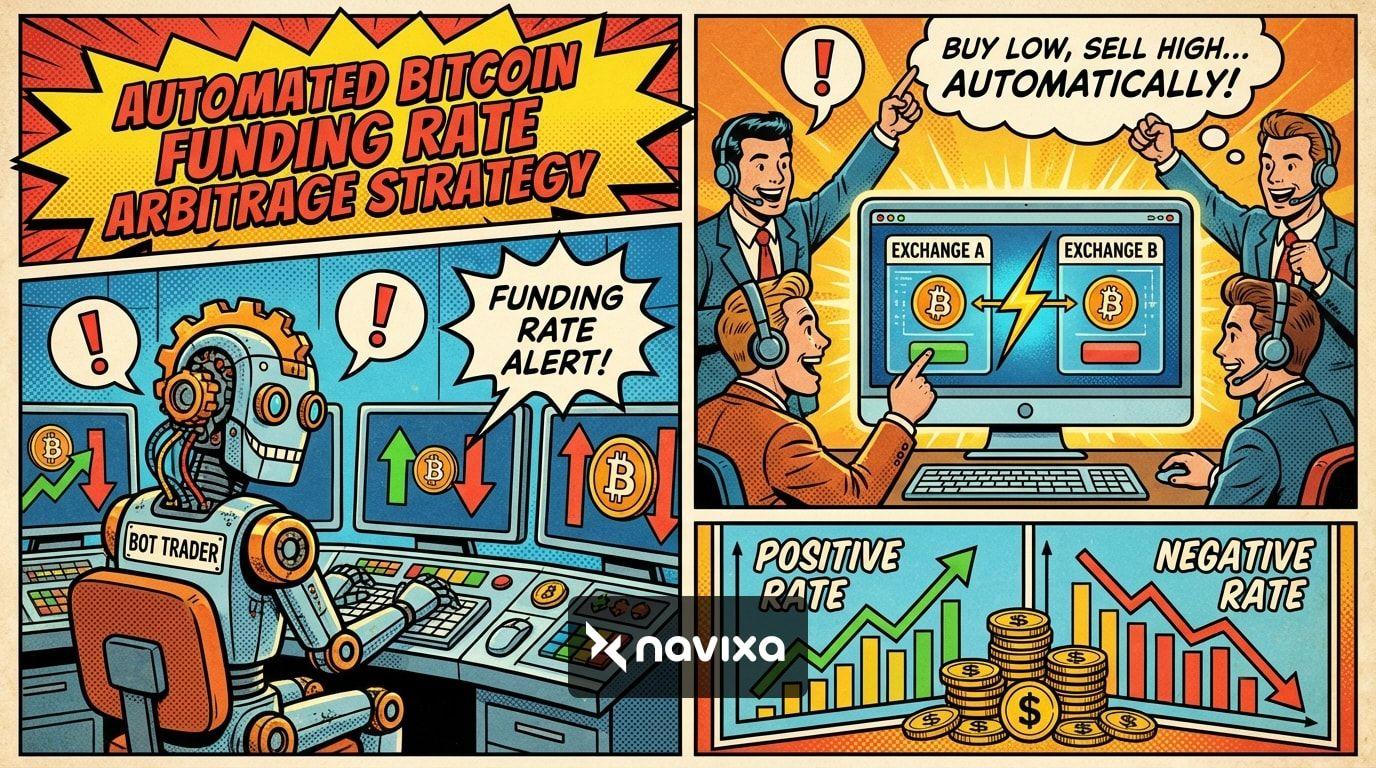
* Positive Funding Rate: When the perpetual contract price is higher than the spot price, the market is overwhelmingly bullish. To incentivize a balance, exchanges require traders holding long positions to pay a fee to traders holding short positions. * Negative Funding Rate: When the perpetual contract price drops below the spot price, the market is bearish. Short sellers must pay long position holders.
Funding rates are typically calculated and exchanged every four to eight hours, depending on the platform. These regular payments create a lucrative opportunity for arbitrageurs.
The Mechanics of Bitcoin Funding Rate Arbitrage
The core philosophy of a Bitcoin funding rate arbitrage strategy is to maintain a "delta-neutral" portfolio. This means your overall exposure to Bitcoin's price movement is zero; if Bitcoin goes up $1,000 or drops $1,000, your net portfolio value remains unchanged. You profit solely from the funding fee payments.
There are two primary ways to structure this trade.
1. Positive Carry (Cash and Carry)
This is the most common form of funding rate arbitrage. It thrives in bull markets where funding rates are consistently positive. * Leg A (Spot): Buy $10,000 worth of Bitcoin in the spot market. * Leg B (Perpetual): Simultaneously open a $10,000 short position in the Bitcoin perpetual futures market.
Because you are shorting the perpetual contract during a period of positive funding, you will receive regular funding payments from the long traders. Your spot holdings perfectly hedge your short position, insulating you from price swings.
2. Reverse Carry
Reverse carry is utilized when the market flips bearish and funding rates turn negative, meaning shorts are paying longs. * Leg A (Spot Margin): Borrow Bitcoin and sell it (short) in the spot margin market. * Leg B (Perpetual): Simultaneously open a long position in the perpetual futures market.
In a negative funding environment, your long perpetual position receives funding payments. Again, the two legs cancel out your directional price risk.
"The true beauty of funding rate arbitrage lies not in predicting where Bitcoin will go next, but in exploiting the structural inefficiencies of the derivatives market for a predictable yield."
Why You Need an Automated Bitcoin Funding Rate Arbitrage Strategy
While the concept of funding rate arbitrage is straightforward, executing it manually is incredibly difficult. Markets move at light speed, and funding rates can fluctuate wildly across different exchanges. This is why deploying an Automated Bitcoin Funding Rate Arbitrage Strategy is practically mandatory for modern traders.
In recent years, the crypto industry has seen a massive rollout of tools specifically designed for this purpose. Platforms like Phemex and Crypto.com have launched native, fully automated Arbitrage Bots that allow users to capture yields with minimal setup. Furthermore, open-source trading engines like Hummingbot offer customizable scripts for executing advanced cross-exchange funding rate arbitrage. Additionally, tools like the P2P.Army scanner continuously monitor spreads across over 15 major exchanges 24/7, pinpointing the most profitable opportunities instantly.
Here is why automation outperforms manual trading:
1. Speed and Precision: An automated bot can execute both legs of the trade (spot and perpetual) simultaneously, often in milliseconds. This eliminates the risk of "legging," where the price of Bitcoin moves between your first and second trade, resulting in an immediate loss. 2. 24/7 Market Scanning: Funding rates change constantly. An automated system can continuously monitor multiple exchanges (e.g., Binance, Bybit, Hyperliquid) and dynamically allocate capital to the highest-yielding opportunities. 3. Low Latency Execution: Professional arbitrage systems use sophisticated APIs (Application Programming Interfaces) to interact directly with exchange matching engines. As noted by industry developers, execution must be aligned to tight funding-settlement windows to avoid slippage.
Manual vs. Automated Arbitrage
| Feature | Manual Arbitrage | Automated Arbitrage |
|---|---|---|
| Execution Speed | Slow (Seconds to minutes) | Lightning Fast (Milliseconds) |
| Market Monitoring | Limited to screen time | 24/7 Continuous scanning |
| Risk of Legging | High (Price slippage is likely) | Extremely Low (Simultaneous API orders) |
| Yield Optimization | Static and difficult to adjust | Dynamic reallocation across venues |
| Emotional Bias | Prone to panic and greed | 100% Rules-based execution |
Step-by-Step: Setting Up Your Automated Strategy
If you are ready to implement an automated Bitcoin funding rate arbitrage strategy, follow these actionable steps:
Step 1: Choose Your Automation Platform
Decide whether you want a plug-and-play solution or a highly customizable bot. * Native Exchange Bots: Platforms like Crypto.com and Phemex offer built-in bots that require zero coding knowledge. You simply select the pairs, allocate funds, and start the bot. * Custom Frameworks: For advanced traders, Hummingbot provides an open-source framework where you can run a Python script to arbitrate between a decentralized exchange like Hyperliquid and a centralized one like Binance.
Step 2: Select the Right Trading Venues
You need access to highly liquid spot and futures markets. Look for exchanges with deep order books and historically favorable funding rates. Ensure you understand the fee tiers of each platform, as high trading fees can quickly eat into your arbitrage profits.
Step 3: Define Your Risk Parameters
A robust automated strategy must have strict parameters: * Minimum Yield Threshold: Instruct your bot to only enter a position if the annualized funding rate exceeds a certain percentage (e.g., 10% APY). * Take-Profit Levels: As demonstrated by Hummingbot's configurations, you can define a minimum PnL (Profit and Loss) threshold. Once the accrued funding payments push your net PnL above a target (like 1%), the bot automatically closes the positions to lock in profits. * Maximum Slippage: Set strict slippage limits to ensure your bot doesn't execute trades at highly unfavorable prices during sudden volatility spikes.
Step 4: Deploy and Monitor
Start with a small allocation to test the bot's execution speed and logic. Monitor the first few funding cycles to ensure the funding payments are being credited correctly and that the bot's hedging mechanism remains perfectly delta-neutral.
Advanced Technical Considerations: Latency and Settlement
For the highly technical trader, the real alpha in funding rate arbitrage is found in the micro-details. Funding settlement is often much messier than retail traders realize.
Settlement timing can vary slightly by exchange, and liquidity often thins out just seconds before the funding snapshot. Naive bots that simply chase the highest displayed rate will often fail due to excessive execution costs, network latency, and delayed exits. To counter this, advanced C++ or optimized Python trading systems use explicit position tracking and structure their API calls to minimize jitter and throttling during the chaotic funding settlement window.
Risk Management: Protecting Your Capital
While funding rate arbitrage is widely considered a "low risk" strategy compared to directional trading, it is not "no risk." Understanding the potential pitfalls is crucial.
1. Liquidation Risk: Even though your position is hedged, the futures leg of your trade is still subject to liquidation if the mark price of Bitcoin violently spikes against your position. You must maintain sufficient margin balances to weather temporary "wicks" in the market. 2. Exchange Counterparty Risk: You are relying on the exchange to hold your funds and honor the derivatives contracts. If an exchange becomes insolvent or halts withdrawals, your capital is trapped. Mitigate this by diversifying across multiple top-tier exchanges. 3. Execution Risk: If an exchange API goes down while your bot is trying to place its second leg, you could end up with a naked, unhedged position. Ensure your bot has robust error handling and fail-safes. 4. Negative Yields: Funding rates are dynamic. A persistently positive rate can turn negative during market corrections. If your bot is running a positive carry strategy, a negative funding rate means *you* will start paying the fee. Your automated system must be programmed to automatically unwind the position if the rate flips unfavorably.
Conclusion
An automated Bitcoin funding rate arbitrage strategy is one of the most elegant ways to extract consistent yield from the cryptocurrency markets. By capitalizing on the structural necessity of funding fees, traders can generate passive income while neutralizing their exposure to Bitcoin's unpredictable price swings.
Whether you utilize a user-friendly exchange bot or custom-code a low-latency execution engine, automation is the key to minimizing risk and maximizing efficiency. Start with a small capital allocation, rigorously test your parameters, and gradually scale up your operations as you become comfortable with the nuances of perpetual futures arbitrage.
---
Frequently Asked Questions
What is a delta-neutral trading strategy?
A delta-neutral trading strategy is an investment approach designed to have zero sensitivity to the price movement of the underlying asset. In Bitcoin funding rate arbitrage, this is achieved by taking equal and opposite positions—such as holding Bitcoin in the spot market while shorting the exact same amount in the futures market. Your net exposure to Bitcoin's price is zero.
How often are funding rates paid in crypto?
Funding rates are typically calculated and paid every four or eight hours, depending on the specific cryptocurrency exchange. For example, a platform might execute funding settlements at 00:00, 08:00, and 16:00 UTC. Some decentralized platforms or specific contracts may even calculate funding continuously.
Can I lose money doing funding rate arbitrage?
Yes, while it is lower risk than directional trading, losses can occur. Potential risks include API execution failures that leave you unhedged, margin liquidations if you do not keep enough collateral to survive sudden price wicks, trading fees that outweigh the funding yields, and exchange counterparty failures.
Do I need to be a programmer to set up an automated arbitrage bot?
No. While advanced custom bots require programming knowledge (like Python or C++), many modern cryptocurrency exchanges now offer built-in, no-code Arbitrage Bots directly on their platforms. Users can simply select their preferred parameters and launch the strategy with a few clicks.
Why do funding rates sometimes turn negative?
Funding rates turn negative when the market sentiment shifts to heavily bearish, causing the perpetual contract price to drop below the spot index price. To encourage traders to open long positions and push the contract price back up to spot parity, the exchange forces short sellers to pay a fee to long position holders.