
Introduction to AST SpaceMobile Market Dynamics
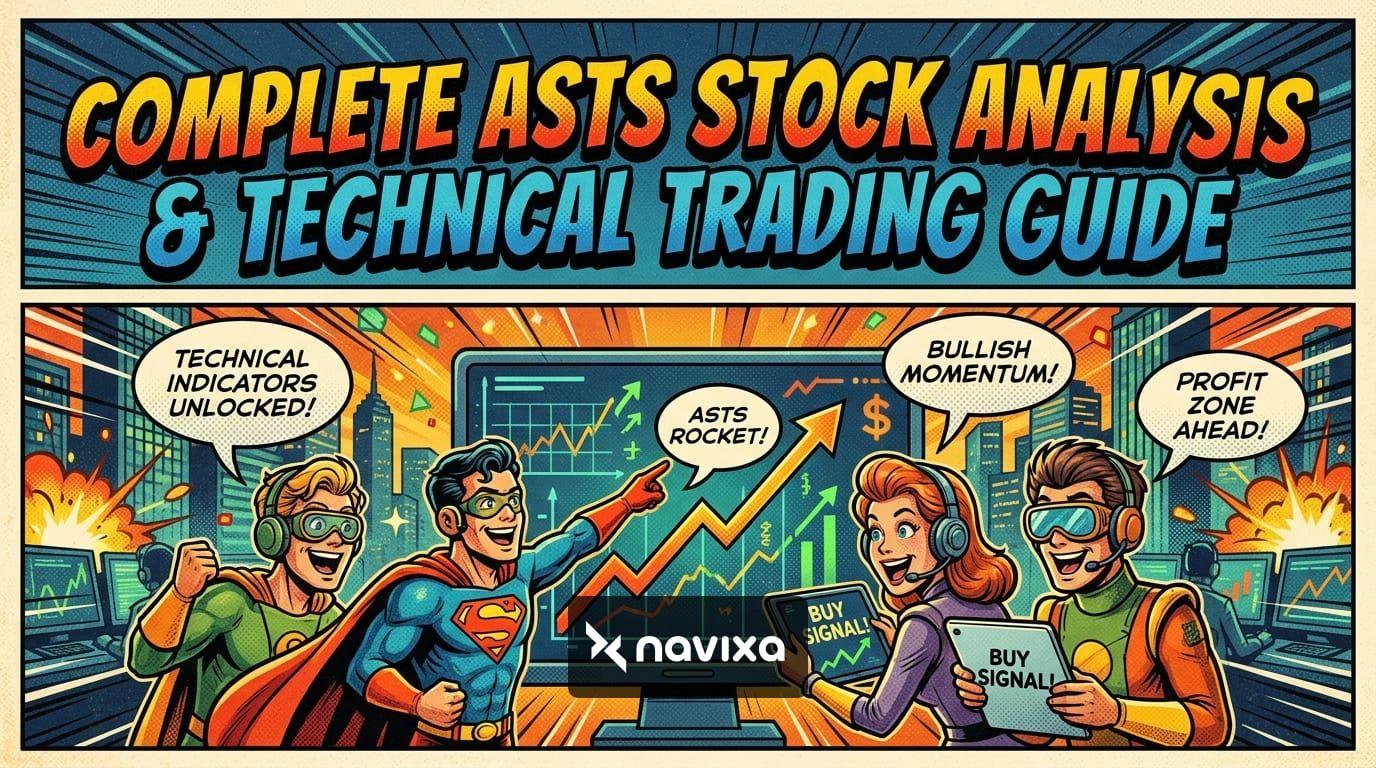
The evolution of the satellite direct-to-device (D2D) communications sector has birthed some of the most explosive price action in modern financial markets. At the forefront of this revolution is AST SpaceMobile (NASDAQ: ASTS), a company attempting to bridge global cellular dead zones by beaming broadband directly to standard mobile phones. Conducting a thorough ASTS stock analysis is no longer just for traditional equity investors; the stock's massive volatility, soaring valuation, and aggressive retail following make it trade very much like a high-cap digital asset.
Recently, the company has faced fundamental roadblocks, notably the lower-than-planned orbital altitude of its BlueBird 7 satellite in April 2026. This misstep triggered a sharp 17% overnight plunge, shaking out weak hands and creating fresh opportunities for technical traders. Whether you are a swing trader looking to capitalize on a technical bounce or a long-term believer trying to time an accumulation phase, understanding the underlying technicals is absolutely paramount.
In this comprehensive guide, we will break down the current market fundamentals, outline critical support and resistance zones, and provide actionable trading strategies designed to navigate the intense turbulence of AST SpaceMobile's stock. By merging fundamental market realities with strict technical indicators, traders can better position themselves to capitalize on this volatile space race.
Market Fundamentals: The Space Race Heat Up
While technical indicators dictate precise entry and exit points, macroeconomic fundamentals establish the overarching market trend. In the case of AST SpaceMobile, the fundamental narrative is a high-stakes race against time and deep-pocketed competitors.
As of mid-2026, ASTS commands a staggering market capitalization hovering around $34 billion. This valuation is built entirely on forward-looking expectations rather than current revenues. The company reported roughly $54.3 million in Q4 2025 revenue and provided a 2026 revenue guidance between $150 million and $200 million. Market optimists point to aggressive consensus targets of nearly $1 billion by 2027 and nearly $2 billion by 2028. However, getting there requires flawless execution—a massive hurdle when dealing with aerospace engineering.
The Impact of Competitive Pressures
The fundamental thesis for ASTS cannot be analyzed in a vacuum. SpaceX has relentlessly expanded its Starlink constellation, deploying over 1,000 new satellites recently, with a direct-to-cell network now exceeding 650 operational units. Furthermore, the FCC's recent conditional approval allowing SpaceX to provide direct-to-cell SMS services places immense pressure on ASTS to deliver its promised broadband capabilities without further delay.
Additionally, the broader landscape is consolidating. Amazon's strategic acquisition of Globalstar highlights the willingness of mega-cap tech giants to buy their way into the satellite communications sector, intensifying the competitive environment. For an independent firm like ASTS, any launch delay—such as the recent BlueBird 7 altitude issue—compresses their 'window of opportunity' and threatens their valuation premium.
ASTS vs. Top Satellite Competitors
Understanding where AST SpaceMobile stands in the broader market requires looking at its primary rivals. Below is a comparative breakdown of the industry leaders.
| Feature / Metric | AST SpaceMobile (ASTS) | SpaceX (Starlink) | Amazon (Globalstar) |
|---|---|---|---|
| Core Technology | Direct-to-Device Cellular Broadband | Low-Earth Orbit Broadband & SMS | Emergency SOS & IoT Services |
| Market Status | Early Commercialization Phase | Established, Expanding D2D | Acquired / Integrated |
| Valuation Model | High Speculative Premium (~$34B) | Private Valuation Dominance | Corporate Backed Integration |
| Current Challenge | Launch Delays, BlueBird 7 Issues | Regulatory Hurdles | Lower Bandwidth Capabilities |
ASTS Stock Analysis: Technical Breakdown
Fundamental narratives create the volatility, but technical analysis provides the roadmap to profit from it. The recent price movements of ASTS have pushed key technical indicators into critical decision zones.
Analyzing the Moving Averages
Moving averages are essential for filtering out market noise and identifying the dominant trend. Currently, AST SpaceMobile is exhibiting a fierce battle between short-term bearish pressure and long-term bullish market structure.
The 50-Day Moving Average: Positioned around the $89.00 to $90.00 mark, the 50-day Simple Moving Average (SMA) has historically acted as a reliable short-term support line during sustained uptrends. The recent 17% gap down caused the stock to slice decisively through this level, flipping it from support into near-term resistance. A daily close above this line is required to shift short-term momentum back to the bulls.
The 200-Day Moving Average: Hovering in the $70.50 to $72.30 range, the 200-day SMA represents the structural foundation of ASTS's broader bull market. Institutional algorithms and long-term trend followers heavily monitor this zone. Should the stock continue its descent, this area will serve as the ultimate line in the sand. A bounce here could offer one of the most lucrative risk-to-reward setups of the year.
Key Support and Resistance Levels
Trading high-beta assets requires a strict adherence to predefined price levels. Based on recent pivot points and historical price action, we can identify the following zones:
* Resistance 1 ($94.00): The immediate overhead resistance. This level represents the point of breakdown before the most recent negative catalyst. * Resistance 2 ($105.00): A major psychological and historical pivot. Regaining this level would confirm a resumption of the broader parabolic uptrend. * Support 1 ($84.00): The immediate technical floor. This zone has provided temporary relief from the recent sell-off and serves as an intra-week consolidation base. * Support 2 ($72.00): The macro defense line, perfectly aligning with the 200-day moving average.
Volume and Momentum Indicators
Price action alone does not tell the whole story; volume and momentum validate the moves. The Relative Strength Index (RSI), set to a standard 14-day period, currently sits in the 39 to 46 range. This indicates a neutral-to-bearish stance. It is approaching oversold territory (below 30) but is not quite there yet, suggesting that the asset may need further consolidation—or a final flush down—before a true reversal occurs.
Meanwhile, the Moving Average Convergence Divergence (MACD) indicator has printed a bearish crossover, largely driven by the sudden gap down in price. The histogram bars are expanding negatively, confirming that the bears are currently in control of the immediate momentum.
Actionable Trading Strategies for ASTS
Given the complex interplay of high valuations, intense competition, and volatile technicals, how should traders approach ASTS? Here are three actionable strategies tailored for current market conditions.
1. Swing Trading the Volatility Channel
For active swing traders, the current environment is ideal for channel trading. The strategy involves initiating long positions near the confirmed $84.00 support level, utilizing a tight stop-loss just below $81.50 to protect against further downside. The profit target for this mean-reversion trade is the $89.00 to $90.00 zone, specifically aiming to front-run the 50-day moving average resistance. By keeping hold times relatively short (3 to 8 days), traders can mitigate the risk of sudden, negative aerospace headlines.
2. The Golden Bounce: Accumulating at the 200-Day MA
Long-term investors or macro-swing traders may prefer a more patient approach. This strategy requires waiting for the stock to experience a deeper correction toward the 200-day SMA (the $70.50 to $72.00 zone). Because this level represents structural support, taking a position here offers an asymmetric risk profile. If the stock bounces, the upside potential back to the $90s is massive. If the stock fails and breaks below $68.00 on high volume, the long-term thesis is invalidated, and the position is cut with minimal relative damage.
3. Hedging with Options
Due to the binary nature of satellite launches—where a single failure can erase billions in market cap overnight—trading the underlying stock without a hedge can be disastrous. Sophisticated traders holding long positions often purchase out-of-the-money (OTM) put options expiring shortly after major announced launch dates. This acts as an insurance policy, capping catastrophic downside risk while allowing the equity position to capture the upside of a successful deployment.
Applying Cryptocurrency Trading Principles
While ASTS is a traditional equity, it exhibits the behavioral characteristics of a high-cap digital token. The community-driven retail enthusiasm, the massive valuation premium relative to current cash flow, and the extreme price gaps are all hallmarks of crypto markets.
Traders who specialize in digital assets can easily transition their skills to stocks like ASTS. The key is understanding the 'hype cycle.' Just as altcoins experience parabolic run-ups followed by brutal 30% corrections, high-beta tech stocks undergo similar purges to reset momentum. By utilizing platforms like the TradingView ASTS Chart and referencing institutional data from the Yahoo Finance ASTS Profile, agile traders can exploit the emotional overreactions of retail investors who panic during sharp drawdowns.
Essential Risk Management
No technical setup is foolproof, and surviving in high-beta markets requires draconian risk management.
'Trading highly volatile equities requires treating them like emerging digital assets—respect the overarching trend, aggressively manage your downside risk, and never ignore the power of a fundamental catalyst.'
First and foremost, position sizing is critical. Traders should generally avoid allocating more than 5% of their total trading capital to a single speculative asset like ASTS. Secondly, stop-losses must be non-negotiable. Mental stop-losses often fail when emotion takes over; utilizing hard stop-limit orders ensures capital preservation. Finally, traders must maintain extreme catalyst awareness. Holding an unhedged, highly leveraged position over a weekend when a satellite payload is scheduled for deployment is akin to gambling, not trading.
Practical Takeaways
To synthesize this comprehensive ASTS stock analysis, keep the following core principles in mind:
* Respect the 50-Day MA: The $89.00 - $90.00 level is the immediate barrier to bullish recovery. * Watch the RSI: An RSI reading below 30 on the daily time frame may signal a prime contrarian buying opportunity. * Acknowledge the Competition: SpaceX and Amazon are rapidly closing the execution gap; ASTS's valuation requires flawless future execution to be justified. * Manage the News Cycle: Aerospace stocks trade heavily on binary outcomes (launch success vs. failure). Never trade without a defined exit plan.
Conclusion
Conducting an ASTS stock analysis reveals a fascinating dichotomy: a company with a revolutionary product capable of reshaping global telecommunications, yet burdened by a speculative valuation and immediate execution hurdles. The recent pullback to the mid-$80s has provided a necessary reset for overheated momentum indicators, opening the door for calculated technical trades.
Whether you are playing the short-term volatility channel or waiting for a structural bounce off the 200-day moving average, patience and discipline are your greatest assets. Ensure your risk parameters are set, respect the overarching trend, and stay vigilant regarding upcoming industry catalysts.
Frequently Asked Questions
What caused the recent drop in ASTS stock?
In mid-April 2026, AST SpaceMobile experienced a significant 17% price drop following news that its BlueBird 7 satellite failed to reach its planned orbital altitude. This technical setback raised concerns about the company's aggressive deployment timeline, which originally targeted a massive network rollout by the end of 2026.
Is ASTS a good stock for swing trading?
Yes, due to its high beta, immense liquidity, and frequent news-driven price gaps, ASTS is exceptionally well-suited for swing trading. Traders often rely on technical support levels, such as the 50-day and 200-day moving averages, to time entries and exits during periods of high volatility, much like trading a digital asset.
What are the key support levels to watch for ASTS?
Currently, the immediate minor support rests around $84.00, which has historically acted as a consolidation zone. However, the more critical structural support is found near the 200-day moving average, positioned roughly between $70.50 and $72.30. A break below this macro level would signal a major shift in long-term sentiment.
How does AST SpaceMobile compare to SpaceX's Starlink?
While both companies aim to provide direct-to-cell connectivity, SpaceX currently holds a significant operational advantage with thousands of functional satellites in orbit and recent FCC approvals for SMS services. ASTS relies on a highly sophisticated broadband technology architecture but struggles with launch execution and a highly speculative valuation premium compared to SpaceX's established revenue engine.