
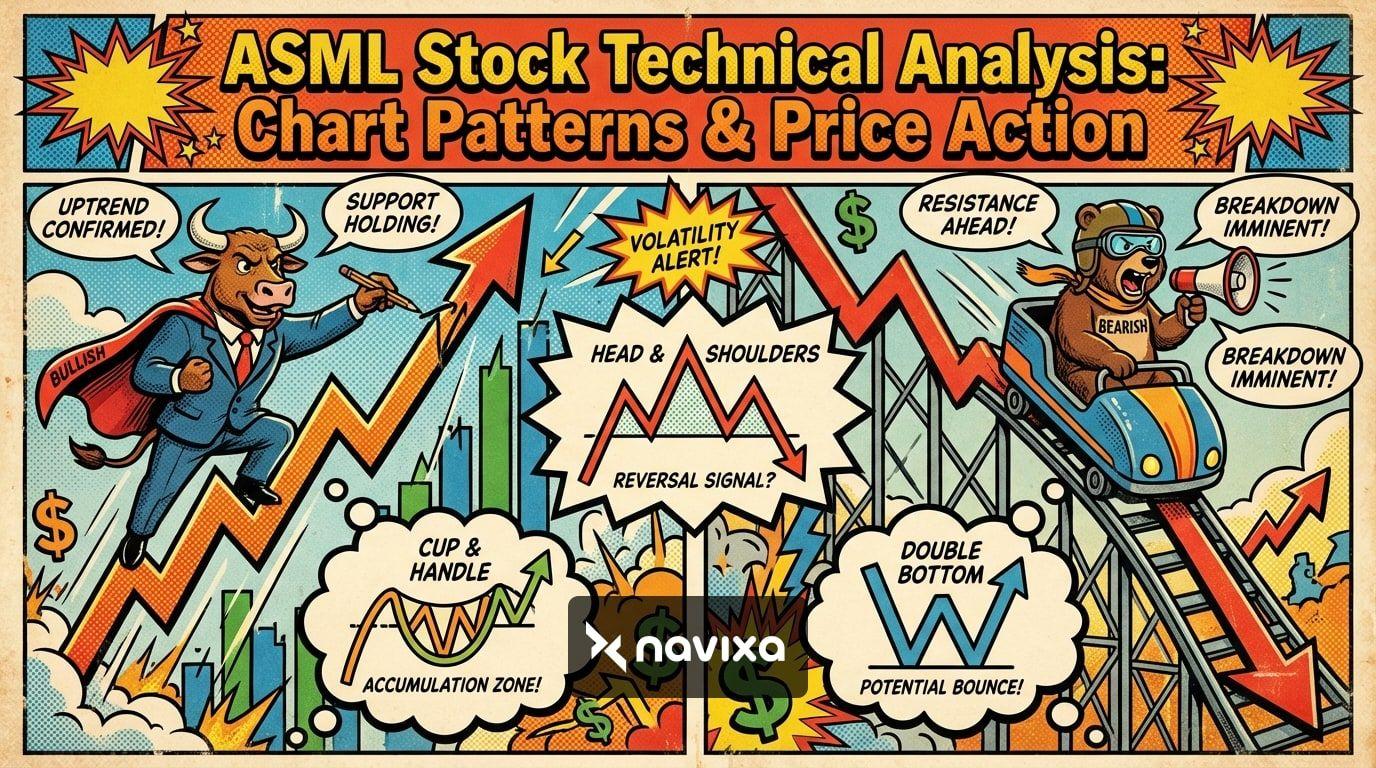
The global semiconductor market has seen explosive, unrelenting growth over the past few years, and positioned squarely at the absolute center of this technological revolution is ASML Holding N.V. As the undisputed global leader and monopolist in Extreme Ultraviolet (EUV) and High-NA lithography machines, ASML virtually dictates the pace at which the world's most advanced AI chips are manufactured. However, from an investment standpoint, fundamentally knowing that a company is an absolute powerhouse is only half the battle. To truly optimize your market entry and exit points, protect your capital, and maximize your returns, mastering ASML stock technical analysis is entirely non-negotiable.
Whether you are an aggressive day trader looking to capitalize on volatile intraday price action, a measured swing trader attempting to catch multi-week momentum, or a long-term investor seeking the perfect structural dip to add to your core portfolio, analyzing ASML's chart patterns offers a purely objective lens into overarching market psychology. The charts do not lie; they visualize exactly where institutional money is flowing.
The Macro Background: Why ASML Continues to Rally
Before diving deeply into the granular technical indicators, understanding the broader macroeconomic context is critical. Price action does not exist in a vacuum. It is continuously driven by the underlying fundamental catalysts that force institutional accumulation or distribution. Surging global demand for artificial intelligence infrastructure, data center expansion, and advanced computing has kept institutional buying pressure incredibly steady.
When a high-flying stock like ASML breaks past major psychological thresholds—such as the formidable $1,500 barrier—retail and institutional traders alike heavily rely on technical analysis to determine if the asset has become violently overextended, or if it is healthily establishing a brand new baseline of support. This constant tension between supply and demand makes understanding chart patterns, momentum oscillators, and key moving averages a crucial skill for anyone participating in the market.
Core ASML Stock Technical Analysis
A robust technical analysis strategy requires a confluence of multiple indicators. Relying on a single metric in isolation often leads to false signals and painful losses, but when several indicators align simultaneously, the statistical probability of a successful trade increases dramatically.
Moving Averages (SMAs)
Simple Moving Averages (SMAs) smooth out erratic price data to create a visually clear, trend-following indicator. They do not predict future price direction; rather, they clearly define the current prevailing direction with a slight time lag.
For a behemoth like ASML, traders typically monitor the 20-day, 50-day, and 200-day SMAs to gauge short, medium, and long-term health.
* The 20-Day SMA: This fast-moving average acts as dynamic support for short-term swing traders. When ASML is in a strong, impulsive breakout phase, pullbacks to the 20-day SMA are often fiercely defended by buyers looking to "buy the dip." * The 50-Day SMA: This metric represents the medium-term institutional trend. A definitive daily close below the 50-day moving average can signal a significant shift in market momentum, frequently prompting active traders to hedge their long positions or take profits off the table. * The 200-Day SMA: Often viewed globally as the ultimate line in the sand for long-term investors. When a stock trades significantly above its 200-day SMA, it signifies extreme structural bullishness, but simultaneously warns of a potential mean-reversion event if the gap becomes too wide.
Relative Strength Index (RSI) & Momentum
The Relative Strength Index (RSI) is a leading momentum oscillator that measures the speed and magnitude of recent price changes, typically plotted on a scale from 0 to 100.
* Overbought vs. Oversold: Traditionally, an RSI reading above 70 indicates that a stock is officially overbought and may be due for a cool-down. Conversely, an RSI below 30 indicates it is oversold and potentially undervalued in the near term. * Current ASML Context: When ASML experiences periods hovering around an RSI of 60 to 62, the stock sits in a "goldilocks" neutral-to-bullish zone. It has ample room to run before hitting extreme overbought territory. This suggests that the primary uptrend has sustained underlying momentum without the immediate, looming threat of a massive exhaustion sell-off. Traders can learn more about how to leverage this oscillator in this comprehensive RSI guide.
Moving Average Convergence Divergence (MACD)
The MACD is a sophisticated trend-following momentum indicator that illustrates the complex relationship between two separate moving averages of a stock's price.
When the MACD line crosses aggressively above the slower signal line, it generates a loud bullish signal, indicating that upward momentum is rapidly accelerating. Conversely, a cross below the signal line warns of decelerating momentum and potential distribution. Traders analyzing ASML also pay close attention to the MACD histogram. Expanding positive green bars confirm that enthusiastic buyers are still fully in control of the tape. However, astute traders always watch out for "bearish divergence"—a dangerous scenario where the stock price pushes to a higher high, but the MACD indicator makes a lower high, hinting at underlying weakness.
Chart Patterns and Price Action Dynamics
While indicators are mathematically derived from past price history, pure price action itself is the rawest, most unadulterated form of market data. By studying specific candlestick formations and structural chart patterns, you can effectively anticipate institutional moves before they fully materialize in the mainstream news cycle.
Breakout Patterns and Bull Flags
ASML's historical price action is famously characterized by strong, multi-day rallies followed by healthy, necessary periods of sideways consolidation. These consolidations frequently take the shape of "bull flags" or "pennants."
* The Bull Flag: After a near-vertical price spike (often referred to as the flagpole), the stock drifts gently downward in a tight, orderly parallel channel (the flag). When ASML violently breaks above the upper resistance line of this flag on surging volume, it signals the immediate continuation of the primary bullish trend. * Ascending Triangles: We also frequently observe ascending triangles on the ASML daily and weekly charts. This highly bullish pattern occurs when the stock hits a flat, horizontal resistance level multiple times while simultaneously forming higher lows. This visual compression indicates that sellers are slowly absorbing the available supply at the resistance level, but buyers are growing increasingly aggressive, eventually forcing a massive breakout.
Volume Analysis
Volume is the essential fuel that drives legitimate price action. A technical breakout above a key resistance ceiling is only valid and trustworthy if it is accompanied by surging, above-average trading volume.
If ASML breaks to a new all-time high on notably low volume, experienced traders refer to this as a "fake-out" or a "bull trap." The lack of volume suggests that large institutions are not participating in the move, leaving retail traders exposed to a sudden reversal. Monitoring the average daily trading volume ensures that you are participating in a structural move backed by serious institutional capital.
Key Support and Resistance Levels
Support and resistance lines are the foundational pillars of any coherent trading strategy. They represent key psychological price points where the opposing forces of supply and demand violently converge. For a deeper, foundational dive into this concept, you can explore this guide on Support and Resistance.
When conducting an ASML stock technical analysis, locating these exact pivot zones is paramount:
* Immediate Resistance: As the stock pushes past major psychological barriers like the $1,500 level, the next major Fibonacci extensions and classical resistance pivots often align near $1,560 to $1,660. If motivated buyers can push the price completely through this ceiling, it triggers algorithmic buying programs, making the higher bounds the next logical target. * Immediate Support: In the event of a sudden macroeconomic shock, a broader index sell-off, or a sector-wide pullback, the $1,230 to $1,240 zone frequently serves as the very first major line of defense. This critical area previously acted as a stubborn resistance ceiling and, according to the principle of polarity, should now mathematically flip to act as strong support. * Major Support: A complete, daily-candle breach of immediate support would likely trigger a cascade of institutional stop-loss orders, sending the stock down to test much lower levels around $1,140, which closely aligns with the longer-term structural moving averages.
Technical Indicators Breakdown
To provide a clear, easy-to-read overview of the current technical landscape, here is a comprehensive comparison table outlining the primary indicators used heavily in ASML stock technical analysis:
| Indicator Type | Metric | Current Status | Trading Implication |
|---|---|---|---|
| Trend | 50-Day SMA | Price > SMA | Bullish continuation; indicates exceptionally strong medium-term buying. |
| Trend | 200-Day SMA | Price > SMA | Macro bull trend intact; stock remains in long-term institutional favor. |
| Momentum | RSI (14-Day) | ~61.0 (Neutral/Bullish) | Ample room for upward expansion before becoming critically overbought. |
| Momentum | MACD | Positive Histogram | Upward momentum is accelerating; no immediate bearish divergence seen. |
| Price Level | Support | $1,232 - $1,240 | Key structural zone for buyers to defend fiercely during any market corrections. |
| Price Level | Resistance | $1,561 - $1,660 | Primary upside targets for systematic profit-taking or next breakout thresholds. |
Designing a Winning Trading Strategy for ASML
Armed with high-quality technical data, the next logical step is strict implementation. How do you actually trade ASML based on these recurring patterns without letting human emotion ruin your execution?
Trend-Following Strategy
If you identify as a pure trend follower, your primary objective is to ride the prevailing momentum for as long as mathematically possible, entirely ignoring minor daily noise.
1. Entry: Wait patiently for ASML to decisively break and close above a key resistance level on notably higher-than-average volume. 2. Stop-Loss: Place a dynamic trailing stop-loss just underneath the 20-day SMA. As the stock inevitably rises, your stop-loss rises sequentially with it, locking in guaranteed profits. 3. Exit: Exit the position entirely only when the stock finally closes firmly below the 50-day SMA, indicating the medium-term trend has officially broken down.
Swing Trading Pullbacks
For conservative traders who highly prefer buying at a relative discount, the "pullback" or "dip-buying" strategy is exceptionally effective.
1. Entry: Wait patiently for the stock to experience a brief, natural correction down to a known, historically validated support level or the 50-day SMA. Look for a strong bullish reversal candlestick pattern—such as a hammer candle or a massive bullish engulfing candle—to actively confirm that large buyers are stepping back in. 2. Stop-Loss: Place a strict, uncompromising stop-loss 2% to 3% below the designated support level to protect against a catastrophic trend breakdown. 3. Exit: Systematically take profits as the stock predictably approaches the previous swing high or the very next overhead resistance level.
Essential Risk Management Rules
Even the most pristine, textbook chart patterns fail. Technical analysis deals exclusively in mathematical probabilities, not guarantees or certainties. Therefore, rigid risk management is the only absolute way to ensure your longevity in the financial markets.
"The elements of good trading are: 1. Cutting losses, 2. Cutting losses, and 3. Cutting losses. If you can follow these three rules, you may have a chance." – Ed Seykota
* Position Sizing: Never risk more than 1% to 2% of your total trading capital on a single, isolated trade. If you operate a $10,000 account, your absolute maximum accepted loss on an ASML trade should never exceed $100 to $200. * Honor Stop-Losses: A stop-loss is never a mere suggestion; it is a strict, undeniable boundary. Do not maliciously move your stop-loss down to give a losing trade "more room to breathe." If the core technical thesis is officially invalidated, aggressively take the small loss and move on to the next setup. * Avoid Earnings Roulette: Blindly holding short-term, highly leveraged options positions through a volatile earnings report is purely gambling, not trading. Implied volatility aggressively expands into earnings, and the resulting overnight price gaps can easily blow completely past your designated stop-loss.
Actionable Steps for Traders
To effectively execute your ASML stock technical analysis, ensure you follow these actionable, daily steps:
* Map the Chart Daily: Before the opening bell rings, update all your support and resistance lines. Price levels shift dynamically based on previous daily closes, and outdated charts lead to outdated decisions. * Set Price Alerts: Do not blindly stare at the flickering screen all day. Set automated alerts at your key breakout or breakdown levels so you are instantly notified when real action is required. * Monitor the Semiconductor Sector: ASML does not trade in complete isolation. Continuously keep an eye on semiconductor sector ETFs (like the SMH) and major industry customers to properly gauge the broader market sentiment. If the entire semiconductor sector is violently breaking down, ASML will likely follow suit, entirely regardless of how beautiful its individual chart patterns look.
Practical Takeaways
* ASML remains an undeniable, dominant force in the global semiconductor industry, a fundamental reality that heavily influences its remarkably bullish technical posture. * Core moving averages continuously highlight a strong, uninterrupted long-term uptrend, with the underlying price comfortably trading well above its foundational 200-day SMA. * Momentum indicators, specifically the RSI and MACD, suggest continued underlying strength without indicating immediate, dangerous overbought exhaustion. * Traders should strictly base their entries on volume-backed, confirmed breakouts or precisely defined pullbacks to established, historical support zones. * Uncompromising risk management, fundamentally including fixed stop-losses and mathematically controlled position sizing, is absolutely vital for long-term survival and trading success.
Conclusion
Mastering ASML stock technical analysis directly empowers you to expertly navigate the notorious volatility of the global semiconductor market with razor-sharp precision and unwavering confidence. By deeply understanding the complex interplay between moving averages, momentum oscillators, and core price action patterns, you rapidly transform from a reactive, emotional spectator into a highly proactive, disciplined trader. The financial market ruthlessly rewards intense preparation and brutally punishes emotion. Keep your charts perfectly clean, fundamentally respect your support and resistance levels, and always trade your predefined plan.
If you are finally ready to take your trading to the next advanced level, start aggressively backtesting these exact strategies on a paper trading account today, and refine your unique edge before ever risking real, hard-earned capital!
Frequently Asked Questions
What is the overall technical consensus for ASML stock right now?
Based heavily on moving averages, momentum oscillators, and overarching current price action trends, the technical consensus for ASML is fundamentally and strongly bullish. The stock consistently trades well above its key 50-day and 200-day simple moving averages, indicating robust, sustained institutional demand.
What are the key support and resistance levels for ASML today?
While these critical levels are inherently dynamic and shift fluidly with ongoing price action, recent technicals place immediate, heavy support around the $1,232 to $1,240 zone. On the upside, major overhead resistance is continuously targeted near the $1,561 to $1,660 range. A definitive, high-volume break above resistance often signals the aggressive start of a brand new bullish leg.
Is ASML currently considered overbought based on the RSI?
No. The 14-day Relative Strength Index (RSI) for ASML has largely been hovering in the 60 to 62 range. This specific reading is widely considered a neutral-to-bullish zone, meaning the stock has robust upward momentum but has not yet reached the extreme 70+ level that traditionally signals a dangerous overbought condition.
How does the AI chip boom impact ASML's price action?
ASML operates as the sole global provider of Extreme Ultraviolet (EUV) lithography systems, which are strictly essential for manufacturing the world's absolute most advanced AI chips. The surging, seemingly insatiable demand in the AI sector acts as a massive fundamental catalyst, which reliably translates technically into aggressive institutional buying volume, incredibly bullish chart patterns, and steadily higher support floors.
Should I use moving averages to time my ASML entries?
Yes, moving averages are exceptionally excellent tools for precise entry timing. Professional swing traders often wait patiently for the stock price to pull back gently to the 20-day or 50-day Simple Moving Average before officially entering a long position. These specific levels frequently act as reliable, dynamic support where institutional buyers predictably step back into the market.