
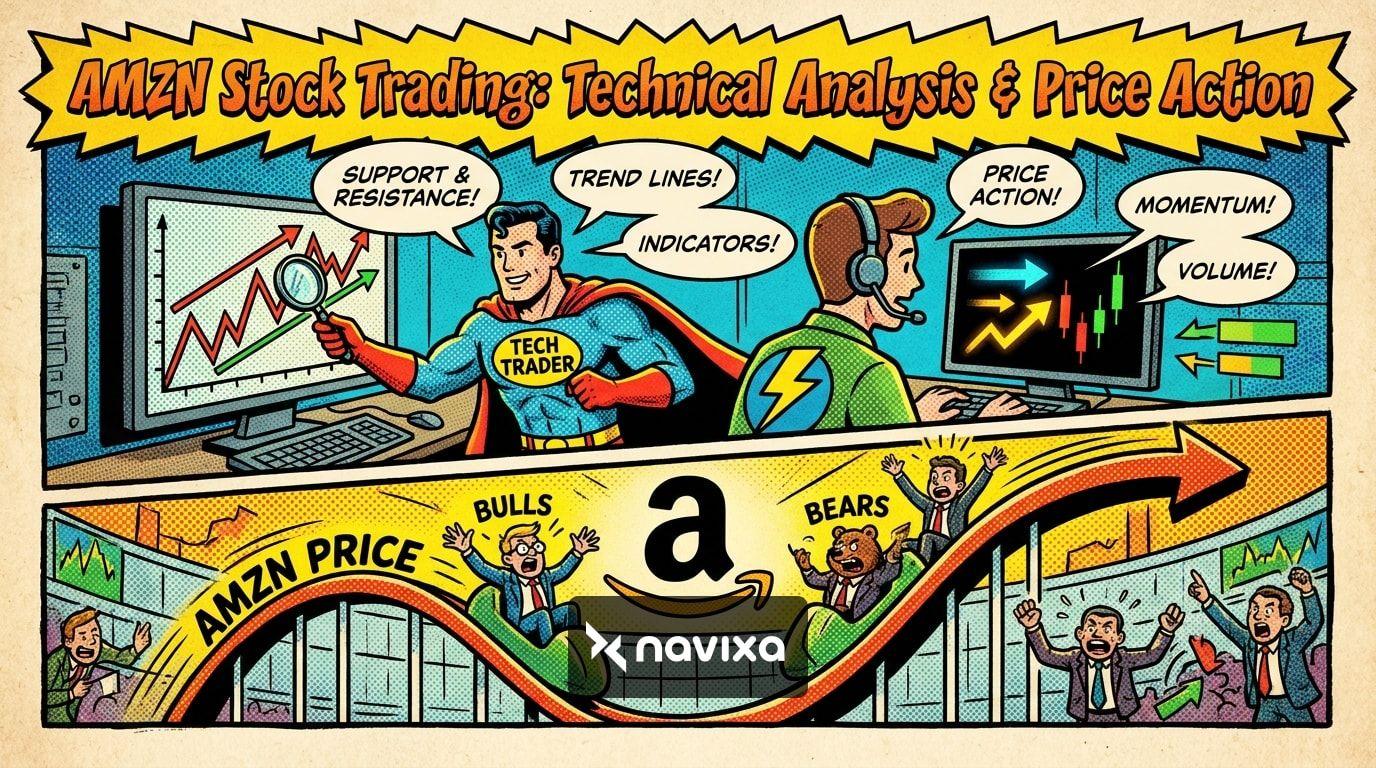
Introduction to AMZN Stock Trading
When discussing AMZN stock trading, the conversation has fundamentally shifted over the last few years. Amazon has evolved from a pure e-commerce giant into a foundational artificial intelligence and cloud computing powerhouse. For active traders and technical analysts, Amazon.com Inc. (NASDAQ: AMZN) presents a highly liquid, volatile, and technically respectful chart that offers numerous opportunities for both day traders and long-term swing traders.
Navigating the complexities of AMZN stock requires a deep understanding of market psychology, volume dynamics, and momentum indicators. Because Amazon is a mega-cap tech stock, its price action is heavily influenced by institutional positioning, algorithmic trading, and broad market indices. Understanding how to read the technical footprints left by these major market participants is essential for building a profitable trading edge.
This article provides an in-depth breakdown of technical analysis and price action strategies specific to Amazon. By marrying key fundamental catalysts with technical chart patterns, traders can better anticipate breakouts, manage downside risks, and optimize their entries and exits.
The Macro Landscape: Fundamentals Driving the Technicals
Before diving into chart patterns, it is crucial to understand that fundamental catalysts provide the "fuel" for technical breakouts and breakdowns. Technical analysis tells you *when* to buy or sell, but fundamental analysis tells you *why* the market is moving in a particular direction.
Recently, Amazon's narrative has been dominated by its aggressive expansion into artificial intelligence infrastructure and satellite networking. The company has committed a historic $200 billion in capital expenditures, the largest single-year CapEx budget in corporate history, primarily aimed at scaling its Amazon Web Services (AWS) data centers and custom AI chips, Trainium and Graviton.
Furthermore, Amazon's expanded $25 billion partnership with AI startup Anthropic and its multi-billion dollar acquisition of Globalstar for Project Leo have signaled to Wall Street that the company is playing the long game. These massive expenditures initially spooked some investors, causing temporary pullbacks, but the "smart money" quickly recognized the long-term compounding value.
"In modern markets, you cannot separate a mega-cap's fundamental data from its technical price action. Earnings reports, CapEx announcements, and cloud growth metrics dictate the momentum and volume that ultimately print on the chart."
Understanding these macro drivers allows traders to contextually interpret technical signals. For instance, a bullish moving average crossover carries significantly more weight when it aligns with reports of AWS AI revenue crossing a $15 billion annualized run rate.
Technical Analysis Breakdown for AMZN
Successful AMZN stock trading relies heavily on reading the correct technical indicators. Because Amazon boasts immense daily trading volume, its chart is less susceptible to erratic manipulation and tends to respect major technical levels.
Moving Averages and Trend Confirmation
Moving averages are the backbone of any trend-following strategy. For AMZN, traders typically monitor the 20-day Exponential Moving Average (EMA) for short-term momentum, alongside the 50-day and 200-day Simple Moving Averages (SMA) for broader trend context.
When AMZN's price is trading comfortably above its 50-day SMA, the intermediate-term trend is firmly bullish. Pullbacks to this level often serve as low-risk entry points for swing traders. Conversely, the 200-day SMA acts as the macro trendline. A "Golden Cross," where the 50-day SMA crosses above the 200-day SMA, historically triggers significant institutional buying algorithms, propelling the stock higher.
Relative Strength Index (RSI) and Momentum
Trading momentum is visually quantified using the Relative Strength Index (RSI). When AMZN's RSI pushes above the 70 level, traditional textbooks suggest the stock is "overbought." However, seasoned price action traders know that in strong upward trending markets, an overbought RSI is a sign of immense strength, not necessarily an immediate shorting opportunity.
Traders should watch for bearish divergence—when the stock price prints a higher high, but the RSI prints a lower high. This divergence often precedes a healthy pullback or a period of consolidation, allowing traders to lock in profits or reposition for the next leg up.
Support, Resistance, and Volume Profile
Price memory is a powerful psychological factor in stock trading. Previous all-time highs, such as the crucial $258.60 level, serve as major psychological resistance. When AMZN approaches these historical supply zones, volume tends to dry up as buyers become hesitant and early investors begin taking profits.
Traders utilize Volume Profile tools to identify where the bulk of trading activity has occurred over a given period. High Volume Nodes (HVN) act as gravitational pulls for the price, serving as strong support floors during market corrections. For instance, the $227 and $219 price levels have historically functioned as massive institutional accumulation zones. You can track these volume patterns using professional charting software like TradingView.
Actionable Price Action Strategies
Understanding indicators is only half the battle; the other half is executing reliable strategies. Here are some of the most effective price action strategies for AMZN stock trading.
The Breakout and Re-Test Strategy
One of the safest ways to trade major resistance levels is the breakout and re-test strategy. Instead of buying the initial surge past a key resistance line (which can often result in a "fake-out" or bull trap), patient traders wait for the price to close above the resistance level on the daily chart.
Once the breakout is confirmed, the previous resistance theoretically becomes the new support. Traders will place limit orders just above this new support line, catching the price as it briefly pulls back to "re-test" the breakout level before continuing its upward trajectory. This strategy provides an excellent risk-to-reward ratio.
The Moving Average Pullback
In a confirmed uptrend, stocks rarely move in a straight line. They undulate, pulling back to their mean before advancing again. The moving average pullback strategy involves waiting for AMZN to dip toward its 20-day EMA or 50-day SMA.
When the price touches these dynamic support lines, traders look for a bullish reversal candlestick pattern—such as a hammer, a bullish engulfing candle, or a morning star formation. The presence of these candlestick formations, combined with a bounce off the moving average, offers a high-probability entry signal.
Earnings Gap Plays
Amazon is notorious for making massive pre-market moves following its quarterly earnings announcements. If AWS growth exceeds Wall Street expectations, the stock may gap up significantly. Day traders often utilize the "Gap and Go" strategy, where they buy the stock within the first 15 minutes of the market open if the price breaks above the pre-market highs. Alternatively, if the gap is too large, swing traders might wait for a "Gap Fill"—a slow drift downward to fill the empty space on the chart before resuming the primary trend.
Market Comparison: AMZN vs. Hyperscaler Peers
To truly understand AMZN's relative strength, traders must compare its technical and fundamental posture against other mega-cap tech competitors. Capital flows within the tech sector often rotate between these giants.
| Ticker | Primary Focus Area | Estimated Annual CapEx | Technical Momentum | Distance from All-Time High |
|---|---|---|---|---|
| AMZN | Cloud, AI Infrastructure, Retail | ~$200 Billion | Bullish (RSI > 70) | ~3% |
| MSFT | Enterprise AI, Cloud, Software | ~$145 Billion | Neutral to Bullish | ~5% |
| GOOGL | Search, Cloud, Consumer AI | ~$180 Billion | Bullish | ~2% |
*Note: This table represents the competitive landscape among hyperscalers. AMZN's massive CapEx commitment indicates a highly aggressive growth posture that technical traders expect to eventually price into the chart.* You can track these fundamental metrics through financial screeners like Finviz.
Risk Management in AMZN Stock Trading
No technical analysis strategy is complete without strict risk management parameters. Capital preservation must always be the primary objective for any active trader.
Setting Logical Stop-Losses
Traders should never place arbitrary stop-losses based purely on a percentage decline (e.g., "I will sell if it drops 5%"). Instead, stop-losses should be placed based on technical invalidation levels. If you buy a bounce off the 50-day SMA, your stop-loss should be placed slightly below the recent swing low or the moving average itself. If the price breaks below that level, your thesis for entering the trade is proven wrong, and it is time to exit the position gracefully.
Position Sizing and the ATR
Volatility dictates position sizing. The Average True Range (ATR) is an indicator that measures market volatility by decomposing the entire range of an asset price for that period. If AMZN is experiencing a period of high volatility with wide daily trading ranges, traders should reduce their position sizes to account for the wider stop-losses required to avoid being prematurely stopped out by standard market noise.
Options for Hedging
For traders holding large long positions in AMZN stock, the options market provides excellent hedging tools. Selling covered calls against long stock positions can generate premium income while the stock consolidates. Alternatively, purchasing protective put options ahead of major macroeconomic events (such as Federal Reserve rate decisions or highly anticipated quarterly earnings reports) can serve as an insurance policy against sudden, violent gap-downs.
Conclusion
Mastering AMZN stock trading requires a balanced blend of macro-fundamental awareness and meticulous technical analysis. The stock is heavily influenced by its massive cloud and AI infrastructure expenditures, shifting institutional narratives, and broad market tech sector rotations.
By diligently tracking key moving averages, respecting horizontal support and resistance zones, and waiting for high-probability setups like the breakout-retest or moving average pullbacks, traders can effectively navigate Amazon's price action. Most importantly, combining these technical strategies with disciplined risk management ensures that traders can survive market volatility and capitalize on the immense compounding potential of one of the world's most dominant technological forces.
Frequently Asked Questions
What are the best technical indicators for trading AMZN stock?
For a highly liquid mega-cap stock like AMZN, traders find the most success using a combination of the 50-day and 200-day Simple Moving Averages for trend direction, the Relative Strength Index (RSI) for momentum, and Volume Profile to identify institutional support and resistance zones.
How does Amazon's AWS growth affect its technical price action?
AWS is Amazon's primary profit engine. When AWS revenue and AI infrastructure growth accelerate, institutional investors increase their buying pressure, which prints on the chart as high-volume accumulation days, breaking the stock out of technical consolidation patterns and pushing it toward new highs.
Should I trade AMZN stock before or after its earnings reports?
Trading directly into an earnings report is inherently risky and akin to gambling due to unpredictable gap-ups or gap-downs. Professional technical traders generally prefer to wait until after the report is released, allowing the market to digest the news and establish a clear post-earnings price trend before entering a position.
Is AMZN stock suitable for day trading?
Yes, AMZN is highly suitable for day trading. Because of its massive market capitalization and incredibly high daily trading volume, it offers tight bid-ask spreads and sufficient intraday volatility, allowing day traders to execute precise technical strategies without significant slippage issues.