
The semiconductor industry is currently experiencing a generational supercycle, and Advanced Micro Devices (AMD) is sitting right at the epicenter of this financial momentum. With the intense global demand for artificial intelligence infrastructure pushing AMD stock trading into the mainstream spotlight, market participants are facing unprecedented levels of both volatility and opportunity.
"Successful trading is 80% psychological and 20% methodological. The ongoing AI boom amplifies both the systemic risks and the exponential rewards for active tech investors."
Trading AMD is not just about reading price action, drawing trendlines, or memorizing candlestick patterns; it requires an ironclad mindset and strict risk management. As AMD confidently challenges its rivals in the AI accelerator market, the stock’s rapid and often aggressive price swings can easily trigger emotional decision-making. To achieve long-term profitability, traders must build a systematic approach that protects their capital from their own behavioral biases.
The Unique Ecosystem of AMD Stock Trading
Over recent years, AMD has successfully transitioned from a perceived CPU underdog to a formidable challenger in the lucrative AI hardware market. Driven by the massive success of its Instinct MI300X accelerators and the highly anticipated rollout of the "Helios" systems featuring MI450 GPUs, AMD's market valuation has surged tremendously. Recently pushing past the $300 per share milestone, the stock has drawn massive volume and liquidity from both retail traders and institutional hedge funds.
This high liquidity and expanding daily true range make AMD a premier asset for active traders. However, hyperscaler demand, custom silicon rollouts, and global supply chain constraints mean that sudden macroeconomic shifts can heavily impact intraday pricing. A single news headline regarding a data center deployment can cause a multi-point swing in seconds. To survive and thrive, traders must anchor their strategy in psychological discipline and risk mitigation.
The Psychology of Trading High-Growth Tech
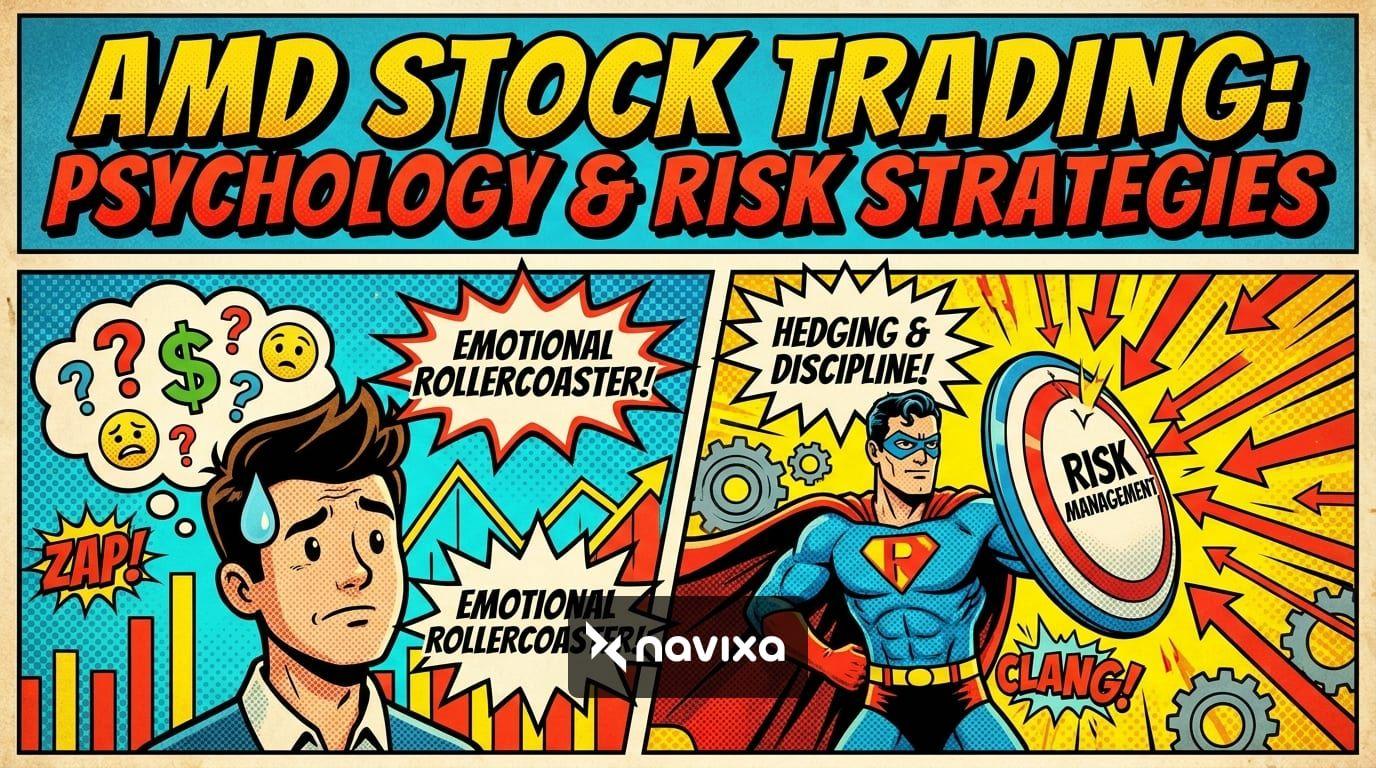
The emotional rollercoaster of trading high-beta semiconductor stocks can quickly derail an unprepared trader. Managing your mental state is just as critical as managing your financial capital. Understanding the psychological traps that plague most traders is the first step toward consistency.
Overcoming FOMO (Fear of Missing Out)
When a stock like AMD gaps up 5% or 6% in a single session—often driven by news of massive data center deployments or an analyst price target upgrade—the urge to market-buy at the top is overwhelming. This Fear of Missing Out (FOMO) is a primary reason retail traders suffer severe drawdowns.
To effectively combat FOMO: * Trust Your Pre-Defined Setup: Only enter a trade if AMD's price action directly aligns with your predetermined technical criteria (e.g., bouncing off the 50-day moving average or breaking out of a bull flag). * Accept Missed Moves: The stock market will open again tomorrow. Missing a 10% rally is mathematically better than buying the local top and suffering an immediate 15% drawdown.
Dealing with Earnings Anxiety
Technology sector earnings are notorious for crushing options premium and causing violent price gaps. For example, AMD's quarterly revenue targets and forward-looking guidance regarding its data center franchise heavily dictate short-term market sentiment. Holding short-term, unhedged positions through an earnings print is effectively gambling. Professional traders manage this anxiety by actively scaling out of positions before the report or utilizing specialized options strategies to define their absolute maximum risk.
The Danger of Revenge Trading
A common psychological trap when trading high-volatility stocks like AMD is revenge trading. If you get stopped out of an AMD long position due to a sudden intraday dip, the immediate emotional response might be to double down and buy back in at a lower price to "win back" your lost capital. This abandons all risk parameters and often results in compounding losses. A professional trader accepts the stop-out as an operational cost of doing business and patiently waits for the next high-probability setup to emerge.
Key Technical Indicators for AMD Stock Trading
While fundamental analysis tells you *what* to buy, technical analysis dictates *when* to execute the trade. Integrating the right momentum and volume indicators is critical for trading AMD successfully.
Moving Averages as Dynamic Support
For trend-following strategies, moving averages are indispensable tools. AMD frequently interacts with its core Simple Moving Averages (SMA). * The 20-Day SMA: Often acts as a mean-reversion baseline during aggressive AI rallies. Day traders and short-term swing traders watch this dynamic level closely. * The 50-Day SMA: Represents the medium-term market trend. A high-volume bounce off the 50-day SMA is historically considered a strong buy signal for swing traders. * The 200-Day SMA: The ultimate barometer for long-term momentum. Institutional buyers often step in when AMD approaches this macroeconomic trendline during broader market corrections.
Relative Strength Index (RSI) and Momentum
Because AMD can become highly overbought during periods of AI market exuberance, the RSI is a vital tool. An RSI reading above 70 indicates the stock may be overextended, signaling traders to tighten their trailing stop-losses or trim positions. Conversely, an RSI below 30 often precedes a technical relief rally, providing an entry window for contrarian traders.
Volume Profile and Institutional Footprints
Price moves without volume are often traps designed to lure in retail liquidity. Traders must look for high relative volume to confirm major breakouts. Using Volume Profile tools allows traders to identify specific pricing "nodes" where heavy institutional accumulation occurred. When AMD breaks through overhead resistance on double its average daily volume, it strongly signals that large institutional players are aggressively building their positions.
Core Risk Management Strategies
Risk management is the defensive shield that keeps you in the market long enough to capitalize on your winning streaks.
Position Sizing and Capital Allocation
The golden rule of trading is to never risk more than 1% to 2% of your total trading equity on a single setup. If your overall account size is $50,000, your maximum risk per AMD trade should be strictly between $500 and $1,000. This figure refers to the mathematical distance between your exact entry price and your hard stop-loss, not the total cost of the shares purchased. By utilizing strict position sizing, you ensure that a sudden semiconductor sector sell-off won't devastate your portfolio's long-term compounding ability.
Strategic Stop-Loss Placement
High-growth technology stocks require significant breathing room to perform. Placing a stop-loss too tight on AMD will almost certainly result in being "wicked out" by normal intraday market noise. Traders should purposefully place stops directly below key structural levels, such as a major volume node, a moving average, or a recent swing low.
Additionally, utilizing trailing stops allows you to lock in compounding profits during a runaway AI rally while simultaneously protecting your downside if the macroeconomic trend suddenly reverses.
AMD Trading Strategies Comparison
Different psychological profiles naturally suit different trading methodologies. Here is a breakdown of common approaches to navigating AMD's unique price action:
| Strategy | Ideal For | Risk Level | Average Holding Period |
|---|---|---|---|
| Day Trading | High-frequency, active screen monitors | Very High | Minutes to Hours |
| Swing Trading | Technical and trend followers | Medium-High | Days to Weeks |
| Options Hedging | Advanced volatility traders | Medium | Weeks to Months |
| Buy and Hold | Conviction-driven, long-term investors | Low-Medium | Years |
Advanced Risk Management: Options Hedging
For traders who want exposure to AMD's upside potential but want to strictly limit their downside risk, the options market provides excellent utility and strategic leverage.
Protective Puts
If you are currently long a substantial amount of AMD shares and fear an upcoming inflation data release or an unconfirmed rumor about chip supply constraints, purchasing protective puts acts as a direct insurance policy. For a small premium, you establish a firm floor on your maximum loss, allowing you to hold the underlying shares through the volatility without triggering a psychological panic-sell.
Covered Calls
Traders holding 100 or more shares of AMD can sell out-of-the-money covered calls to generate passive income. While this strategy essentially caps the upside potential if AMD surges parabolically, it effectively lowers the cost basis of the overall position and provides a cash buffer during flat or slightly bearish market periods.
Fundamental Drivers to Watch
Even pure technical day traders must keep a watchful eye on the fundamental backdrop that drives institutional trading volume. For AMD, the primary catalysts include:
1. AI Market Share: AMD's operational ability to capture double-digit market share in the AI inference and training space is highly critical. Their execution against competitors directly dictates much of their forward price-to-earnings multiple. 2. Data Center Revenue: Server CPU momentum (specifically EPYC processors) and massive enterprise cloud deployments are the true backbone of AMD's cash flow generation. 3. Macro Semiconductor Trends: Always pay attention to global memory pricing constraints (like HBM availability) and custom silicon production demands.
To stay constantly updated, active traders should frequently review official materials from AMD Investor Relations and diligently track institutional filings via the SEC EDGAR database.
Practical Takeaways for Traders
To properly synthesize psychology and risk management into an actionable daily routine, consider implementing the following habits:
* Pre-Market Preparation: Always identify key support and resistance levels before the opening bell rings. Know exactly where you will enter, where you will take profit, and where you will exit if the trade fails. * Trading Journal: Meticulously record every trade you take, including your explicit emotional state at the time of entry. This practice helps identify toxic psychological patterns over time. * Scale Out of Winners: When AMD experiences a rapid impulse move in your favor, intelligently sell a portion of your position to secure realized profits and move your remaining stop-loss to breakeven.
Conclusion
Mastering AMD stock trading requires significantly more than a rudimentary understanding of supply and demand economics. As the company relentlessly continues to battle for global dominance in the trillion-dollar compute and AI accelerator market, the stock will undoubtedly remain a high-beta battleground. By proactively conquering emotional biases like FOMO and strictly enforcing risk management protocols like proper position sizing, traders can survive the immense volatility and thrive in the semiconductor supercycle. Take control of your mindset today, and let rigid discipline drive your trading success.
Frequently Asked Questions
Why is AMD stock so volatile compared to the broader market?
AMD operates within the semiconductor industry, which is highly cyclical and currently undergoing a massive structural shift due to the rapid adoption of artificial intelligence. High capital expenditures by hyperscalers, rapid technological advancements, and intense hardware competition make AMD highly sensitive to forward-looking guidance, leading to consistently wide price swings.
How much of my portfolio should I allocate to AMD?
For active trading, it is universally recommended by professionals to risk no more than 1% to 2% of your total account equity on any single trade setup. For long-term investing, allocation depends heavily on your overall risk tolerance, but tech-heavy single stocks should generally not exceed 5% to 10% of a fully diversified portfolio.
What drives the price of AMD stock the most?
Currently, the most significant overarching driver of AMD's valuation is its Data Center segment, specifically the global sales and adoption of its AI accelerators (like the MI300 and the upcoming MI450/MI500 series) alongside its EPYC server CPUs. Market share gains in the AI infrastructure space heavily influence institutional buying patterns.
Should I hold AMD stock through an earnings report?
Holding short-term directional trading positions through an earnings report is highly risky due to the unpredictable nature of implied volatility crushes and aggressive post-earnings price gaps. Active traders often close or significantly reduce their positions before the print, or utilize specific options strategies to define their maximum risk, whereas long-term investors may choose to weather the turbulence.