
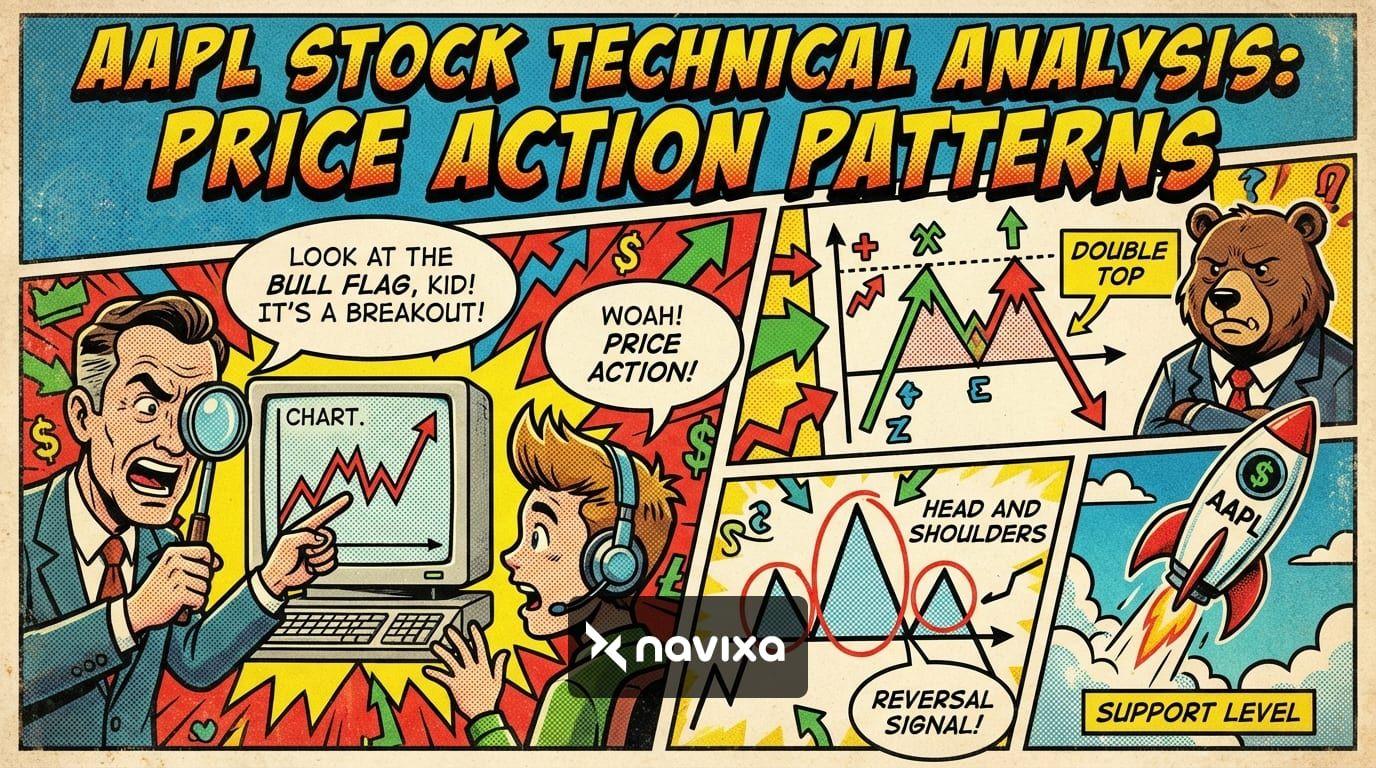
Apple Inc. (AAPL) stands as a titan in the global financial markets. Due to its massive market capitalization, high daily trading volume, and widespread institutional ownership, the stock exhibits highly structured and reliable price movements. For traders and investors alike, mastering AAPL stock technical analysis is a crucial step toward navigating market volatility and optimizing entry and exit points. By understanding historical price action, recognizing chart patterns, and utilizing momentum indicators, market participants can decode the complex narratives driven by Apple's product cycles, regulatory hurdles, and macroeconomic shifts.
Whether you are a day trader looking to capitalize on intraday volatility or a swing trader aiming to ride medium-term trends, learning how to read Apple's price charts can provide a significant edge. This comprehensive guide explores the essential components of AAPL stock technical analysis, focusing on fundamental indicators, distinct price action patterns, and actionable strategies tailored for this tech behemoth.
Understanding AAPL Price Action and Market Context
Price action trading involves analyzing a stock's historical price movements to predict future trends, stripping away the noise of news feeds and focusing strictly on what the market is doing. Apple's stock is highly liquid, frequently trading over 40 to 60 million shares daily. This immense liquidity ensures that technical levels—such as support, resistance, and moving averages—are rigorously tested and widely respected by automated trading algorithms and institutional investors.
Currently, AAPL's price action often reflects a battle between its long-term growth narrative (such as the integration of AI capabilities via partnerships like Google Gemini) and short-term headwinds (such as engineering challenges regarding foldable devices or shifting App Store revenues). For instance, analyzing the stock's recent consolidation ranges reveals critical support floors, such as the widely monitored $245 level, which has served as a psychological and technical bedrock for buyers.
"Price action is the footprint of smart money. By studying how a stock reacts at critical support and resistance levels, traders can align themselves with institutional momentum."
Why Technical Analysis Works for Apple
Unlike smaller, illiquid equities, AAPL is less susceptible to random, unexplainable price spikes. Its movements are generally methodical. Technical analysis works exceptionally well for Apple because millions of market participants are watching the exact same indicators. When Apple approaches its 200-day moving average or nears a 52-week high (historically testing levels near $288), the collective reaction of buyers and sellers often fulfills the predictions of technical chart patterns.
Key Technical Indicators for AAPL Stock
To conduct a thorough AAPL stock technical analysis, traders must combine trend-following indicators with momentum oscillators. This dual approach helps confirm signals and prevents false breakouts.
Moving Averages (50-Day vs. 200-Day)
Moving averages smooth out price data to identify the broader trend direction. For AAPL, the two most critical moving averages are:
* The 50-Day Moving Average (MA): This indicator acts as a proxy for the medium-term trend. When AAPL trades above its 50-day MA, it typically indicates bullish sentiment driven by recent positive earnings or product announcements. Conversely, falling below this level signals near-term weakness. * The 200-Day Moving Average (MA): This is the ultimate barometer for Apple's long-term health. Currently hovering near the $248 mark, the 200-day MA is a crucial line in the sand. Institutional investors heavily defend this level. A sustained break below the 200-day MA can trigger algorithmic selling, while a bounce off this line often creates an optimal buying opportunity.
RSI and MACD Dynamics
Momentum oscillators help traders understand whether Apple is overbought (due for a pullback) or oversold (due for a bounce).
* Relative Strength Index (RSI): The RSI measures the speed and change of price movements on a scale of 0 to 100. When AAPL's RSI drops below 30, it is historically oversold, often preceding a relief rally. When it exceeds 70, the stock may be overextended, warning traders to tighten stop-losses. Often, AAPL's RSI hovers in the neutral 50-zone during consolidation periods. * Moving Average Convergence Divergence (MACD): The MACD shows the relationship between two moving averages of a security's price. A bullish MACD crossover—when the MACD line crosses above the signal line—often precedes a strong upward push in Apple's stock price, especially if it occurs below the zero line.
Chart Patterns to Watch
Identifying structural patterns is a cornerstone of AAPL stock technical analysis. These formations provide visual representations of market psychology.
The Double Bottom Pattern
A double bottom resembles the letter "W" and indicates a major reversal from a downtrend to an uptrend. For example, when Apple's stock tests a strong support zone—such as the $245 to $248 range—bounces, retraces to test it again, and holds, it forms a double bottom. This pattern suggests that sellers have exhausted their supply, and buyers are stepping in aggressively to defend the valuation.
Consolidation and Breakouts
Apple frequently enters periods of consolidation, forming symmetrical triangles or bullish flags on the daily chart. During these phases, trading volume typically dries up. A breakout occurs when AAPL surges past its resistance line on above-average volume (e.g., trading over 60 million shares). Traders look for these high-volume breakouts to initiate long positions, targeting the next historical resistance level or all-time highs.
Comparing Essential Trading Indicators
To effectively trade AAPL, it is helpful to understand how different indicators interact. The table below outlines the primary indicators used in AAPL stock technical analysis and their ideal setups.
| Indicator | Purpose | Ideal AAPL Setup |
|---|---|---|
| Relative Strength Index (RSI) | Measures momentum & overbought/oversold levels | Buy near 30 (Oversold), Sell near 70 (Overbought) |
| Moving Average Convergence (MACD) | Identifies trend direction & momentum shifts | Bullish crossover below the zero line |
| 50-Day Moving Average | Tracks medium-term price trends | Price breaking above 50-day MA indicates strength |
| 200-Day Moving Average | Determines long-term macro trend | Strong support level during market corrections |
| Bollinger Bands | Measures volatility and potential breakouts | Price bouncing off the lower band for mean reversion |
Actionable Trading Strategies
Armed with an understanding of indicators and patterns, you can implement structured trading strategies. For further foundational knowledge, you may want to consult Investopedia's guide on Technical Analysis.
1. The Moving Average Pullback Strategy
Because AAPL is a fundamentally strong company, buying the dip during an established uptrend is highly effective. If Apple is trading well above its 200-day MA but experiences a short-term sell-off due to macroeconomic noise, traders will place buy limit orders near the 50-day or 100-day MA. The goal is to catch the rebound as the overarching uptrend resumes.
2. The Support and Resistance Range Trade
When AAPL lacks a clear directional catalyst, it often trades in a defined channel (e.g., fluctuating between $245 support and $260 resistance). Range traders buy near the support floor and sell covered calls or take profits near the resistance ceiling. This strategy requires strict discipline to cut losses if the support level breaks on high volume.
3. The Breakout Strategy
Traders using advanced charting platforms like TradingView often set alerts for key resistance breakouts. If AAPL breaks above a major consolidation zone, traders will buy the stock while simultaneously placing a stop-loss just below the breakout level. This ensures participation in the new trend while capping downside risk.
Risk Management in AAPL Trading
Even the most meticulously crafted AAPL stock technical analysis can be derailed by unexpected news, such as a sudden shift in tech regulations or an earnings miss. Therefore, strict risk management is non-negotiable.
* Position Sizing: Never risk more than 1% to 2% of your total account equity on a single AAPL trade. This rule ensures that a sudden gap-down in price will not devastate your portfolio. * Stop-Loss Orders: Always define your exit point before entering a trade. If you buy AAPL on a bounce off the $245 support level, a logical stop-loss might be placed at $242. If the price hits that level, the technical thesis is invalidated, and it is time to exit. * Monitor Fundamental Catalysts: Technical analysis does not operate in a vacuum. Keep an eye on Apple's quarterly earnings dates, product launch events, and global supply chain news, as these events can cause erratic price spikes that bypass technical levels. You can track official announcements via Apple Investor Relations.
Practical Takeaways
* Respect the MAs: The 50-day and 200-day moving averages are essential roadmaps for AAPL's price action. * Wait for Confirmation: Don't front-run a breakout. Wait for a daily candle to close above resistance on high volume before committing capital. * Use RSI for Context: Avoid initiating heavy long positions when AAPL's daily RSI is above 70, as the risk of a near-term pullback is statistically higher. * Watch the Volume: A price move without volume is a trap. High volume confirms institutional participation in a trend.
Conclusion
Mastering AAPL stock technical analysis provides a robust framework for demystifying market fluctuations and making objective, data-driven trading decisions. By identifying key support and resistance zones, interpreting moving averages, and managing risk with clinical precision, traders can consistently navigate Apple's price action. As with any financial instrument, continuous learning and adaptation are required to stay ahead of the curve. Open your charting software, map out AAPL's current technical levels, and start testing these strategies to refine your trading edge today.
Frequently Asked Questions
What timeframe is best for AAPL stock technical analysis?
For day trading, the 5-minute and 15-minute charts are highly effective for catching intraday momentum. For swing traders and long-term investors, the daily and weekly charts provide the most reliable signals for broader market trends.
How do moving averages affect AAPL stock?
Moving averages act as dynamic support and resistance levels. Because millions of algorithms and institutional traders use the 50-day and 200-day moving averages, Apple's stock price often reacts predictably when it intersects with these lines, either bouncing off them or accelerating if they are breached.
Can I use cryptocurrency trading strategies on Apple stock?
Yes, many technical analysis concepts used in cryptocurrency trading—such as RSI, MACD, Fibonacci retracements, and price action patterns—apply perfectly to Apple stock. However, AAPL generally exhibits lower volatility and is heavily influenced by quarterly earnings and traditional macroeconomic data compared to the crypto market.
Why is the $245 support level critical for AAPL?
Historically, strong psychological and technical support levels form when a stock repeatedly bounces off a specific price point over several months. For AAPL, the mid-$240s region has recently acted as a heavy demand zone where institutional buyers step in, making it a critical line of defense against broader market sell-offs.