
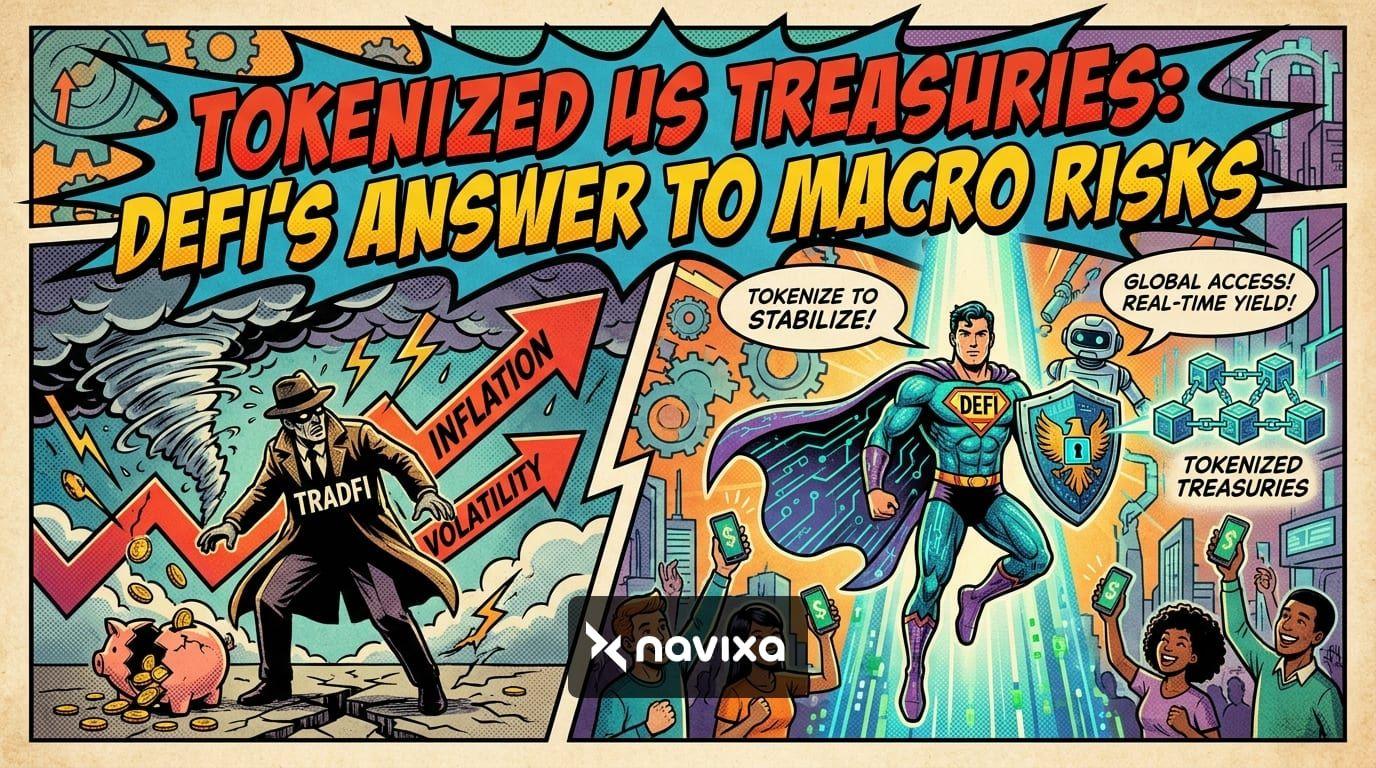
The world of decentralized finance (DeFi) is undergoing a silent but irreversible revolution. For years, the foundation of DeFi liquidity relied almost exclusively on zero-yield stablecoins. However, as shifting monetary policies and macroeconomic headwinds introduce unprecedented volatility, both institutional and retail capital are seeking safer harbors. Enter tokenized US treasuries, the bridge between the ironclad stability of traditional finance (TradFi) and the frictionless composability of the blockchain.
By digitizing government debt, decentralized finance protocols are effectively importing the traditional "risk-free rate" onto the blockchain. This innovation allows traders and investors to earn a predictable yield on their idle capital without sacrificing the ability to deploy those assets across decentralized applications. In a landscape historically driven by speculative excess, the integration of real-world assets (RWAs) is maturing the market, offering a pragmatic answer to enduring macro risks.
The Explosive Growth of Tokenized US Treasuries
The tokenization of government debt is no longer a fringe experiment; it has rapidly evolved into an institutional cornerstone. In early 2024, the total market capitalization for tokenized government debt was a mere fraction of what it is today. Propelled by sustained institutional entry and retail demand for stable, yield-bearing assets, the sector has exploded to nearly $14 billion in total value.
This staggering growth places tokenized US treasuries at the absolute forefront of the broader RWA ecosystem. When broader crypto markets face downward pressure or sideways consolidation, capital naturally flows toward safety. Stablecoins solve the volatility problem, but they fail to compensate investors for the time value of money. As global interest rates hover in ranges that make cash actively profitable, holding unyielding tokens has become economically irrational.
Powerhouses of traditional finance have recognized this shift. Asset managers are aggressively deploying blockchain-native funds to capture market share. Products like BlackRock's BUIDL and Franklin Templeton's BENJI are competing directly with crypto-native solutions like Circle's USYC and Ondo Finance's USDY. This competition not only legitimizes the sector but aggressively accelerates the development of secure, scalable infrastructure across multiple blockchain networks.
How Tokenized Treasuries Counter Macro Risks
Macroeconomic risks—ranging from inflationary spikes to unexpected central bank policy shifts—can wreak havoc on traditional crypto portfolios. Here is how tokenized U.S. debt provides a strategic counterweight.
Providing a True Risk-Free Rate On-Chain
In traditional finance, U.S. government debt is universally regarded as the "risk-free rate" because it is backed by the full faith and credit of the United States. Historically, DeFi participants had to accept significant smart contract risks and protocol vulnerabilities to earn comparable yields through automated market makers (AMMs) or lending protocols.
Today, tokenized US treasuries provide a mathematically sound baseline return. By holding tokens backed by short-term T-bills, investors can offset the corrosive effects of inflation on their portfolio's cash allocation. This baseline yield acts as a shock absorber during periods of acute market distress.
Replacing Zero-Yield Foundations
For years, traders parked their collateral in standard stablecoins during bear markets. While this protected the principal from downside price action, the capital remained entirely unproductive. The opportunity cost of holding zero-yield assets becomes glaringly apparent when fiat interest rates remain elevated.
Tokenized treasuries are actively replacing these zero-yield foundations. Because these assets are composable, they can be utilized as collateral across various DeFi platforms. Traders can now earn a baseline 3% to 5% annual percentage yield (APY) on their idle collateral while simultaneously using that same capital to underwrite derivatives positions or secure margin loans.
"The shift from zero-yield stablecoins to tokenized government debt represents one of the most significant structural upgrades in the history of decentralized finance."
Integrating Tokenized Treasuries into Your Trading Strategy
Understanding the macro implications is only half the battle; implementing them into a cohesive trading strategy is where true alpha is generated. Here is how advanced traders are leveraging these assets.
Yield-Bearing Collateral for Derivatives
Historically, trading perpetual futures or options on-chain required depositing standard stablecoins or volatile crypto assets as margin. By substituting traditional stablecoins with tokenized US treasuries, traders fundamentally alter the math of their portfolio.
If a trader deposits $100,000 in tokenized treasuries as collateral on a decentralized derivatives exchange, that capital is continuously accruing interest in the background. Even if the trader's active trading strategy breaks exactly even for the year, the portfolio still grows by the yield generated from the underlying government debt. This "yield-stacking" approach dramatically improves the risk-adjusted returns of delta-neutral strategies.
Actionable Steps for Crypto Investors
1. Evaluate Your Idle Capital: Review your crypto portfolio and calculate the percentage of assets currently sitting in non-yielding stablecoins. 2. Choose the Right Asset: Determine your eligibility. Retail investors might gravitate toward accessible options like Franklin Templeton's BENJI or Ondo's USDY, whereas qualified institutions may prefer the bespoke structuring of BlackRock's BUIDL or Circle's USYC. 3. Understand the Mechanics: Research whether your chosen asset is an *accruing* token (where the token's price increases as interest is earned) or a *rebasing* token (where the token's price remains pegged at $1, but your wallet balance increases). 4. Deploy as Collateral: Look for DeFi lending markets or decentralized perpetual exchanges that explicitly accept your chosen tokenized treasury asset as approved collateral.
To gain deeper insights into the mechanics of traditional government debt, investors can consult resources provided by the U.S. Department of the Treasury. Additionally, keeping an eye on aggregate RWA data via platforms like RWA.xyz is crucial for monitoring on-chain liquidity trends.
Technical Analysis of RWA Market Dynamics
The technical underpinnings of the tokenized treasury market reveal a rapidly maturing multi-chain ecosystem. While Ethereum initially dominated the space due to its vast DeFi liquidity and battle-tested security, the landscape is violently diversifying. Networks like BNB Chain, Stellar, and Solana are capturing massive market share by offering faster settlement times and near-zero transaction fees—critical features for institutional market makers managing high-frequency collateral flows.
Furthermore, analyzing holder distribution provides vital clues about market health. Unlike the speculative fervor that drives retail-heavy altcoins, the tokenized treasury sector is heavily dominated by smart money and institutional whales. High minimum investment thresholds for top-tier funds mean that the capital injected into this space is "sticky." It does not flee during minor crypto market corrections, providing a stabilizing anchor for the overall blockchain economy.
Platform Comparison: Leading Treasury Protocols
The market features a diverse array of issuers, each targeting different segments of the global financial system. Below is a comparative look at the heavyweights currently dominating the space.
| Provider | Product Ticker | Target Audience | Market Capitalization |
|---|---|---|---|
| Circle | USYC | Non-US Institutions | ~$2.67 Billion |
| BlackRock | BUIDL | US Qualified Purchasers | ~$2.42 Billion |
| Ondo Finance | USDY | Broad / Retail | ~$1.88 Billion |
| Janus Henderson | JTRSY | Institutions | ~$1.32 Billion |
| Franklin Templeton | BENJI | Retail & Institutions | ~$1.02 Billion |
Risk Management and Considerations
While tokenized US treasuries are colloquially referred to as "risk-free," this designation only applies to the underlying sovereign debt. The process of tokenization introduces several new risk vectors that traders must actively manage.
Counterparty and Custodial Risk
Unlike purely decentralized assets like Bitcoin, tokenized RWAs require centralized entities to hold the physical assets in traditional brokerage accounts or special purpose vehicles (SPVs). If the custodian faces insolvency, or if the asset manager mismanages the fund, the on-chain tokens could become unbacked or frozen.
Smart Contract Vulnerabilities
The tokens themselves are governed by code. Any bug or exploit in the smart contract bridging the real-world asset to the blockchain could lead to a catastrophic loss of funds. Investors must ensure they are interacting with heavily audited protocols.
Regulatory Compliance
The regulatory landscape surrounding tokenized securities is still taking shape. Because these tokens represent ownership or claims on regulated financial instruments, they are subject to strict securities laws. A sudden regulatory crackdown or change in compliance requirements could severely impact liquidity and the ability to seamlessly transfer these assets on public blockchains.
Practical Takeaways
* The Ultimate Hedge: Tokenized US treasuries provide a reliable, yield-bearing alternative to zero-yield stablecoins, acting as a direct hedge against macroeconomic volatility and inflation. * Capital Efficiency: By utilizing these assets as collateral in DeFi protocols, traders can unlock unprecedented capital efficiency, earning passive interest while executing active trading strategies. * Institutional Dominance: The sector's explosive growth to nearly $14 billion is largely driven by institutional behemoths like BlackRock, Circle, and Franklin Templeton, signaling long-term market viability. * Ecosystem Diversity: There is no one-size-fits-all solution. Depending on geographic location, capital size, and risk tolerance, investors have a wide range of products to choose from.
Conclusion
The integration of tokenized US treasuries into decentralized finance marks a pivotal maturation point for the cryptocurrency industry. By bridging the undeniable stability of sovereign debt with the borderless, 24/7 efficiency of blockchain technology, the market has finally engineered a robust defense against macroeconomic uncertainty.
As global financial systems become increasingly intertwined, the lines between TradFi and DeFi will continue to blur. For the modern trader, adapting to this new reality is no longer optional. Reevaluating your portfolio's cash position and exploring the strategic deployment of yield-bearing real-world assets could be the deciding factor in navigating the next major macroeconomic cycle.
Frequently Asked Questions
What are tokenized US treasuries?
Tokenized US treasuries are digital representations of United States government debt, such as short-term Treasury bills, issued on a blockchain. They allow investors to gain exposure to the traditional "risk-free rate" while benefiting from the speed, transparency, and composability of decentralized finance.
How do I earn yield from these tokens?
Depending on the specific protocol, the yield is distributed in different ways. Some tokens are *accruing*, meaning the price of the token steadily rises as the underlying assets generate interest. Others are *rebasing*, where the token price remains pegged to $1, but the quantity of tokens in your wallet automatically increases over time.
Can anyone buy tokenized treasuries?
Not necessarily. Due to strict securities regulations, many of the largest funds restrict access to accredited investors or qualified purchasers and require massive minimum deposits. However, other platforms like Ondo Finance and Franklin Templeton offer products that are significantly more accessible to retail investors.
Are tokenized treasuries safer than stablecoins?
They offer a different risk profile. While fiat-backed stablecoins generally do not fluctuate in value, they also do not pay interest, meaning they lose purchasing power to inflation. Tokenized treasuries pay interest that helps combat inflation. However, they carry additional regulatory and custodial risks because they are classified as securities.
Why use tokenized treasuries instead of traditional brokerage accounts?
The primary advantage is blockchain composability. Unlike treasuries held in a traditional brokerage account, tokenized versions can be instantly transferred 24/7 across borders and natively used as collateral in DeFi lending and derivatives markets, drastically improving a trader's overall capital efficiency.