

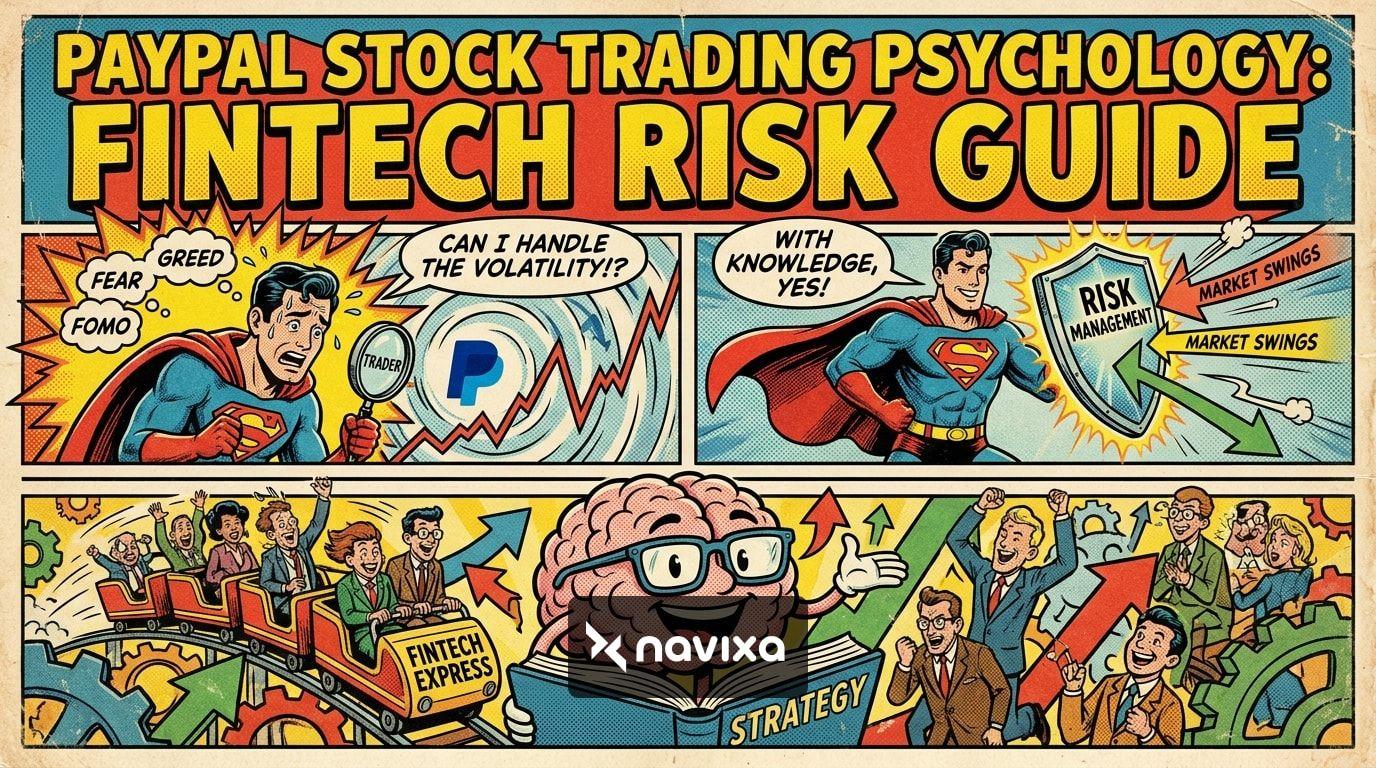
The financial landscape of mid-2026 is an unforgiving arena. With Bitcoin comfortably trading above $81,000 and total cryptocurrency market capitalization soaring near $2.8 trillion, traditional fintech stocks find themselves caught in a tug-of-war between legacy operations and Web3 innovation. In this volatile environment, mastering PayPal stock trading psychology is paramount for survival and profitability. Despite the company beating its Q1 2026 earnings estimates with $8.4 billion in revenue and an adjusted EPS of $1.34, PYPL shares experienced a jarring 10% pullback due to softer-than-expected forward guidance.
Navigating this cognitive dissonance—where good fundamental news is met with punishing price action—requires a resilient mindset. The emotional whiplash of holding a "turnaround" asset can lead to disastrous portfolio decisions if not properly managed.
- Controlling your emotional responses to PayPal's post-earnings volatility is essential for long-term fintech investing.
- Anchoring bias traps many traders into believing PYPL will rapidly return to its pandemic-era all-time highs.
- The expansion of PayPal USD (PYUSD) into 70 global markets introduces new fundamental catalysts to the stock's valuation.
- Utilizing disciplined dollar-cost averaging helps mitigate the psychological stress of catching a falling knife in the market.

The Realities of Fintech Volatility in 2026
To understand the psychology behind trading PayPal, we must first look at the objective data shaping market sentiment. In early May 2026, under the leadership of CEO Enrique Lores, PayPal attempted to shift its narrative toward accelerated growth and disciplined execution. However, Wall Street is a forward-looking mechanism. When management projected a high-single-digit decline in adjusted EPS for Q2 2026, the market aggressively repriced the stock, sending it down to the mid-$40 range.
This type of price action breeds frustration among retail investors. Why does a stock drop when it beats current estimates? The answer lies in institutional expectations. Traders who do not understand this forward-weighting mechanism often fall victim to revenge trading—attempting to buy aggressive dips without a coherent risk management plan, only to be stopped out as the downtrend continues. As the classic market wisdom reminds us:
"The stock market is a device for transferring money from the impatient to the patient."
Avoid revenge trading immediately following a negative earnings reaction. The initial days after a massive sell-off are characterized by high implied volatility and institutional repositioning, making it a dangerous environment for impulsive retail entries.
Market Analysis & Trading Psychology
When analyzing a distressed asset like PayPal, psychological biases often override technical and fundamental analysis. The most pervasive trap for PYPL traders is the *anchoring effect*. Because PayPal previously traded above $300 in 2021, the human brain anchors to this historical valuation, making $45 seem like a "guaranteed bargain." This logical fallacy ignores the reality of shrinking transaction margins and rising competition from decentralized finance (DeFi) networks and rival payment apps.
Just as you must learn to master SBUX stock trading psychology to deal with consumer sentiment swings and cyclical spending, trading PayPal requires accepting the company's current reality rather than its past glory. A turnaround play is inherently uncertain. The psychological framework required for this involves accepting lower short-term probabilities of outsized growth and focusing instead on value accumulation and margin stabilization.
Traders also suffer from *confirmation bias*, selectively seeking out bullish news—like PayPal's aggressive share repurchase programs or favorable TipRanks analyst ratings—while completely ignoring the competitive threats eating away at market share. By actively recognizing these biases, you can detach emotionally from the ticker and execute trades based on current data, not hopeful nostalgia.
The PYUSD Factor and Crypto Synergy
While the traditional payment processing side of PayPal faces margin compression, the company's Web3 initiatives provide a fascinating psychological catalyst. As of Q1 2026, PayPal USD (PYUSD) expanded to 70 global markets, achieving a massive market capitalization of $4.09 billion. This stablecoin, deployed natively on Ethereum and Solana, represents a critical bridge between traditional finance and the $2.7 trillion cryptocurrency ecosystem.

Understanding how PYUSD adoption affects PayPal stock requires a hybrid mindset. Traders must evaluate both the equity metrics of a mature tech company and the fast-paced network effects of a crypto asset. With Bitcoin's dominance at 58.66% and top altcoins like Solana moving significant volume, PYUSD's success in capturing remittance and DeFi market share is vital.
If you are exploring how broader macroeconomic forces affect digital assets, analyzing the GDP impact on crypto trading can provide an excellent framework. Similar macroeconomic indicators—such as interest rates, inflation, and global liquidity—directly influence both cryptocurrency valuations and PayPal's cross-border payment volumes. The trader who synthesizes these two worlds gains a distinct psychological advantage over the pure equity trader who ignores blockchain integration.
Strategies for Managing Portfolio Risk
Your conviction in a trade means nothing without proper execution and risk control. Many investors experience deep anxiety holding PayPal stock simply because their position size is too large for their account. The key to mastering your trading psychology is implementing systematic frameworks that remove decision fatigue.
Dollar-Cost Averaging (DCA) in Turnarounds
When trying to capture value in a stock experiencing a prolonged downtrend, precision bottom-picking is a fool's errand. Instead, implementing a structured Dollar-Cost Averaging (DCA) system allows you to build a position incrementally. This strategy mechanically overrides the fear of entering a position by spreading the risk over multiple price levels.
For investors who want to systemize their accumulation phase without being tethered to their charts, utilizing a proven smart DCA strategy script can automate entries at statistically optimal support zones. Removing the "trigger pull" anxiety is one of the most effective ways to preserve your mental capital.
Emotional vs. Systematic Trading
How do you know if you are trading PayPal stock emotionally rather than systematically? Let's review a comparison of the two approaches:
| Trading Behavior | Emotional Trading Approach | Systematic Trading Approach |
|---|---|---|
| Entry Motivation | FOMO or the belief that the stock is "too cheap" | Pre-defined technical support and valuation metrics |
| Position Sizing | Going "all-in" to maximize a potential bottom bounce | Scaling in via fractional sizing (e.g., 2% of portfolio) |
| Earnings Reaction | Panic selling on an EPS guidance drop | Holding or adjusting based on predefined stop-loss levels |
| Information Filter | Seeking confirmation bias on social media | Analyzing SEC filings and on-chain PYUSD data |

Navigating Market Volatility: Step-by-Step Execution
Developing a resilient PayPal stock trading psychology requires a step-by-step game plan. Think of it similarly to crafting a robust QCOM stock trading strategy; both require navigating cyclical technology markets, managing earnings volatility, and identifying macro trend shifts.
Here are the actionable steps to execute safely:
1. Define Your Thesis: Are you trading PayPal for a quick technical bounce off the mid-$40s support, or are you investing in the multi-year PYUSD and AI integration turnaround? If your thesis is short-term, your stops must be tight. 2. Determine Capital Allocation: Never allocate more than 5% of your total trading portfolio to a single volatile turnaround play. This strict sizing instantly reduces the psychological burden. 3. Map Out Support Levels: Identify historical liquidity zones. Top platforms like CoinMarketCap for crypto and major stock charting platforms provide the tools necessary to overlay moving averages and volume profiles. 4. Accept the Worst-Case Scenario: Before you click "buy," visualize the stock dropping another 20%. If that scenario causes you panic, your position size is too large. Reduce it until you feel indifferent to short-term fluctuations.
Set price alerts rather than staring at live charts. Checking the PYPL ticker every ten minutes triggers dopamine loops and increases the likelihood of premature emotional exits. Let the market come to your predefined levels.
Practical Takeaways for the Fintech Trader
The intersection of legacy payments and blockchain innovation is messy. PayPal's transition from an e-commerce checkout button to a global stablecoin issuer and AI-driven platform will not happen overnight. The traders who profit from this transition will be those who manage their minds as strictly as they manage their money.
* Acknowledge the Data: Trust the numbers—like the $4.09 billion PYUSD market cap and the 9% projected Q2 EPS decline—over the sensational headlines. * Neutralize Biases: Recognize when you are anchoring to outdated price targets. * Systematize Execution: Use automation and DCA tactics to remove the emotional friction of buying into weakness.

Conclusion: Mastering the Mindset
Mastering PayPal stock trading psychology is ultimately an exercise in self-awareness. The market does not care about your entry price or your expectations. In 2026, fintech is a battleground of intense competition, shifting regulations, and rapid technological advancement. By combining objective market analysis with rigid risk management frameworks, you can navigate the volatility of PayPal stock without compromising your mental equilibrium.
The best traders are not those who predict the future perfectly, but those who manage their emotional reactions when the future surprises them. If you are ready to remove emotion from your execution and adopt a professional, data-driven approach, take the time to explore Navixa strategies designed for modern volatile markets. Building discipline today will protect your capital tomorrow; don't hesitate to start trading with Navixa to refine your edge.
Frequently Asked Questions
Why did PayPal stock drop in 2026 despite beating Q1 earnings?
Although PayPal beat Q1 revenue and EPS estimates, the stock dropped significantly due to soft forward guidance. Management projected a high-single-digit decline in adjusted EPS for the second quarter, which caused institutional investors to reprice the stock based on future growth concerns.
How does PYUSD affect PayPal's stock valuation?
PYUSD, PayPal's stablecoin, acts as a bridge between traditional finance and cryptocurrency. Its expansion to 70 markets and growth to a $4.09 billion market cap provides a new revenue stream and global utility, though it still represents a smaller fraction of the company's total legacy payment volume.
What is the biggest psychological mistake traders make with PayPal?
The most common mistake is the anchoring effect—believing the stock is inherently undervalued at $45 simply because it previously traded over $300 in 2021. This bias causes traders to ignore current structural challenges and shrinking transaction margins.
How can I safely trade a stock in a prolonged downtrend?
Utilizing a Dollar-Cost Averaging (DCA) strategy and maintaining strict position sizing (e.g., limiting exposure to a small percentage of your portfolio) are the best ways to manage risk. This system reduces the psychological stress of trying to time the exact market bottom.