

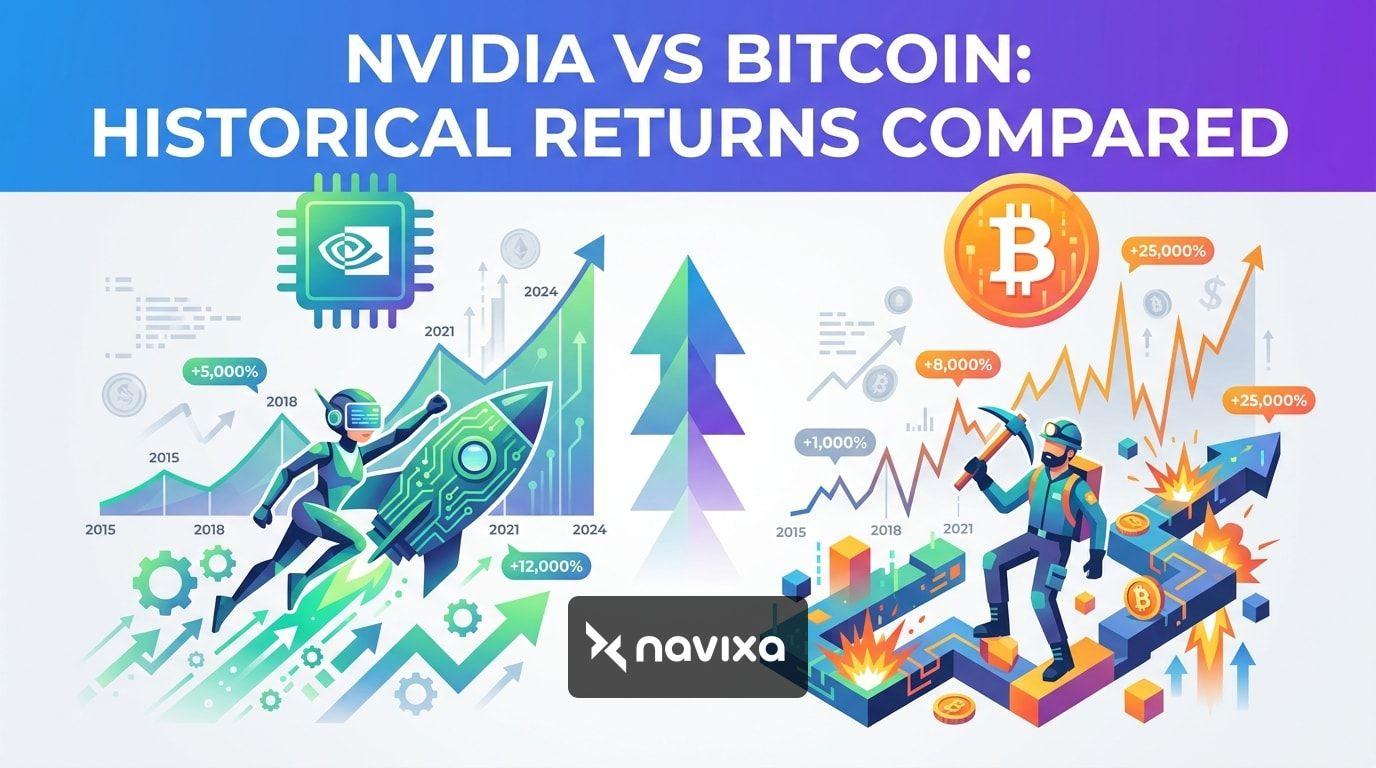
When deciding where to allocate capital in the modern financial landscape, few comparisons are as electrifying as Nvidia stock vs Bitcoin. Over the past half-decade, these two titans have dominated headlines, shattered performance benchmarks, and fundamentally reshaped how we think about wealth generation. Nvidia represents the undeniable engine of the artificial intelligence revolution, while Bitcoin remains the undisputed king of decentralized digital scarcity. But looking beyond the hype, how do their risk profiles and actual returns stack up against one another?
- Nvidia has broadly outperformed Bitcoin on a 5-year rolling basis, driven by unprecedented AI infrastructure demand.
- Bitcoin offers decentralized, absolute scarcity unattached to corporate earnings, protecting against fiat debasement.
- Both assets experience severe volatility, requiring distinct psychological approaches and disciplined risk management.
- Investors often benefit from holding both as uncorrelated pillars of a high-growth portfolio strategy.

The Tale of Two Titans
To understand the dynamic between Nvidia and the world's leading cryptocurrency, we have to examine their distinct market narratives. As of mid-2026, the global crypto market boasts a staggering valuation of over $2.7 trillion, with Bitcoin alone maintaining a market capitalization of roughly $1.58 trillion at a price point hovering around $78,947. While impressive, this massive pool of digital liquidity operates fundamentally differently than traditional corporate equity.
Nvidia, on the other hand, transitioned from a leading graphics processing unit (GPU) manufacturer into the undisputed backbone of the global AI economy. This transformation propelled its market capitalization past legacy giants, making it a multi-trillion-dollar juggernaut. When looking at long-term data, Nvidia has delivered astronomical growth—often exceeding 2,000% over a five-year rolling window—outpacing almost every major asset class in existence. While comparing them directly can feel like comparing apples to oranges, evaluating historic ROI profiles helps investors understand the spectrum of hyper-growth opportunities available today. Both assets have cemented themselves as mandatory considerations for modern institutional portfolios.
Market Analysis & Trading Psychology
Investing in Nvidia is essentially a directional bet on exponential human productivity and corporate dominance. The core psychological anchor for Nvidia investors revolves around quarterly earnings. Every three months, the market holds its collective breath for revenue growth figures, data center sales, and forward-looking guidance. If Nvidia misses a Wall Street expectation by even a fraction, the stock can experience violent short-term pullbacks, severely challenging an investor's conviction.
Conversely, Bitcoin's psychology is rooted in macroeconomic trends, liquidity cycles, and structural supply shocks, such as the widely monitored 2024 halving. News like the U.S. CLARITY Act or shifting institutional adoption rates dictates market sentiment far more than quarterly revenue. You aren't tracking a CEO's operational performance; you are tracking global fiat debasement and network hash rates. Navigating this type of volatility requires a robust, emotionless system, which is why utilizing a smart DCA trend strategy can help smooth out the extreme emotional peaks and valleys associated with accumulating both of these assets.
**Volatility Risk:** Both Nvidia and Bitcoin are prone to sudden, severe drawdowns during macro tightening. Never allocate capital to these high-beta assets that you might need for short-term liquidity, as market sentiment can shift abruptly.
You must build a mindset capable of surviving 30% to 50% drawdowns without panic selling. Unlike traditional value investing compared, where dividends and tangible book value provide psychological safety during bear markets, holding AI and crypto leaders demands an iron stomach and a multi-year time horizon. The psychological toll of holding high-beta growth assets is the price of admission for extraordinary returns.

Comparing Fundamentals and Mechanics
Despite their shared status as top-performing assets, the fundamental mechanics driving their underlying value are entirely distinct. Bitcoin is a decentralized monetary protocol; Nvidia is a centralized, profit-driven corporation.
| Feature | Nvidia (NVDA) | Bitcoin (BTC) |
|---|---|---|
| Asset Class | Corporate Equity (Stock) | Decentralized Cryptocurrency |
| Value Driver | AI Chip Demand, Revenue Growth | Scarcity, Network Adoption, Fiat Hedge |
| Supply Dynamics | Can issue new shares or authorize splits | Capped at exactly 21 million coins |
| Market Correlation | High correlation to tech indices | Historically lower correlation to equities |
| Regulatory Risk | Antitrust probes, hardware export controls | SEC rulings, taxation policies, network bans |
Understanding these structural differences is critical for strategic allocation. While Nvidia's fortunes are inextricably tied to the broader tech sector, measuring historical technology index returns provides a solid baseline for what to expect during traditional equity bull markets. Conversely, Bitcoin thrives in environments where trust in centralized financial institutions wanes, making it a powerful counterbalance when standard corporate equities falter.
Portfolio Construction: Do You Need Both?
The central question isn't necessarily whether to choose Nvidia stock vs Bitcoin, but rather how to optimally size them within a modernized investment portfolio. They serve two distinctly different functions. Nvidia is your ultimate offensive play on the future of compute, robotics, and artificial intelligence. Bitcoin is your defensive play against the gradual erosion of sovereign currency and traditional banking failures.
During market corrections, these assets may not move in tandem. When global liquidity tightens, highly valued tech stocks might suffer heavily due to rising discount rates, while Bitcoin might occasionally see safe-haven inflows—or vice versa depending on the macro catalyst. Implementing structured crypto long-term holding strategies ensures that you capture the long-term upside of digital scarcity without overexposing your entire net worth to systemic tech-sector pullbacks.
**The Institutional Shift:** With traditional financial powerhouses now offering spot Bitcoin ETFs, the historical friction to allocate capital between legacy equities like Nvidia and digital assets like Bitcoin has virtually disappeared.
To manage this complex, high-stakes interplay, many active traders turn to algorithmic automation. By systematically removing human emotion from the equation, you can logically take profits during euphoric market rallies and automatically re-accumulate during structural drawdowns. If you want to optimize your high-growth allocations, it might be time to explore Navixa algorithmic strategies that adapt seamlessly to real-time market volatility.


Conclusion
The ongoing debate over Nvidia stock vs Bitcoin beautifully encapsulates the broader shift in global wealth generation. Over the last five years, Nvidia has largely won the raw percentage-return battle, fueled by a frantic, unprecedented global race to build out the world's AI infrastructure. However, Bitcoin remains absolutely unparalleled as a globally accessible, censorship-resistant store of value that operates outside the purview of corporate governance.
Choosing between them depends heavily on your timeline, risk tolerance, and overarching economic worldview. For the forward-thinking investor, completely ignoring either could mean missing out on the most significant economic catalysts of our generation. The smartest approach is often a well-balanced barbell strategy: owning a piece of the infrastructure that will power tomorrow's machine intelligence, alongside the decentralized digital money that will protect your underlying purchasing power. Ready to take control of your financial future? Take the next step and start automating your trades to build a resilient, future-proof portfolio that thrives in any market condition.
Frequently Asked Questions
Which has higher historical returns, Nvidia or Bitcoin?
Over a recent 5-year rolling timeframe leading up to 2026, Nvidia has broadly outperformed Bitcoin in terms of raw percentage growth, primarily driven by the massive explosion in AI data center demand. However, over a longer 10-to-15-year horizon, Bitcoin's initial rise from virtually zero to over $78,000 remains one of the highest percentage returns in documented financial history.
Is Nvidia inherently safer than Bitcoin?
Nvidia is generally considered a more traditional investment because it is backed by physical assets, massive corporate revenue, and immense institutional support. Bitcoin operates without corporate backing and relies entirely on decentralized consensus and network adoption. While Nvidia faces traditional risks like export controls and supply chain disruptions, Bitcoin faces distinct regulatory and macroeconomic risks.
Can I hold both Nvidia and Bitcoin in a standard brokerage account?
Yes. Investors can easily purchase Nvidia equity through any standard stock brokerage. Following the SEC's approval of spot Bitcoin ETFs in recent years, investors can now also gain direct price exposure to Bitcoin within those exact same traditional brokerage and tax-advantaged retirement accounts.
Are the price movements of Nvidia and Bitcoin correlated?
Historically, they have not been tightly correlated, as they are driven by very different underlying mechanics. However, during periods of massive macroeconomic shifts—such as sudden changes in global liquidity, massive stimulus, or extreme interest rate environments—both assets can experience high volatility and may temporarily move in tandem as investors shift toward or away from broader "risk-on" assets.