
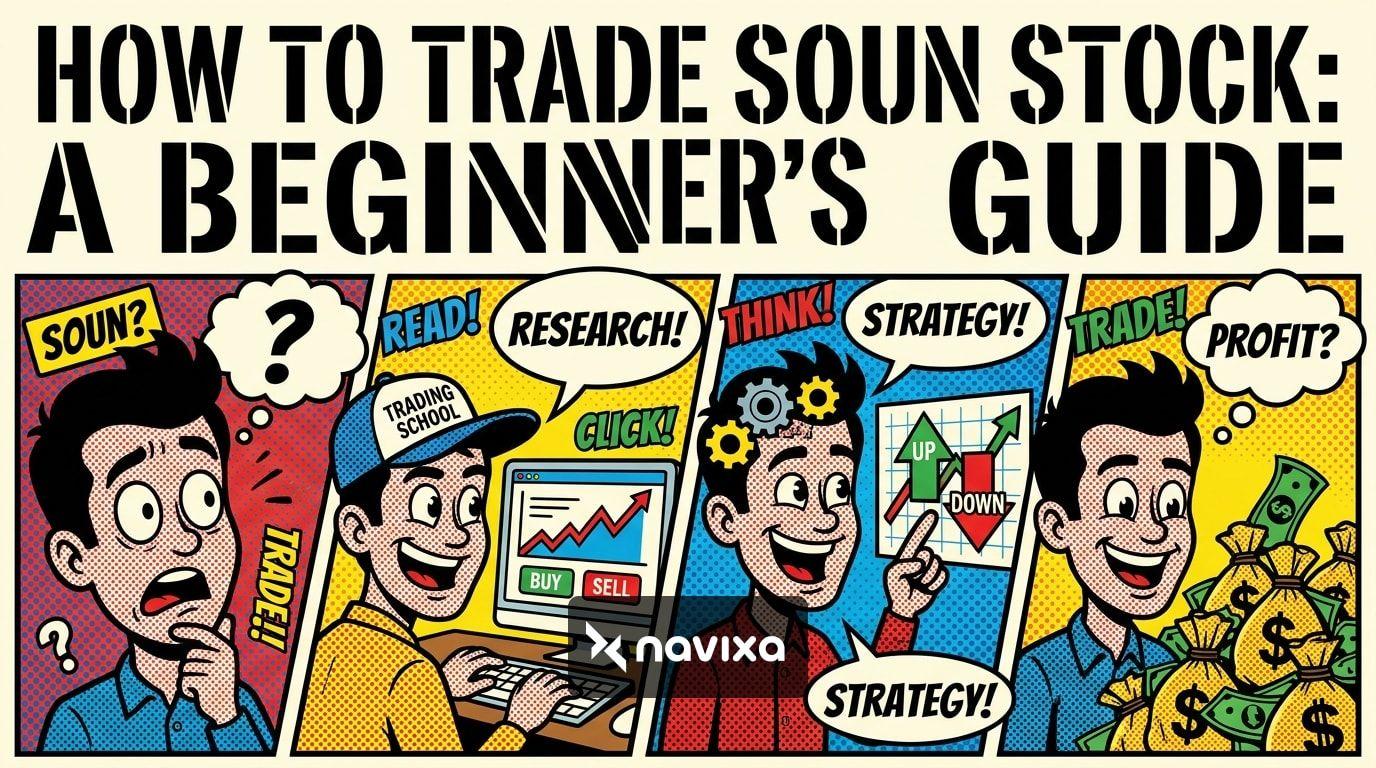
How to Trade SOUN Stock: A Beginner's Guide
Trading artificial intelligence stocks has become one of the most dynamic opportunities in the modern market, and SoundHound AI (NASDAQ: SOUN) is firmly at the center of the action. As a global leader in voice and agentic AI, SoundHound has attracted massive attention from both retail and institutional traders. But high growth potential often comes with significant volatility, making it crucial to approach this asset with a clear, well-defined plan.
Whether you are looking to capitalize on short-term price fluctuations driven by earnings reports or position yourself for a broader artificial intelligence adoption cycle, understanding the mechanics of how to trade SOUN stock is essential.
- SOUN stock is highly volatile, driven by AI sector momentum and high short interest.
- SoundHound's recent Q1 2026 earnings reported 52% year-over-year revenue growth.
- Technical analysis reveals critical support near $9.00 and resistance around $10.50.
- Managing risk is vital due to the stock's high beta and massive retail following.

Understanding SoundHound AI (SOUN): The Fundamentals
Before placing any trades, you must understand the underlying catalysts driving SoundHound's stock price. As of early May 2026, SoundHound AI reported stellar Q1 revenue of $44.2 million, marking a 52% year-over-year increase. The company's growth is heavily fueled by its core automotive and IoT AI vertical, alongside the launch of its OASYS self-learning agentic AI platform.
As CEO Keyvan Mohajer stated during the Q1 2026 earnings call: > "SoundHound started the year strong with our top line growing 52%... highlighting incredible demand across all pillars of our business."
Furthermore, SoundHound recently announced a definitive agreement to acquire LivePerson, a move that analysts expect will push the combined company's revenue potential toward the $500 million mark. Despite this rapid expansion, the company remains unprofitable on a GAAP basis, recording a non-GAAP net loss of $0.06 per share. This mix of high revenue growth and ongoing losses makes SOUN a textbook momentum stock. When assessing companies with similar aggressive scaling phases, trading high-growth tech stocks requires prioritizing revenue trajectory and strategic acquisitions over immediate earnings.
Technical Analysis of SOUN Stock in 2026
To time your entries and exits effectively, technical analysis is non-negotiable. SOUN has historically traded with a high beta of 2.58, meaning its price swings are far more aggressive than the broader market. In 2026, the stock has established a 52-week range between $5.83 and $22.17.
Recent chart patterns show the stock trading above its 20-day and 50-day simple moving averages (SMA), signaling short-term bullish momentum. However, traders must watch two critical levels: 1. Key Support: The $9.00 level has acted as a robust psychological and structural floor. 2. Key Resistance: A breakout above the $10.50 to $11.00 supply zone could trigger significant upward movement, particularly given the stock's massive short interest (roughly 38% of the public float).
If you are accustomed to identifying key technical setups, you will recognize that SOUN is currently forming a consolidation pattern that often precedes a major breakout. You can leverage tools like a price action breakout script to automatically detect wedge and channel formations directly on your trading charts.

Top Strategies for Trading SOUN Stock
Because SOUN operates in the hyper-volatile artificial intelligence sector, different traders will need to apply different strategies based on their time horizons and risk tolerance.
1. The Short Squeeze Play
With short sellers betting heavily against SOUN (over 146 million shares sold short as of May 2026), any unexpected positive news—such as the early closure of the LivePerson acquisition or unexpected margin improvements—can trigger a massive short squeeze. Day traders often monitor Level 2 data and volume spikes to catch these aggressive upward rips.
2. Swing Trading the Range
Swing traders look to capitalize on SOUN's established price channels. Buying near the $9.00 support level and selling into resistance near $10.50 or $12.00 is a classic range-bound strategy. It is essential to use strict stop-losses just below support to protect your capital if the channel breaks downward.
3. Long-Term Accumulation
If you believe in the long-term narrative of voice and agentic AI, you might adopt a dollar-cost averaging (DCA) strategy. By buying small amounts of SOUN stock at regular intervals, you smooth out the volatility. To see how this applies to other sectors, review a holding strategy for volatile assets.
Comparing the Strategies
| Strategy | Time Horizon | Risk Level | Ideal Market Condition |
|---|---|---|---|
| Day Trading / Scalping | Minutes to Hours | High | High volume, post-earnings volatility |
| Swing Trading | Days to Weeks | Medium | Consolidation between clear support/resistance |
| Long-Term DCA | Months to Years | Medium to Low | Broader AI sector macro expansion |
**Trading Tip:** Keep a close eye on analyst ratings and institutional buying. For instance, you can monitor [Wall Street analyst ratings](https://www.marketbeat.com/stocks/NASDAQ/SOUN/) on platforms like MarketBeat to gauge consensus shifts before placing major trades.
Market Analysis & Trading Psychology
Trading a highly publicized AI stock requires immense mental discipline. The fear of missing out (FOMO) is a trader's biggest enemy, especially when headlines announce "52% Revenue Growth" or "Game-Changing AI Platforms."
Retail traders often buy at the peak of a news cycle, just as institutional investors are taking profits. This leads to the classic "buy high, sell low" trap. To succeed, you must disconnect your emotions from the hype. Wait for price pullbacks to defined support levels before entering a trade. If you miss a breakout, let it go. There will always be another setup. Mastering the psychological aspects of trading, such as handling market FOMO safely, will protect your portfolio far more than any single technical indicator.

Furthermore, always size your positions appropriately. Because SOUN has a beta well above 2.0, an oversized position can result in devastating losses during a sudden market downturn. Never allocate more than 1-2% of your total trading capital to a single highly volatile stock.
Actionable Steps to Trade SOUN
If you are ready to execute your first trade on SoundHound AI, follow this systematic approach:
1. Conduct Your Research: Always check the latest SEC filings and SoundHound's Investor Relations page to confirm earnings dates and fundamental changes. 2. Define Your Entry and Exit: Before you buy, know exactly where you will take profits and where you will cut your losses. Write these numbers down. 3. Set a Stop-Loss: Given SOUN's volatility, a hard stop-loss is critical. Do not rely on mental stops. 4. Monitor Volume: Volume precedes price. A breakout above resistance is only valid if it is accompanied by unusually high trading volume. 5. Utilize Professional Tools: Advanced traders don't guess; they use algorithmic strategies and robust platforms. You can explore Navixa trading strategies to gain an edge in identifying high-probability market setups.

**Risk Warning:** SOUN's extremely high short interest and lack of GAAP profitability make it a speculative trade. Sudden market news regarding its competitors, or delays in its LivePerson acquisition, could trigger sharp sell-offs. Trade with caution.
Conclusion
Learning how to trade SOUN stock successfully requires a blend of technical precision, fundamental awareness, and strict psychological discipline. SoundHound AI is currently riding a massive wave of technological innovation, backed by strong revenue growth and strategic acquisitions like LivePerson. However, its high volatility and heavy short interest demand a calculated approach.
Whether you are day trading the volatility or swing trading the consolidation ranges, always prioritize risk management. Protect your capital with stop-losses, avoid emotional trading, and always trade the chart in front of you—not the headlines. If you are ready to put these principles into action, start trading with Navixa to leverage powerful automation tools for your portfolio.
Frequently Asked Questions
Is SoundHound AI (SOUN) a good stock for day trading?
Yes, SOUN is highly favored by day traders due to its high beta and significant intraday price swings. The combination of strong retail interest and high short interest creates excellent volatility, which is essential for day trading.
Why is SOUN stock so volatile?
SOUN operates in the emerging and highly speculative artificial intelligence sector. Its rapid revenue growth coupled with a lack of GAAP profitability makes its valuation highly sensitive to market sentiment, earnings reports, and macroeconomic tech trends.
What does the high short interest in SOUN mean for traders?
A high short interest means that a large percentage of investors are betting the stock price will fall. However, if the company releases positive news, these short sellers may be forced to buy back shares to cover their positions, leading to a rapid price increase known as a short squeeze.
How does the LivePerson acquisition impact SOUN stock?
The acquisition of LivePerson is expected to significantly expand SoundHound's enterprise footprint, potentially unlocking a $500 million revenue opportunity by 2027. Traders view this as a long-term bullish catalyst, though integration execution risks remain.