

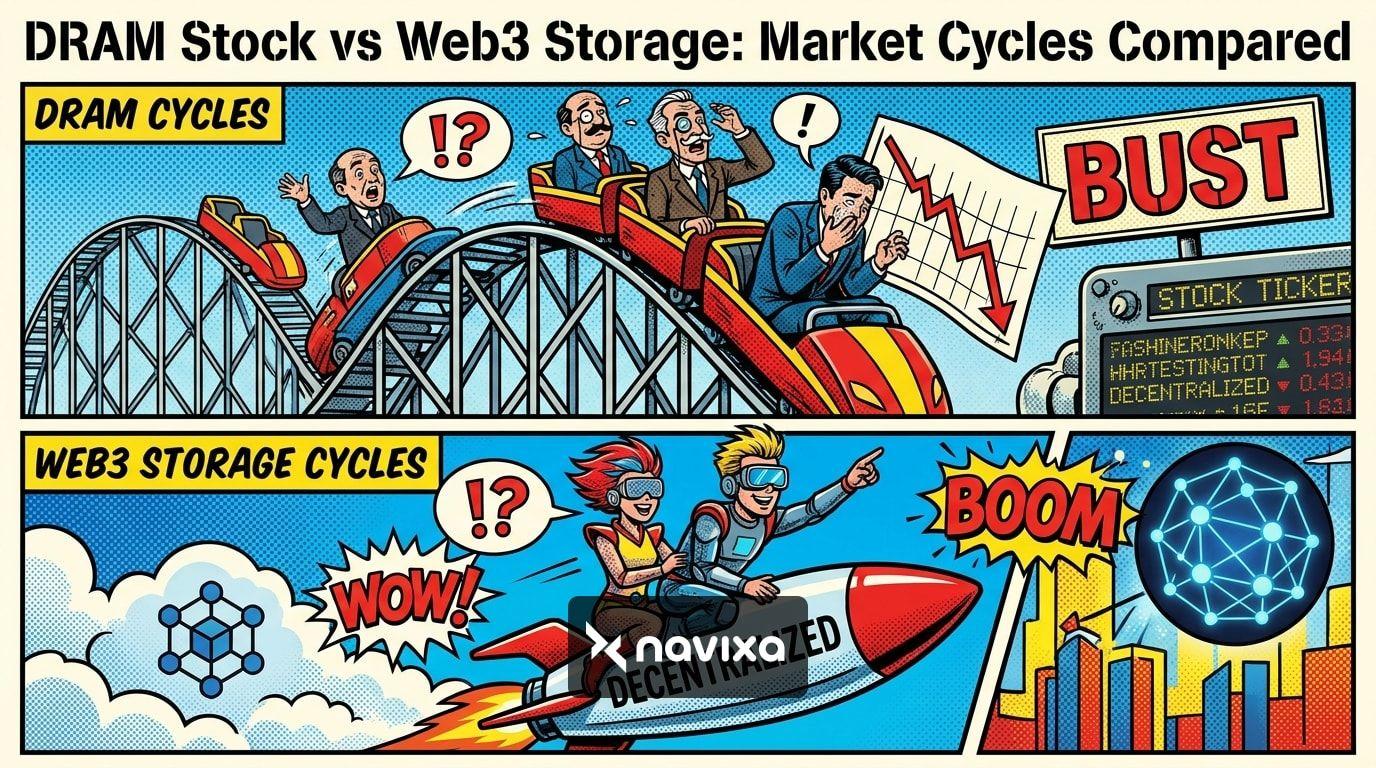
The rapid advancement of artificial intelligence has ignited a voracious demand for data management, creating two massive, parallel investment narratives. On one side, we have the highly consolidated physical hardware realm, represented by the traditional DRAM stock sector. On the other side, we have the decentralized, cryptographically secured ecosystem of Web3 storage tokens. While both target the same underlying resource—data storage and memory—their market cycles, economic models, and trading behaviors are vastly different.
Understanding how these two markets diverge is critical for modern investors aiming to capture the upside of the artificial intelligence revolution without being blindsided by distinct sector risks.
- The AI revolution has triggered massive parallel demand cycles for both hardware memory and decentralized data infrastructure.
- A dominant oligopoly controls the physical DRAM stock market, currently reallocating capacity to highly profitable HBM chips.
- Web3 storage protocols are rapidly evolving, shifting from simple incentivized networks to full-stack decentralized computing layers.
- Blending traditional semiconductor equity with decentralized storage tokens requires distinct risk management and psychology.

The Macro Environment: AI Drives the Storage Wars
Currently, the financial and digital asset ecosystems are deeply intertwined. We are witnessing the total cryptocurrency market capitalization hold incredibly strong at $2.76 trillion. Bitcoin (BTC) is demonstrating significant resilience, stabilizing around the $80,228 mark with a market dominance of 58.11%. As Bitcoin establishes a high-timeframe foundation, capital is actively rotating into high-growth sectors and emerging network technologies. Prominent altcoins and trending networks like Solana (SOL)—currently trading at $93.48—and Sui (SUI) are reflecting this broad shift toward robust decentralized infrastructures.
This capital rotation is profoundly impacted by the global artificial intelligence boom. The insatiable computational appetite of AI agents and enterprise-grade large language models has triggered an unprecedented demand for data. Recent industry events perfectly illustrate this structural shift; as reported by CoinDesk, AI agents recently fueled a massive frenzy of startup building at the Consensus Miami easyA hackathon, proving that decentralized protocols are transitioning from theoretical concepts to critical developer infrastructure.
The Mechanics of the Traditional DRAM Stock Cycle
To understand the hardware side of this phenomenon, we must look at the traditional DRAM (Dynamic Random Access Memory) market. Historically, the DRAM industry experiences distinct boom-and-bust capital cycles. Right now, we are navigating what analysts refer to as the "Seventh DRAM Cycle."
Oligopolies and High Bandwidth Memory
The DRAM market is a classic oligopoly. Just three major players—Samsung, SK Hynix, and Micron—control roughly 94% of global market share. This massive concentration of power means that supply dynamics are carefully curated. Driven by over $400 billion in projected AI data center capital expenditures, these dominant corporations have aggressively shifted their most advanced cleanrooms and lithography tools toward producing High Bandwidth Memory (HBM).
Because HBM is crucial for cutting-edge AI accelerators (like Nvidia's highly sought-after GPUs), the manufacturers have neglected standard DDR5 memory production. This creates a fascinating dynamic: standard consumer memory is facing a severe supply shock, driving up average selling prices and vastly inflating the bottom lines of these tier-one hardware stocks. By exploring macro trends in tech stocks, astute traders can see how this fundamental hardware bottleneck directly correlates to prolonged equity upcycles.
High Bandwidth Memory (HBM) is highly lucrative but extremely resource-intensive. Producing one bit of HBM requires roughly three times the wafer capacity of standard DDR5, creating massive structural supply bottlenecks in traditional DRAM sectors.
Web3 Storage: The Decentralized Alternative
In stark contrast to the physical constraints and corporate centralization of the DRAM oligopoly, Web3 storage protocols offer a software-driven, decentralized approach to the exact same data problem.
While traditional cloud providers (like AWS or Google Cloud) offer reliable centralized servers, decentralized protocols utilize blockchain technology to distribute files across thousands of global nodes. This ensures censorship resistance, mathematical verifiability, and immutability—traits that are becoming mandatory for AI model training data and deep-fake prevention.
The Shift to Decentralized Compute
Protocols like Filecoin and Arweave are no longer just peer-to-peer hard drives; they have evolved into comprehensive infrastructure layers. Filecoin's recent pivot to an "Onchain Cloud" introduces verifiable warm storage with usage-based payments settled via smart contracts. Simultaneously, Arweave's introduction of the "AO" computing layer turns its permanent storage endowment model into a hyper-parallel decentralized AI substrate.
Understanding how macroeconomic liquidity flows into these specialized networks is vital. By assessing the broader crypto macro outlook, traders can better time their entries into these volatile assets before mainstream retail adoption catches up.

Comparison: Traditional Equities vs Decentralized Tokens
While both sectors aim to solve the exponential data growth problem, their structural, financial, and regulatory frameworks require completely different analytical approaches. The table below highlights the stark contrasts between the two asset classes.
| Feature | Traditional DRAM Stocks | Web3 Storage Tokens |
|---|---|---|
| Underlying Asset | Corporate equity (Micron, SK Hynix) | Decentralized network tokens (FIL, AR) |
| Market Structure | Highly concentrated oligopoly | Highly fragmented, open-source networks |
| Value Driver | Earnings, capex cycles, hardware supply | Network adoption, protocol revenue, compute demand |
| Volatility | Moderate to high (cyclical boom-bust) | Extreme (sentiment and liquidity-driven) |
| Primary Use Case | Centralized data centers, hardware memory | Censorship-resistant archives, decentralized compute |
Market Analysis & Trading Psychology
Navigating these dual cycles demands a sophisticated psychological framework. A common pitfall among retail investors is treating a decentralized utility token with the same long-term assumptions as a blue-chip semiconductor stock.
The Equities Mindset
Trading DRAM stocks requires an understanding of capital expenditures and institutional guidance. These equities move heavily based on quarterly earnings calls, corporate forward guidance, and macro supply-chain reports. The psychology here relies on patience and fundamental validation. A trader must look for technical breakouts that align with a stated supply deficit. When SK Hynix or Micron announce delayed capacity expansions, the market typically prices in a prolonged period of elevated memory costs, rewarding the patient investor.
The Crypto Mindset
Conversely, Web3 storage tokens trade on developer activity, network upgrades, narrative momentum, and overall market liquidity. As noted by Cointelegraph, macro crypto sentiment can shift rapidly based on ETF outflows or regulatory news. A Web3 token might pump 60% in a single month based purely on the announcement of a new compute layer integration.
Because token markets operate 24/7 without circuit breakers, the emotional toll on the trader is significantly higher. To survive this volatility, implementing a disciplined crypto long-term holding strategy is essential. Instead of trying to aggressively time the exact bottom of a Web3 altcoin, many professionals employ automated accumulation systems. For instance, using a smart DCA strategy allows traders to steadily build a position in high-conviction storage tokens during structural drawdowns, entirely removing the emotional urge to panic sell during brief market corrections.

Actionable Steps for Portfolio Construction
To effectively capitalize on both the physical DRAM cycle and the decentralized storage revolution, traders must adopt a barbell approach to portfolio construction.
1. Assess the Institutional Cycle: Begin by looking at traditional semiconductor ETFs or individual DRAM giants. If capex is heavily weighted toward AI hardware and consumer chip supplies are tightening, allocate capital to standard DRAM equities for stable, beta-driven growth. 2. Identify Alpha in Web3: Once the traditional foundation is set, carve out a smaller, risk-adjusted portion of your portfolio for decentralized storage protocols. Look for networks showing tangible growth in active nodes, verifiable data storage, and consistent protocol revenue. 3. Diversify and Automate: Do not manually chase green candles. Set limit orders at key support zones for stocks, and utilize automated dollar-cost averaging for tokens.
For those looking to refine their execution across both traditional and digital asset classes, it is highly recommended to explore Navixa strategies to better align your technical entry points with macro market conditions.

Be acutely aware of cyclical peaks. Historically, when memory chip manufacturers finally announce massive capacity expansions to capture high prices, it marks the exact top of the DRAM cycle. When supply floods the market, equities face immediate downward pressure.
Conclusion
The technological arms race fueled by artificial intelligence has secured a massively profitable future for data storage. Whether you choose to invest in the heavily fortified corporate oligopoly of DRAM stocks or the permissionless, innovative frontiers of Web3 decentralized storage tokens, the core narrative remains identical: data is the new oil, and the infrastructure housing it is invaluable. By understanding the distinct psychologies and market cycles driving each asset class, traders can effectively manage risk while capturing extraordinary upside. To systematically apply these insights to your own portfolio, start trading with Navixa today and position yourself ahead of the next macroeconomic shift.
Frequently Asked Questions
What exactly is the seventh DRAM cycle?
The seventh DRAM cycle refers to the current macroeconomic period where traditional memory hardware manufacturers are experiencing massive supply shortages and price spikes. This specific cycle is uniquely driven by the explosive capital expenditure required to build AI data centers, which pulls manufacturing capacity away from consumer memory.
How do Web3 storage protocols differ from standard cloud providers?
Standard cloud providers like AWS store data on proprietary, centralized servers controlled by a single corporate entity. Web3 storage protocols like Filecoin or Arweave distribute encrypted file fragments across a global, decentralized network of independent nodes. This ensures that no single entity can censor, alter, or delete the stored information, providing cryptographic permanence.
Can I trade DRAM stocks and Web3 tokens using the same strategy?
No. DRAM stocks are heavily influenced by quarterly corporate earnings, institutional capital expenditures, and traditional hardware supply chains, meaning they respond well to long-term fundamental analysis. Web3 storage tokens operate in a 24/7 environment driven by network upgrades, developer sentiment, and crypto liquidity, requiring significantly more agile risk management and volatility-adjusted position sizing.
Why are both DRAM and decentralized storage experiencing high demand simultaneously?
Both sectors are downstream beneficiaries of the artificial intelligence boom. AI requires massive amounts of physical hardware memory (DRAM/HBM) to compute complex algorithms. Simultaneously, AI developers need permanent, tamper-proof, and decentralized environments (Web3 storage) to host vast training datasets and autonomous agent interactions securely.